
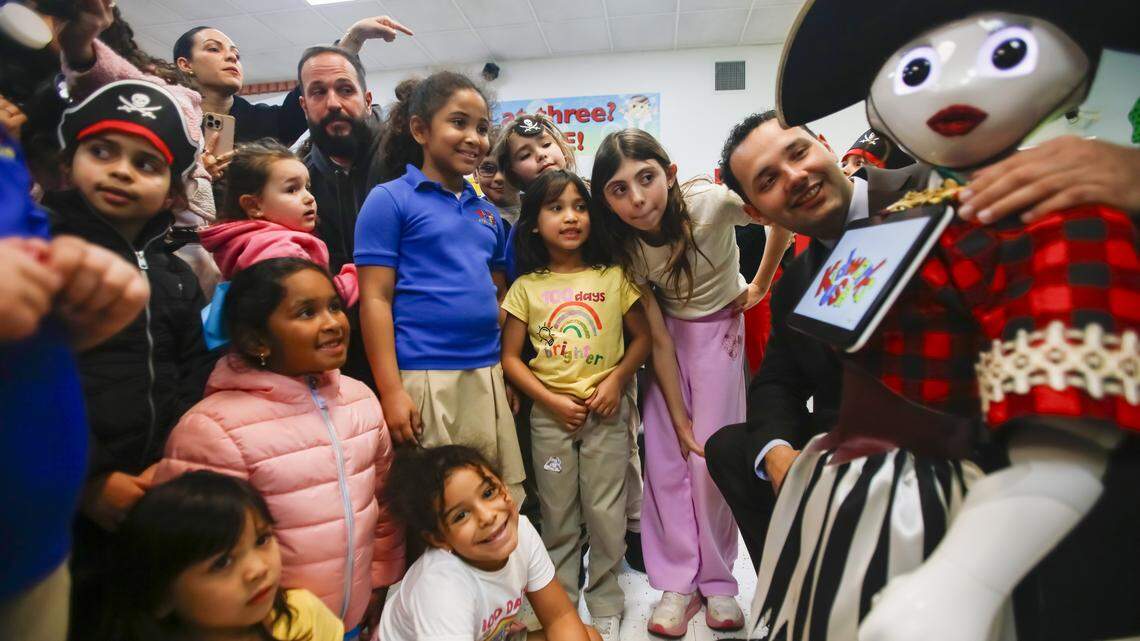
The era in which artificial intelligence can help teach children has arrived in a Hialeah school.
Her name is Pepper.
What began as a grandfather’s dream to build the best possible kindergarten for his first granddaughter has pushed William “Bill” De La Sierra to continuously reinvent education. Twenty-four years ago, the real estate developer built the private school KidWorks USA from the ground up. Now he has introduced one of his boldest ideas yet: an AI-assisted robot teacher.
Pepper sports a pirate-themed wardrobe, reflecting her role as “Captain” in the classroom.
Captain Pepper, the robot teacher, prepares for her debut at KidWorks USA in Hialeah, a school offering programs from pre‑kindergarten through 7th grade. Alexia Fodere for Miami Herald
“When AI started to become popular, I said, ‘Hey, I’ve got to get them excited about artificial intelligence because that’s their future,’” De La Sierra told the Herald. “They’re going to have to deal with AI. I’m not.”
KidWorks USA, at 8155 W. 28th Avenue, offers classroom programs from pre‑kindergarten through 7th grade and plans to add 8th grade next year. And now, the school is introducing AI to students in an interactive way through a robot that will be able to teach three subjects: science, math and history.
On Feb. 2, Pepper was introduced to students alongside Hialeah Mayor Bryan Calvo. Rolling into the room, the robot quickly became the center of attention, with students eager to take photos. During a brief, scripted exchange, Calvo spoke with Pepper in English about education and leadership. She said she brings artificial intelligence into the classroom and helps future leaders grow up smart and confident to lead the country.
Hialeah Mayor Bryan Calvo visits KidWorks USA as the organization introduces Captain Pepper, an interactive educational AI designed to enhance student engagement and learning, in Hialeah on Feb. 2, 2026. Alexia Fodere for Miami Herald
Pepper, just one week old at the time, was still developing her software and learning to control her movements, but that did not stop her from showing off some dance moves. She can move her head and arms in a human-like way and is expected to eventually interact with students once she is fully trained. Initially she will teach in English, but she also has the ability to operate in Spanish. A tablet embedded in her torso displays programmed messages. On the day of the presentation, the screen showed the name of the school.
Pepper’s voice
Behind the robot’s voice is Kevin Soto, a 24-year-old mechanical engineer with a master’s degree in aerospace engineering and a background in robotics research, who has been a KidWorks counselor for years. He was hired as a consultant to research and develop the AI robotic program for the school, and will train and support their teachers. Soto built the technological infrastructure that will allow Pepper to function as a teacher.
She is currently being “taught,” uploaded with all the information she needs to operate as a teacher. Soto said the project to fully operationalize the robot will take about two to three months.
Kevin Soto adjusts Captain Pepper, an interactive educational AI, during an introduction at KidWorks USA in Hialeah on Feb. 2, 2026. Alexia Fodere for Miami Herald
Pepper has a modular system that allows for extensive customization. While the company that manufactures the robot primarily designs it for instructional purposes, the version being used at KidWorks USA is still being developed and tailored to fit the school’s needs.
“We’re adding the features we need for it to be successful in the classroom,” Soto said. The robot can be programmed with speech recognition and text-to-speech capabilities. Because the system operates through downloadable software packages, different language modules can be installed as needed.
For De La Sierra, the robot is not meant to replace teachers, but to introduce students early to the technologies that will shape their futures. The school already offers a range of hands-on STEM programs, including drone pilot training, robotics, coding, and hydroponics classrooms where students grow strawberries and tomatoes while learning about science and sustainability. It also participates in NASA’s Growing Beyond Earth program, which studies plants that could one day become part of astronauts’ food supply during long-term missions in space, giving students opportunities to apply classroom learning to real-world challenges while developing critical thinking, creativity, and technical skills.
The robot, made by RobotLAB a Dallas-based company, currently runs on ChatGPT-based software but could operate on other platforms capable of supporting what developers call API connections. In simple terms, an API allows different software systems to communicate with one another, enabling Pepper to generate lesson plans, answer students’ questions and adapt responses in real time.
De La Sierra said he constantly asks himself what he can bring to his students to better prepare them for the world ahead. His passion for education, first for his granddaughters and now for generations of children in Hialeah, has led him to incorporate hands-on technology into the school’s curriculum. He added he is always bringing refreshing ideas, because that’s what the world is about.
Now, artificial intelligence is the next step. “We have drone training, we have jujitsu, we have science, we have hydroponics, and now artificial intelligence,” he said. “I’m preparing the kids for the future.”
Captain Pepper represents a $30,000 investment for the school, and De La Sierra is already looking into the possibility of another robot, the Optimus made by Tesla.
“With the development of AI, we can improve how teaching works, but it’s also important to know that it’s not a replacement for teachers. It’s just a tool.” Soto said. “And that’s how it is going to be positioned.”
Privacy, safety concerns
The controversial use of AI technology is raising concerns among educators, who say it could disrupt learning and undermine the emotional development of young children.
Because KidWorks is a private school it is not required to follow the curriculum or guidance of Miami-Dade Public Schools, a lack of oversight that worries some education advocates. Karla Hernandez-Mats, president of Educated We Stand, a nonpartisan organization focused on electing pro-public-education school board candidates, said the absence of clear standards raises questions about how the technology is going to be used and by whom.
Hernandez-Mats, a certified teacher and former president of United Teachers of Dade, added that introducing a humanoid robot into the classroom feels more like “a gimmick for a private school” than a meaningful educational strategy. She said Pepper would be unable to recognize when a child is overwhelmed or in distress.
“A robot cannot teach you how to calm down or show empathy,” she said. “If a child gets frustrated, how do you detect that? A robot cannot replace a human in that sense.”
While acknowledging that artificial intelligence is increasingly part of education, she emphasized that public schools approach the technology with limits.
“We teach students how to use AI ethically, as a tool for research, note-taking and learning, not as a replacement for teachers,” she said. Because KidWorks is a private school, it is hard to tell what standards, if any, are guiding the use of this technology, she said. “There are no guardrails.”
This story was originally published February 20, 2026 at 11:12 AM.
el Nuevo Herald
Verónica Egui Brito ha profundizado en temas sociales apremiantes y de derechos humanos. Cubre noticias dentro de la vibrante ciudad de Hialeah y sus alrededores para el Nuevo Herald y el Miami Herald. Se unió al Herald en 2022. Verónica Egui Brito has delved into pressing social, and human rights issues. She covers news within the vibrant city of Hialeah, and its surrounding areas for el Nuevo Herald, and the Miami Herald. Joined the Herald in 2022.