
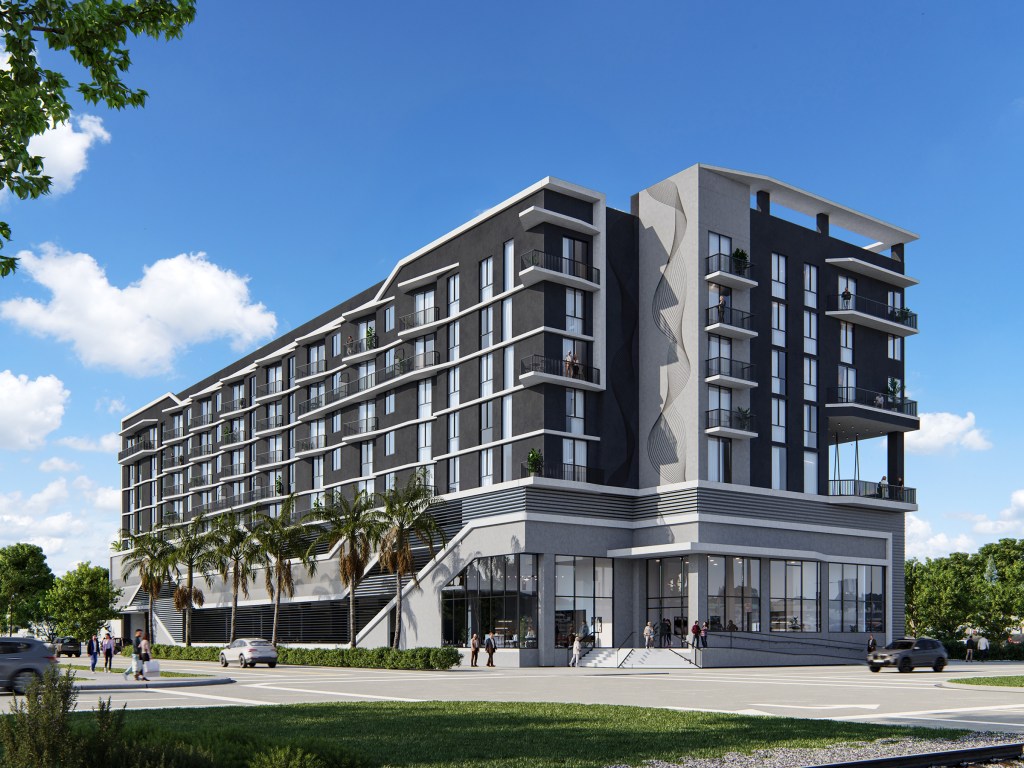
Good news for senior citizens in search of affordable housing: A new project is going up in Broward County with rents ranging from $713 to $1,555 a month.
Villa Jordana is scheduled to rise in Hollywood next year, serving low-income seniors earning between 33% and 60% of the city’s median monthly income of $2,179 as calculated by the national firm RentCafe. It’s a joint venture of the Miami-based Housing Trust Group and the nonprofit AM Affordable Homes led by NBA Hall of Famer Alonzo Mourning.
“Villa Jordana reflects Housing Trust Group’s deep commitment to ensuring that seniors can age with dignity in the communities they call home,” said Matthew A. Rieger, president and CEO of Housing Trust Group, in a statement. “As South Florida’s senior population continues to grow, the need for high-quality, affordable housing has never been more urgent.”
A number of analysts and advocates who devote much of their time following the situation would agree. In South Florida, the pace of construction is far from keeping up with the needs of not only a growing senior citizen population filled with retiring Baby Boomers, but hourly wage workers who toil in the region’s traditional industries such as construction, health care, hospitality, retail, trade and transportation.
The HTG announcement came shortly after RentCafe, a firm that tracks apartment rental pricing nationwide, released a survey that showed Broward and Palm Beach counties ranked well behind Miami-Dade in the construction of affordable housing for lower-income renters.
The national survey took snapshots of new affordable apartment construction in nearly 150 metropolitan areas during two time periods: 2015 to 2019 and 2020 through 2024.
In a statement, RentCafe, an affiliate of Yardi Matrix, the commercial real estate intelligence firm that conducted the survey, outlined the following conclusions about South Florida:
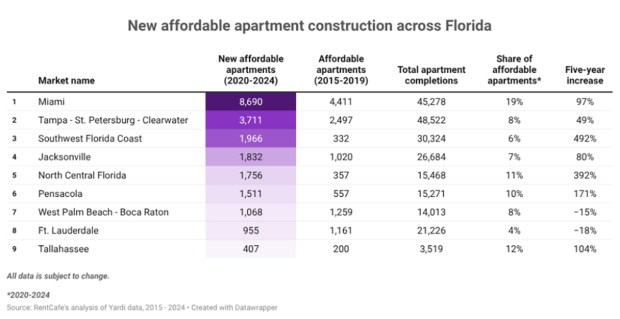
Fort Lauderdale: Broward County’s biggest city experienced an 18% drop in completed apartments, with 955 affordable apartments built between 2020 and 2024 against 1,161 units built between 2020 and 2024.
West Palm Beach–Boca Raton: The area “saw affordable housing construction decline by 15%” with 1,068 units constructed between 2020 and 2024 versus 1,259 between 2015 and 2019. The area’s affordable apartments also accounted “for less than 10% of new construction.”
Miami: Its greater metropolitan area led the state “by a wide margin, with 8,690 affordable apartments completed between 2020 and 2024. These units account for about 19% of all new apartment construction in the metro,” Rent Cafe said. “Compared with the previous five-year period, affordable housing construction in Miami increased by 97%, reinforcing the metro’s role as Florida’s largest hub for income-restricted development.”
Tampa–St. Petersburg–Clearwater: This Gulf Coast area ranked second in the state, adding 3,711 affordable apartments over the past five years.
Southwest Florida and North Central Florida: Both regions saw construction surge “from a small base.” The Southwest added 1,966 apartments — “a 492% increase compared with the previous five years.” The North Central region completed 1,756 units, “a 392% increase from the pre-pandemic period with affordable units making up about 11% of all new apartment completions.”
The state, according to RentCafe, “has been one of the country’s most active states for affordable apartment construction in recent years.”
“Miami leads the state by a wide margin,” Doug Ressler, manager of business intelligence at Yardi Matrix, said in an interview. “One of the things we saw is Miami developed because of the density of Miami proper and rapidly scaled up projects in the face of demand.”
Nationally, construction rose 73% in the post-pandemic period versus the previous five years, the company said in a statement. The year 2024 was a high water mark for construction “with more than 91,000 affordable apartments completed.”
Minding the gap
But in a region that has been awash in new higher-income residents since the COVID-19 pandemic started, the construction has not been enough. While economic development agencies and growth-minded politicians succeeded in attracting well-paid financial and technology executives to Florida, housing prices headed sharply upward, muscling aside longer-term residents who have experienced a protracted case of sticker shock.
“You’ve had a huge migration of wealth down here,” said JC de Ona, Southeast Florida division president for Arkansas-based Centennial Bank, which maintains a large presence in the tri-county area. “You’ve had all of those CEOs and high-level executives and entrepreneurs. It’s really given a boost for the economy.”
But he added: “The problem still looms for a majority of the population. Middle-level employees can’t afford the properties.”
Zack Simkins, managing director of Miami-based Vaster, which provides bridge financing for developers, said the state Live Local Act is helping builders expedite affordable projects with rapid government approvals. Vaster provides loans for site acquisitions, allowing developers the time to prepare for the construction phase of their projects.
“That’s by no means the cure,” Simkins said of the act. “It’s a Band-Aid to soften the effects of the high-rise condominiums that are going to be too expensive for the hourly wage workers.”
Ressler, meanwhile, suggested that all three counties have not all seized upon the act’s advantages. “Miami-Dade has grasped it a little more aggressively,” he said.
Still, he acknowledged, “South Florida officials in general have been working to incentivize the construction of more below-market apartments.”
‘Cost-burdened’ residents
For years, Dr. Edward “Ned” Murray of Florida International University’s Jorge M. Perez Metropolitan Center has monitored and analyzed the South Florida housing market and assisted Broward County in assessing its housing needs. In an interview last week, he said he’s “concerned about the labor force, as well as in-migration and out-migration.
But equally important are the “cost burdened” — hundreds of thousands of South Floridians who are paying out large chunks of their monthly incomes to keep a roof over their heads. It means they’re spending at least 30% of their monthly incomes on housing.
“Miami-Dade is much larger population wise, and being larger they have a lot more renters and prospective homeowners priced out of the market,” Murray said.
So-called “affordability ratios” that show the percentage of earnings a resident pays for rent “are much higher than Broward and even Palm Beach. The numbers are just shocking.”
The main industries that dominate South Florida’s economy, Murray added, “don’t come close to paying what they need.”
“We’re not building for the economy,” he said. “The housing supply should represent in some fashion our economic base and it doesn’t at all.”
In the meantime, “net out-migration is increasing by the year,” he said. “Our labor force is really stressed right now.”
Public dollars
Sandra Veszi Einhorn, a long-time affordable housing advocate from Hollywood who is board chair of the Florida Housing Finance Corp. and executive director of the Coordinating Council of Broward, noted the County Commission last Tuesday unanimously approved a resolution to allocate 90% of revenue from expired Community Redevelopment Agencies for the Broward County Affordable Housing Trust Fund.
Ninety percent of the county’s share of expired CRA tax increment financing revenue would go to affordable housing, with the remaining 10% reserved for economic development.
“We’ve got buy-in from the board of county commissioners on the value of affordable housing,” she said. “I am thrilled to say [the resolution] did pass and once again the board of county commissioners made the commitment to those dollars.”
She believes the approach beats a new round of taxes or borrowing via the bond market.
“Affordable housing is the key to economic prosperity,” she said. “We continue to keep our foot on the gas pedal which is what we’ve been doing.”
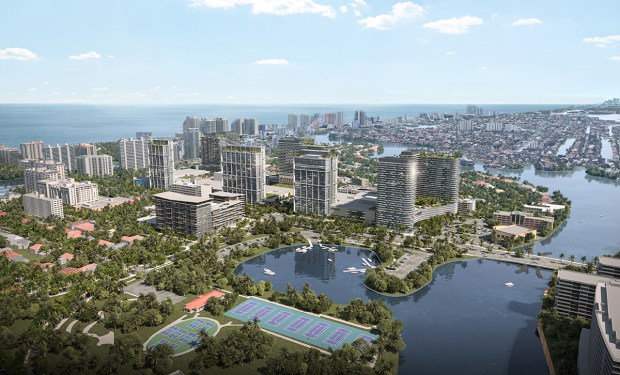 A rendering of the proposal for the Galleria Mall redevelopment in Fort Lauderdale, which has acquired state approval and would be undertaken with the help of the Live Local Act. Despite the inclusion of affordable apartments, many neighbors oppose the plan for its multiple high-rises and density. (Architectonica/Courtesy)
Public-private partners
In the statement from the Housing Trust Group, Hollywood Mayor Josh Levy lauded the city’s collaboration with the company.
“Through our continued partnership with HTG, we are transforming a once-blighted property into modern, affordable housing for seniors — a true win for our community,” he said.
HTG is a firm devoted to the affordable end of the housing business. In Hollywood, it has also developed the 96-unit Hudson Village community and University Station, a 216-unit mixed-use community that also houses the Barry University College of Nursing and Health Services.
The Villa Jordana project brings the total number of units developed by HTG to 408 in Hollywood, 1,009 countywide, and 2,696 across South Florida, the company said.
“Big problems require big solutions — and the affordable housing crisis demands a coordinated effort from federal, state and local leaders,” said Matthew Rieger, the HTG chief executive officer and president. “Municipalities that work closely with private developers and nonprofit partners to expand housing supply thoughtfully and strategically will see the most progress. That’s what we’ve seen in Hollywood, where we’ve been fortunate enough to work closely with city officials to create more mixed-income, transit-oriented and senior housing in the downtown area, placing residents closer to jobs and key services.”
The look ahead
Will the region ever catch up with the demand for affordable housing?
Murray of FIU credited Broward with being “a leader” in construction.
“They have funded a decent share of housing over the last seven years or so,” he said. “Palm Beach County not even near as much. And Miami-Dade, they’ve done okay but given the scope and scale of the affordable housing needed it’s just coming up short.”
Bob Swindell, president and CEO of the Greater Fort Lauderdale Alliance, the economic development agency for Broward, said the biggest challenge is persuading residents of existing neighborhoods that affordable housing projects are positives for the community.
The task at hand: “Getting neighbors to understand these people moving in are going to be good neighbors. We have to get people to embrace it.”
“We would have to build so much to catch up,” said JC de Ona of Centennial Bank. “I don’t know that we will ever catch up unless our population growth has a shift somehow. You’d have to build a lot of projects to get there.”
Fort Lauderdale developer Dev Motwani, a member of the city’s Downtown Development Authority, managing partner of Merrimac Ventures, and creator of a philanthropic fund for education and the arts in a partnership with the Community Foundation of Broward, said the issue ultimately boils down to supply and demand. Moreover, he views housing as a regional matter given the high volume of crossings over county lines by daily commuters to their jobs.
“People working in Miami-Dade live in Broward and vice versa,” Motwani said. “I don’t view it as one county versus the other.”
“In the end housing continues to be a supply and demand issue,” he said. “The more density we provide, the more supply we provide, the more costs are going to be controlled. That’s just simple economics.”