
TAMPA — Hillsborough County commissioners agreed that updated redevelopment plans for the Museum of Science and Innovation (MOSI) site finally match the scale they envisioned for what board chair Ken Hagan says will be the county’s largest economic development project ever.
During a briefing last week on the MOSI property, Hagan, who originally proposed redeveloping the county-owned site years ago, said earlier concepts fell short of his and county staff’s expectations, but the latest vision represents a big step forward.
“I was extremely critical of the previous conceptual site plans because, in my opinion, they certainly were not transformative and actually quite elementary,” he said. “This is extremely impressive. The illustrations you showed, it’s similar to Water Street or Midtown, and really is awesome.”
Assistant County Administrator Ron Barton presented the updated progress report, emphasizing the project remains in pre-development and construction timeline has been finalized.
Hurdles remain, he said, like rezoning approvals, environmental studies and a traffic analysis. Because of the site’s planned mix of uses, Barton said the rezoning process could take up to 18 months.
A key early milestone, however, has been cleared: the comprehensive plan amendment and land-use application were unanimously approved by the Tampa Planning Commission earlier this month, he said.
Located across Fowler Avenue from the University of South Florida, the 67-acre site is expected to play a major role in the economic growth of the university area.
“It’s a true mixed-use development,” Barton said. “We’re excited about it because there’s been so much potential for USF from an economic development standpoint… so with this project (and others like the mall, the Fletcher District and new football stadium), we really think they all are complimentary in driving the economic center that we think the university can be.”
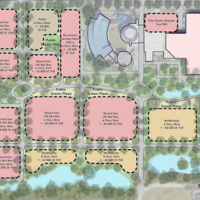
The updated master plan, presented as a conceptual “bubble diagram,” displays a wide-ranging district blending education, athletics, entertainment, residential and commercial uses in what officials say will ultimately be a $2 billion project.
The athletic field house and accompanying hotel will be the centerpiece of the project, Hagan said, and part of the first phase of development.
MOSI is preserved, and an entertainment corridor will extend from the existing MOSI planetarium and include a film studio and black box theater.
Elsewhere, the plan calls for residential units, retail space, offices and hospitality, including two hotels.
A privately developed ice facility, championed by commissioner Chris Boles, is proposed for the opposite corner from the fieldhouse. If that does not materialize, more residential and retail would be added.
“We believe this plan truly is a neighborhood,” Barton said, as a live, work and play area.
While supportive of the vision, several commissioners said they want to see development move more quickly.
Boles said the desired pace would be similar to the “all hands on deck” efforts to attract the Tampa Bay Rays during stadium discussions.
“I’d like to see that same urgency (here),” he said, pointing out the project involves county-owned land which will benefit residents, as opposed to billionaires.
Hagan had similar thoughts.
“I want to stress that we’re driving this bus,” he said. “It’s my understanding that the developer is going at a slower pace on the overall development plan than we are with the field house. Now that’s not necessarily a bad thing. However, I don’t want their pace to slow down our planning.”
He clarified he wasn’t suggesting removing the developer, but wanted to ensure the project stays on track.
The master developer team consists of Coulter & Alliant Partners, working jointly as AKP Renaissance, which is essentially orchestrating the development.
The Patel Group was a partner before pulling out after getting involved in other USF development, to avoid any conflict of interest.
Barton said he expected more investment partners once the project advances through rezoning and other approvals.
“You got to remember, we had a fallow piece of property with the wrong land use, the wrong zoning and some problematic issues with property,” he said. “As we begin to dismiss those, other folks are going to get off the sideline and be courted and be added.”
A public hearing with the City of Tampa is scheduled for April, and Barton said he hopes to file for rezoning in May or June, with another public hearing in June. With a final master development conceptual plan also expected in that timeframe, Barton said by November the project would be “out the chute.”