
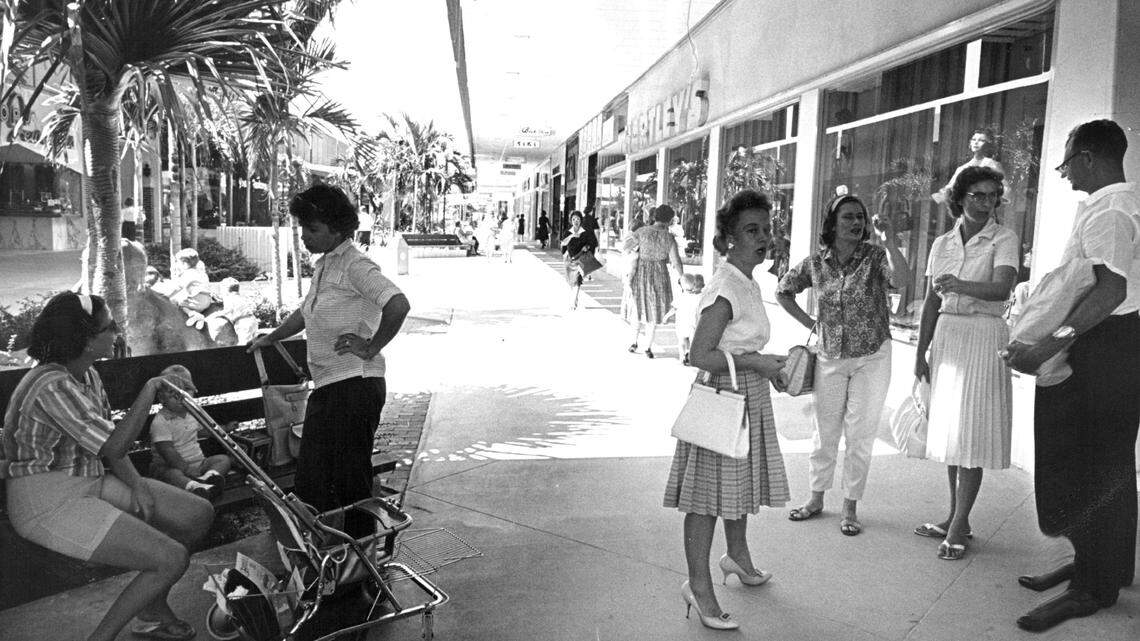
When it opened on October 1, 1962, on Kendall Drive off U.S. 1, Dadeland was dubbed ‘deadland’ because North Kendall Drive, which passes in front of it, was branded “The Road to Nowhere.”
Built as an open-air strip center, Dadeland started up at 400,000 square feet with 62 merchants, including Burdines as its only anchor. But Miami-Dade’s explosive population growth along with the construction of thousands of affordable units of tract housing, the opening of the Palmetto Expressway, the expansion of Kendall Drive into a four-lane highway and the appearance of important community institutions, like Baptist Hospital, radically transformed ”horse country” into a flourishing community.
Dadeland became a thriving retail outlet. By the end of the 1960s, a rapidly expanding Dadeland was enclosed and converted to a mall.
By the 1970s, Kendall had become Miami-Dade’s fastest growing community, with this trend accelerating in the 1980s. In the ’90s, Dadeland Mall was the busiest shopping mall in the continental United States.
The Aventura Mall in Northeast Miami-Dade opened in 1983, with a huge food court and South Florida’s first Macy’s store. In later expansions, the mall added movie theaters.
Several years ago, a new wing opened and a new two-story Apple store has since moved in and a 93-foot slide opened right outside. The original food court was replaced by a more upscale food hall.
Meanwhile, Sawgrass Mills opened in October 1990, and continues to evolve. It remains one of the largest malls in the country.
Outlets for higher-end shops have opened, as well as a long-awaited parking garage. The Wannado City theme park shut down several years ago, but let’s face it, the whole center is a theme park. Call it Mega Shopping World.
Here is at the first days and years of Dadeland, Aventura and Sawgrass Mills from the Miami Herald archives:
Looking back at Dadeland Dadeland shopping center in October 1962. Miami Herald File
Published Oct. 29, 1987
There is no way to put a value on such proof of faithfulness as this.
“I was here when Dadeland first opened,” says Philis Edelman. “At Jordan Marsh, before Jordan Marsh was there, they had a traffic school for kids. We rode tricycles around these things and learned about safety. It’s one of my first memories.”
Now 25 years later, although the giant rearing seahorse sculpture that once functioned as landmark and centerpiece here has departed, along with Tiny Town, Closets Beautiful, Pin Cushion, House of Melody, Vic Tanny and the Yum Yum Shop, Dadeland loyalist Philis Edelman remains, a reassuring constant in the whirling evolution of this place.
On this overcast weekday morning, Edelman, now 30, is here with her own 4-year-old daughter, Leah; her friend, Allison Teisch of North Miami Beach, and Teisch’s 4-year-old, Danielle, all of them on the prowl for enticement and diversion.
Here at Dadeland, it is possible to have one’s shoes reheeled, one’s hearing and vision tested, one’s hair cut, one’s nails polished, one’s ears pierced, one’s makeup revamped, one’s vacation planned, one’s car washed, one’s spare tire repaired, one’s loan application scrutinized, one’s watch fixed or one’s portrait painted.
This is the sort of place where a person can walk in with both hands empty and then out again clutching a certificate for a free spinal check; a $3.50 chocolate golf ball; a $3.95 Ollie North coloring book; a pair of $22 Budweiser-label sneakers; a $40 Willie Mays-autographed baseball; a $149 costumed bear speaker phone with eyes that blink and a mouth that moves in synchronization with the caller’s voice; or a $1,999 shar-pei puppy that wiggles everywhere.
When Dadeland opened on Oct. 1, 1962, it was ballyhooed as the most glorious suburban shopping center in the South. Even today, it remains one of the five or so most profitable centers in the country, generating sales of about $400 a square foot. With its 7.1 acres of land, 9,000 employees, 1.47 million square feet, 175 stores and 8,000 parking spaces, it handily holds its own against such lately hatched competition as Cutler Ridge Mall (1.3 million square feet; 103 stores), Miami International Mall (1.3 million square feet; 175 stores) and Aventura (1.5 million square feet; 196 stores).
If Dadeland pales miserably when compared to that monstrous pretension, West Edmonton Mall in Canada, which boasts 5 million square feet, 836 stores, 15,000 employees, 30,000 parking spaces and an artificial lake with an underwater ride that deploys twice as many submarines as the Canadian navy, well, that is that. It pales.
“I was here yesterday, too,” says Jill Brener, pushing her 4-month-daughter, Jessica, down Dadeland’s western main drag between Jordan Marsh and Burdines.
With Brener are Carol Wechsler, steering 3-month-old Michael, and Shelly Mitchell, pushing 3-month-old Shannon.
Even on a weekday, three mothers with baby carriages comprise a formidable flotilla in a place such as this. These women met a few weeks ago at a coping-with-motherhood course, and after class they routinely come here to chat over lunch at the food court (“If the babies make noise, it doesn’t matter,” says Wechsler). “Then we go to the Burdines baby department,” says Mitchell. Some days there may be as many as eight new mothers in their after-class lunch group, because there are some things these women have to learn on their own.
“You learn never to take the price tags off anything,” says Wechsler.
“There’s always something that doesn’t fit,” says Brener, “so you have to come back the next day and exchange it.”
People who shop at Dadeland as often as these three women do not come here under the delusion that this is the biggest or the oldest or the most convenient mall in South Florida. Mitchell, who lives at the western end of Kendall, drives right past Town and Country Mall and keeps going until she gets here. There is only one reason for such behavior on her part: This is where she wants to be.
“This is just the greatest mall,” says Jeri Volpe, with her two sons and a nephew in tow. “I’m closer to The Falls, but I would rather come here.”
“Tenant mix,” explains general manager Mel Mendelsohn. “You come in here, and you can buy something for $2, or you can buy something for $150,000. We’re a shopping center for everybody. Everybody can come in here and buy something.”
There are no preconceptions, molds or formulas for a place like Dadeland. There are only boasts and superlatives.
Burdines’ present three-story Dadeland store is by itself as large as the whole mall used to be. Its wide main first-floor aisle, a maelstrom on weekends, stretches 391 feet from one end to the other. It is longer than a football field, and on peak shopping days one must feint, dodge and attempt the occasional end run to make any progress against the press, in the process hurling one’s body past Swatch watches, fragrances, men’s shoes, designer handbags and a hot dog stand. This store ranks No. 1 in volume among Burdines’ 27 stores and No. 1 in profits for Federated Department Stores, its parent chain.
“You can imagine,” says Candy Martin, Burdines’ vice president and general manager for Dadeland, “that any vendor would want his merchandise to be right on that aisle.”
Not only that. Almost a third of the center’s original 60 stores are still in business. The W.C. Fields statuary whackiness of The Barefoot Mailman may be a lamented thing of the past here these days, but Gray Drugs is still around, and so are Pampered Lady, Lerner’s, Arango, Mayor’s Jewelers and Baker’s Shoes. In January, the center will begin a $10-million expansion expected to plump things up with 20 new stores and 100,000 additional square feet of floor space. The large wishing fountain near the food court has netted more than $28,000 in small change for the Burn Center at Jackson Memorial Hospital.
The center’s surrounding neighborhood is now home to approximately 50 businesses and services whose names begin with the word Dadeland: from Dadeland Abortion Center to Dadeland Word-o-Matics with Dadeland Mobil Home Park, Dadeland Rare Coins, Dadeland Bank, Dadeland Sandwich Shop and the Dadeland Marriott Hotel floating around in between.
On this 25th anniversary, it is best not to try to find a reason for Dadeland’s continued existence and growth. Dadeland is, because it is. It works, because it works.
Back in the early ‘60s, when they were putting up the first of these shops, using 1,200 workers and 20,000 sheets of plans, the armchair skeptics had a fine time chortling about the fools who were bent on shelling out $4.5 million to build a center so far out in the sticks merchants would have to kidnap people to get them to shop here.
Nine miles from downtown Miami, this was the far suburbs. Some of the people who lived around here did not even have water and electricity. Kendall Drive was the road to nowhere. Dade County already had one regional shopping center at 163rd Street and another, Northside, at Northwest 79th Street and 27th Avenue. Who needed this, this lonely outpost of a place called Dadeland? Deadland was more like it. Dudland.
“There was nothing here,” says David Dolinger, owner of Tiki, one of the center’s original stores. “There weren’t even any customers here. The only thing out this far was Shorty’s Bar-B-Q.”
Mel Mendelsohn was a flier in the Air Force when the mall was going up.
“I used to fly into Homestead,” he says. “My dad would pick me up, and we would drive up U.S. 1, and I would say, ‘You’re kidding. Building a shopping center this far out in the Everglades? Ridiculous.’ Little did people know what was going to happen.”
The signs were there, though, and some people were smart enough to read them.
“I think now, frankly, even in our earliest planning, we identified that location as a prime spot for a shopping center,” says Dade County Planning Director Reginald Walters, who has been with the department since 1959 and is himself a Dadeland shopper.
“Whenever you have a confluence of an expressway (the Palmetto) and two major highways (U.S. 1 and Kendall Drive), you have a setting in which really major activity will occur. If it hadn’t been Dadeland, it would have been another shopping center by another name.”
Today’s typical Dadeland shopper tends to be a woman between the ages of 18 and 34 with at least some college education and an income that ranges between $15,000 and $24,999.
In the early afternoon of a cool January day in 1976, someone who might have been one of those typical customers strolled into Dadeland’s Lane Bryant store. Store manager Helen Pearl noticed her immediately. She was about 20 years old, had long hair and an admirable figure. She was also completely nude.
“Everyone was shocked,” Pearl later reported. “We couldn’t believe it. The girl acted perfectly normal, so everyone thought it was an initiation or a dare.” Pearl recovered her composure sufficiently to suggest that perhaps her store did not carry anything in the young woman’s size.
“I’m just looking,” she said pleasantly. Then she strolled away in the direction of shop called Just Pants.
About the Dadeland Mall Shoppers invade Dadeland Mall the day after Christmas looking for bargains. Pedro Portal EL Nuevo Herald File/2000
▪ Opened: Oct. 1, 1962, with 60 stores and a single anchor, Burdines. Jordan Marsh followed in 1965, and JC Penney came along in ‘70. Saks Fifth Avenue and Lord & Taylor were completed as part of a 193,000-square-foot expansion in ‘83 and ‘84.
▪ Built: The first phase was erected during 14 months on land once owned by aluminum kingpin Arthur Vining Davis. Originally unenclosed, it was designed to be constructed of maintenance-free materials. The original roof decking was large enough to cover eight football fields.
▪ Notable: In 1967, a display of life-size model dinosaurs, including a remarkable five-ton brontosaurus. In 1968, an exhibit called The Guggenhead Collection of Awfully Modern Art, which included such supposed works as Pablo Pistachio’s Nude With Clothes On. In July 1979, the most violent outburst to that time in South Florida’s drug wars occurred when killers in an armored “war wagon” stormed into a Dadeland liquor store, shot two customers dead, wounded two employees and then escaped.
Looking back at Sawgrass Mills A billboard for Sawgrass Mills Miami Herald File
Published Oct. 5, 1990
At Sawgrass Mills, you can park next to a blue dolphin or a yellow toucan, then promenade down a grand allee of palmetto trees to go to shop.
The “food court” in this, the world’s newest and largest discount shopping mall, simulates a hurricane, with kiosks tilting over precariously and umbrellas whooshing away. It is engaging and clever.
Whimsy reigns at Sawgrass Mills, but its architecture is not at all trivial. For its size — and at 2.2 million square feet, with a mile of corridors, this is an immense place — there is a particular attention to the scale and rhythm of the shopping experience.
Most shopping malls rely on marketing formulas that stultify the shopping experience and diminish our fun. Sawgrass Mills is playful and even a little zany, so that amid all those bargain outlet stores, there’s a sense of adventure.
Ultimately, there will be more than 200 stores, big and small, linked along metal-roofed corridors. The corridors are called “Main Streets,” but the experience isn’t in any way a substitute for a real old-fashioned town. It is much more like a parade — except that here, the spectators are moving and the pageantry is stationary.
And there’s plenty of it: Oversized sea horses, beach towels, binoculars, high-heeled shoes — among many other spoofy two-dimensional objects — hang down from high ceilings. The center’s logo is a hungry sawtoothed alligator, visual pun upon verbal pun.
he architects, Arquitectonica International of Coral Gables, paid particular attention to the texture and the tempo of the shopping experience. There’s lots of color and movement, a play of bright and filter light.
Corridors lined with shops bear distinct local architectural themes: Modern, Mediterranean, Art Deco and Caribbean.
he shopfronts are not fully authentic renditions of these architectural styles but fanciful adaptations. They are slightly smaller than the mall norm to give them full facades — turrets, parapets, eaves and all. Green-painted palm fronds form a backdrop behind these little streetscapes. Some facades step out; others are set back.
From a distance, Sawgrass Mills looks almost extraterrestrial, an immense and alien form landed in the barren suburban Broward landscape. It is located out where little else is — at Sunrise Boulevard and Flamingo Road, just before Sunrise terminates at the Sawgrass Expressway. Mall, landscaping and parking — to get away from the psychological impact of all that asphalt, cars will park in “fields” rather than lots — cover 170.5 acres. Just to give an idea of its dimensions, that is just about half the size of all of downtown Fort Lauderdale.
The logistics in a place of this magnitude are astounding. The mall’s builder, Western Development of Washington, fully understood the importance of orientation to its shoppers.
Graphics — by Fuller, Dyal and Stamper of Austin, Texas, and Washington — and landscaping by the SWA Group of Deerfield Beach go hand in hand with the architecture to tie all this together.
Each parking lot has its own special symbol (besides the blue dolphin and the yellow toucan, there are red snappers, pink flamingos, green toads and white sea horses) and is planted with a different tree species. Each entrance is strikingly different — bold geometric statements, ranging from a cube of bright blue fishnet to a grid of hot pink stucco pierced at various angles by huge gray cylinders.
Inside, there are large information booths and lots of directories. But ultimately, the architecture is distinctive enough that Sawgrass Mills is easy to understand. In most malls, there’s little difference in the design from one corridor to another. Here, each space is memorable.
The Mediterranean Main Street links the Cabana Court with the Video Court, which in turn, is connected to the Rotunda Court by the Art Deco Main Street. The Rotunda Court leads to the Caribbean Main Street, which passes by the Hurricane Food Court on the way to the New Ideas Court. (Still to be completed are the Modern Main Street, the Sports Food Court and the Entertainment Court, which will open next month. Construction on the mall’s vast recreational arcade, called the 49th Street Galleria, has not begun.)
The “courts” — basically interior plazas — are the focus of much of the architectural invention here; each has a different shape, a different roofline — pyramid, rotunda, vault. Arquitectonica excels at this kind of spirited, sculptural modernism, and the courts are a fine showcase for their abilities.
The Video Court not only has two 16-screen Pioneer multi- image televisions high against a bright blue wall but also two dramatic windows — a full-circle “sun” and a half-circle “moon” set high in a coral-colored wall. The Cabana Court has a tensile white tent roof and washed-wood walls that look like they might have been built by a modernist Robinson Crusoe.
The lagoon at the Cabana Court features animated alligators and talking toucans, pelicans and flamingos — just a little sideshow. Indeed, there is a certain debt to Disney throughout Sawgrass Mills — well-learned lessons about the way people perceive space and move through it.
True, Sawgrass Mills is not so far-fetched as the time-warp worlds at Magic Kingdom, but the intent is different. At Disney, the ersatz world is the commodity that people are buying.
The achievement of Sawgrass Mills is that it takes what would otherwise be an arduous, monotonous experience and by design makes it fun. There’s nothing innately uplifting about buying a pair of Lee Jeans or Reeboks at half-price; it is up to the architecture to fulfill our real needs.
MORE: What did Aventura Mall look like when it opened four decades ago? See for yourself
Reinvention at Aventura Mall The slide at Aventura Mall. Miami Herald File
Published Dec. 25, 2017
That giant 93-foot glass-and-steel slide that’s been tantalizing shoppers at Aventura Mall for months is finally ready to ride.
The “Aventura Slide Tower,” which was designed by German sculptor Carsten Höller and the Miami firm Permuy Architecture, opened to the public Dec. 15 – the crowning touch in the first phase of Aventura Mall’s ambitious, $214 million expansion. Additions include a luxurious food hall, a covered parking garage, art installations and several new, world-famous tenants.
Expanding a mall in an era when the retail industry is struggling seems counterintuitive – if not downright wacky. But Aventura’s new 315,000-square-foot wing follows the success of other brick-and-mortar shopping centers that are seeking to provide entertainment beyond shopping. The idea is to make the word “mall” synonymous with a social outing – much as it was when malls themselves were a novelty.
“The bulk of the repositioning of malls is happening to [secondary] malls, where they’re taking dead anchors and turning them into multifamily [apartment rentals] and gyms and medical centers,” said Steven Henenfeld, senior vice-president and director of retail leasing for the Miami real estate firm CREC.
“But Aventura Mall is one of the top malls in the country,” Henenfeld said. “This is a mall that is moving with the times. Today’s consumer is looking for an experience – if you just want to buy a shirt, you can do that online. For people to leave the house and go out shopping, the mall has to offer something unique. That’s what Aventura is doing.”
According to the U.S. Department of Commerce, department store sales have plummeted by 40 percent since 2000, from $100 billion to $60 billion. National chains such as Sears, Kmart, Radio Shack, Payless Shoes and HH Gregg have either shuttered locations or gone out of business altogether.
But overall retail sales in the U.S. in November (including e-commerce) were actually up 4.7 percent year over year, and in-store sales in brick-and-mortar retailers also grew 4 percent year over year – the biggest jump since 2014.
And malls located in high-density, tourist-friendly markets such as South Florida are actually thriving. In a 2016 ranking of the top 10 malls in the U.S. conducted for CNBC by the research firm Green Street Advisors, Bal Harbour Shops came in first with sales of $3,185 per square foot – and Aventura Mall tied for sixth (with Pheasant Lane Mall in Nashua, N.H.) at $1,595 in sales per square foot.
In a September 2017 report titled “The Mall Is In Need of Transformation,” Fung Global Retail & Technology managing director Deborah Weinswig claims that shopping malls are transitioning from a focus on apparel to an emphasis on experiences. The report states that nonretail and nonrestaurant tenants occupy 13.3 percent of regional mall space today, up from 10.5 percent in 2012.
“Despite the doomsayers, we believe that the mall format is still relevant and that it can continue to thrive,” Weinswig wrote.
The mammoth Aventura Mall, located at 19501 Biscayne Blvd., has grown from its original 1.2 million square feet when it opened in 1983 to its current 2.7 million square feet, making it the third-largest in the U.S. (Sawgrass Mills is 10th in the country, with 2.4 million square feet). Over the years, stores such as Kaybee Toys have been replaced by more upscale tenants such as Gucci and Louis Vuitton and trendy, hip chains such as Apple, H&M and Anthropologie.
Aventura Mall’s new expansion adds more art and sculptures to the mix – some of which happen to be rides. The free slide – open to those at least 44-inches tall – is open daily from 10 a.m. to 5 p.m. (Evening hours will be added later.) The nine-story stair-climb to the top is a bit of a workout. Once there, you lie on your back atop a slide mat for the 15-second, high-speed plummet, which delivers the hoped-for stomach drop. Four mall employees, two at the top and two at the bottom of the structure, make sure things proceed smoothly.
The slide also marks the entrance to the new wing. The three-level structure is fronted by an 84-foot by 50-foot glass wall and topped by a 350-foot skylight that allows sunlight to shine down to the ground floor.
Among the tenants in the new wing: A Tesla automobile store, the first Florida location of the British clothier Topshop Topman, a flagship Burberry’s and a two-level, 34,000-square-foot store for Zara, the Spanish fashion retailer.
The luxurious new Treats Food Hall, which occupies the third floor of the new wing, will eventually feature a dozen eateries. Luke’s Lobster is already open: coming soon are My Ceviche, Shake Shack, Zuuk Mediterranean Kitchen, Figs by Todd English, Hank & Harry’s, Poke 305, GOGO Fresh, Sliderz, The Bol and Haagen-Dazs.
Three other restaurants are already open in the wing’s outdoor plaza: Genuine Pizza, CVI.CHE 105 and Blue Bottle Coffee. Tap 42, Pubbelly Sushi, Serafina and Rosetta Bakery will join them by spring of 2018, when all the eateries are expected to be up and running. Other additions, such as a rooftop garden and a 7,000-square-foot VIP lounge available for private events, will also be completed next year.
Scattered throughout the new expansion are artworks by Swiss artist Ugo Rondinone and art-furniture godhead Wendell Castle. An outdoor splash fountain at the wing’s main entrance features bronze sculptures by The Haas Brothers.
Adding theme-park attractions to malls to increase foot traffic is not a new tactic. When it opened in 1977, the Omni International Mall had a “Treasure Island” entertainment area that featured a carousel, a video arcade and other carnival attractions. The Monroeville Mall was made famous in George A. Romero’s 1979 gory, consumerist horror-satire “Dawn of the Dead,” which showed zombies shambling around the mall’s indoor ice-skating rink.
And the mammoth American Dream mega-mall proposed near Miami Lakes will span 200 acres and include a ski slope, submarine rides and a Legoland.
But Aventura Mall’s new attractions are more sophisticated and artful, reflecting Miami-Dade’s growing profile as a center for arts and culture.
“Miami has become much more significant culturally than we’ve ever been before,” said Jackie Soffer, CEO and co-chairman of Turnberry Associates, the real estate developer that owns Aventura Mall. “A lot of the new buildings going up are being done by incredible architects. We’ve got all these top restaurants coming here from around the world. And we’re a growing market for retail. The internet is definitely taking a bite, but there are still people who want to go out.”
Soffer said 28 million people will have visited Aventura Mall by the end of the year. No word yet on how many of them will give the slide a try.