
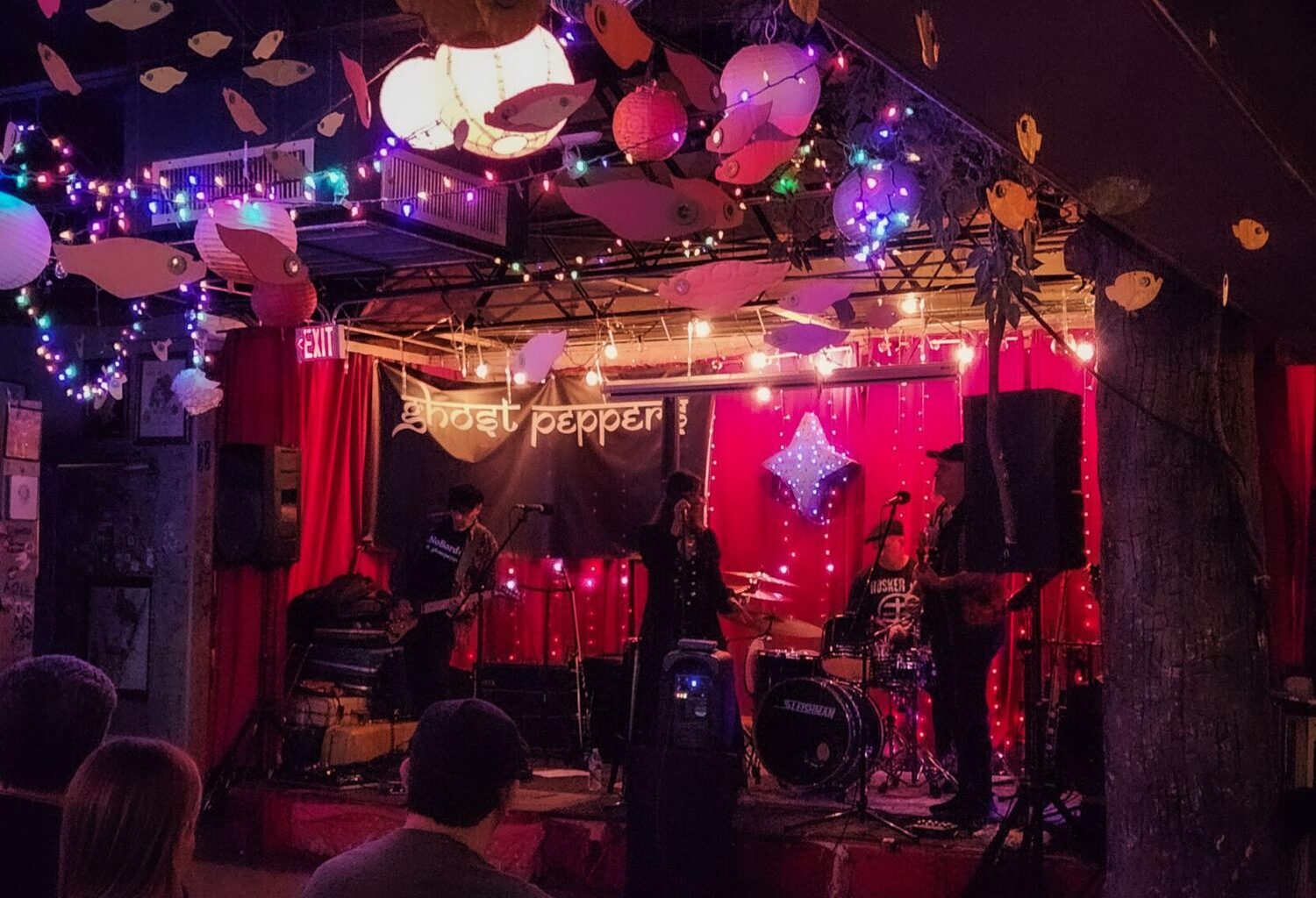

Associate professor of Southeast Asian literature Dr. Amrita Ghosh (center), professor of Caribbean literature Dr. Kevin Meehan on bass (right) and Department of English Chair professor Dr. James Campbell (left) on drums perform songs Friday at Stardust Video and Coffee.
Courtesy of Raiya Shaw
Under dim glowing lights, UCF professors rocked the stage at Stardust Video and Coffee on Friday.
Dr. Amrita Ghosh, Dr. Kevin Meehan and Dr. James Campbell performed in their Southeast Asian fusion band, Ghost Peppers, to a crowd of other UCF professors, faculty, students and Orlando locals.
“It’s just a happy accident that we’re all deeply into music,” said Campbell, the band’s drummer and percussionist.
Ghosh said the band started in 2022 when a conversation between Meehan and her revealed a shared interest in the music of Rabindranath Tagore, a previous winner of the Nobel prize in Literature, and Scottish lyricist Robert Burns. The band’s idea then became an experiment, combining the two distinct musical styles.
“I don’t know of any example where the two of those were done at the same time, so you got to hear the Burns lyrics and music in the same performance with the Tagore music and lyrics that were inspired by Burns, and so that’s where we really started as a thought experiment,” Meehan, singer and bassist, said.
The songs switch between Southeast Asian languages and English with each verse. By the middle of the set, the band played its single “Qatra Qatra/Drop After Drop,” a clear example of how the English and taan vocalizations — prevalent in Indian classical music — flow into one another.
“In my head, it just does not go together,” Ghosh, the main vocalist, said. “But if you hear the song, it’s actually a very soothing and a very complex, rich, harmonious coming together of two really diverse traditions.”
According to Campbell, the fuzzy border between the two styles characterizes the fusion the band aims for, even if in some of its songs the distinctions are much more pronounced. By the end of the set, the band played the first song it wrote together, “Jao Cheray/Waiting for Goodbye.”
Ghosh explains that it was the first time she had written a song in a Southeast Asian language, expressing specifically how tough it was. Meehan said he struggled with translating Tagore’s music.
“Having then succeeded in writing some of these lyrics,” Meehan said. “I mean, you can’t even imagine what it means to me to say that I translated some Tagore. That’s a high point.”
For Campbell, the music that they write in the band acts as a reprieve from the busy management of the English department at UCF. It still, however, acts as the practical usage of all the research and work he puts into studying culture.
“It allows putting these things into practice,” Campbell said. “Sort of these abstract ideas of what is a nation, what is cooperation, what is culture. You can talk about that till you’re blue in the face; this to me is actually practicing it.”
Both Ghosh and Meehan mentioned that the band influences their teaching and research. There is a synergy between composing and researching for Meehan, while Ghosh said it all comes from a similar place of shared academic and creative thinking.
The opening act was a collection of students and members of the Young Poets’ Society, a registered student organization, as well as a sketch comedy group. Both were chosen by the band as fitting openers to its poetic and lyrical music.
“Poetry to me is song and song is poetry, so it makes sense, and it’s a good thing to have poets open for us,” Meehan said.
The lyrics in all of the songs are written in both English and Southeast Asian languages. However, they are not translations but instead a single continuous poem in two different languages. Even if some of those who listen, like Campbell, won’t understand the Southeast Asian languages, he believes the music is still a sublime experience.
“Just enjoy the vibe of the music and don’t let the difference in language throw you off,” Ghosh said.