
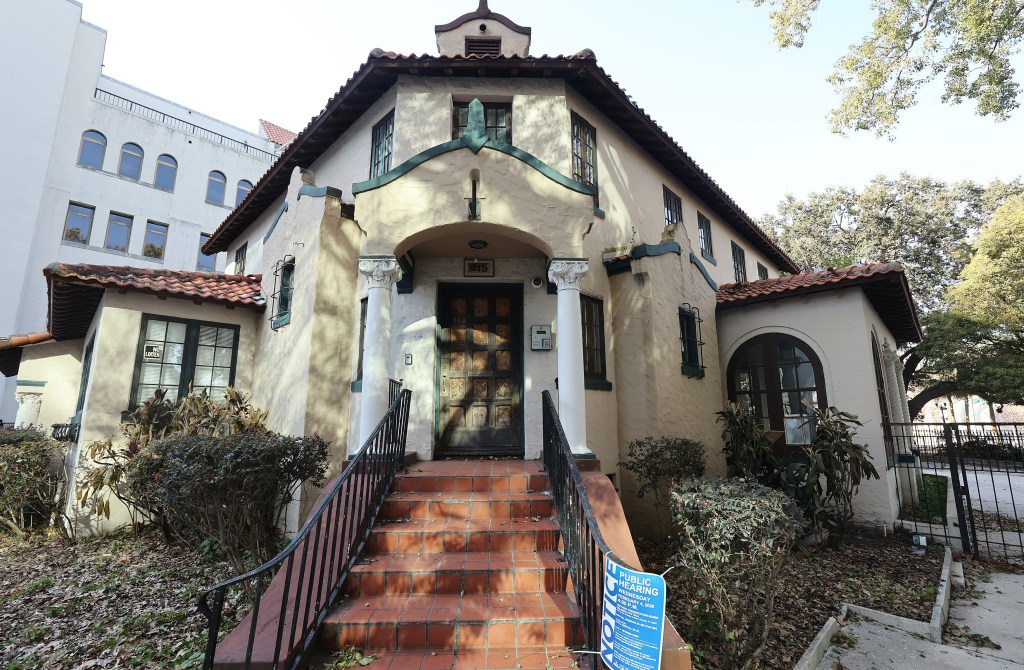
Orlando Mayor Buddy Dyer said Monday the last remaining historical home facing Lake Eola will not be torn down as some residents feared, even as the city plans to expand a park entrance near its location.
Lubbe House sits on the southwest corner of Lake Eola park, near the intersection of Rosalind Avenue and Central Boulevard in downtown Orlando.
The Mediterranean-style building was built almost 100 years ago. The city purchased the house last year as part of the park expansion project.
“We are going to take a very comprehensive look at what it could be used for as part of the gateway project,” Dyer said during a City Council meeting.
Money has already been set aside to evaluate the condition of the house, he said.
The city’s goal is to create a new signature entryway to Lake Eola park, with a plaza, a shade structure and a direct view of the famous fountain at the center of the lake. That project is to be completed in the next year or two.
Several local residents, including City Commissioner Patty Sheehan, had said they were worried the house could be demolished after city officials told them renovations could be too expensive. A city-owned building next to Lubbe House is slated for demolition to make way for the new park entrance, adding to their worries.
Raymond Cox, a member of the Orange Preservation Trust, which wants the house to be preserved, said he would remain on “high alert” until Lubbe House makes it through a physical assessment. There’s always the possibility of a “last minute claim that it’s unsafe or too expensive to rehabilitate,” he said.
Still, he said he was encouraged by Dyer’s statement about the century-old building.
The two-story house, built in 1927, covers over 3,500 square feet. It was designed by Peter Samwell, who was also the architect for the Park Plaza Hotel in Winter Park. It featured three bedrooms, two sun porches and a balcony.
Some residents spoke at Monday’s meeting, urging the city to preserve it.
It is one of the city’s “grand old houses” and should be protected from demolition, said Tana Porter, another preservation board member.
“Through hurricanes and changing times, while most exceptional buildings have come and gone, its lasting quality reminds us of what historical preservation must be about,” she said.
Dyer seemed puzzled that so many thought the house would face the wrecking ball.
Sheehan told Dyer that city staff had shared that message. “There’s a lot of misinformation out there, a lot of confusion, and I’m hoping we can have a transparent process,” Sheehan said.
Dyer said the city did get a cost estimate for demolition — it would cost about $50,000 — but will not take that option.
He also said turning it into a restaurant would cost around $5 million but did not indicate if that was an option or what else might be done with the historic property. Some residents have hoped it would be turned into something like the iconic Tavern on the Green restaurant in New York City’s Central Park.
The preservation trust has filed a petition to have the house designated as a landmark, which would prevent the city from demolishing it.
Dyer said he doesn’t support that effort, however, as landmark designation will mean more costs for the city.
But Cox said having a landmark designation would have some benefits for Orlando, allowing the city to obtain grants and to waive certain building codes during renovation.
The city’s Historic Preservation Board is expected to discuss the house’s landmark designation at a meeting in March.