
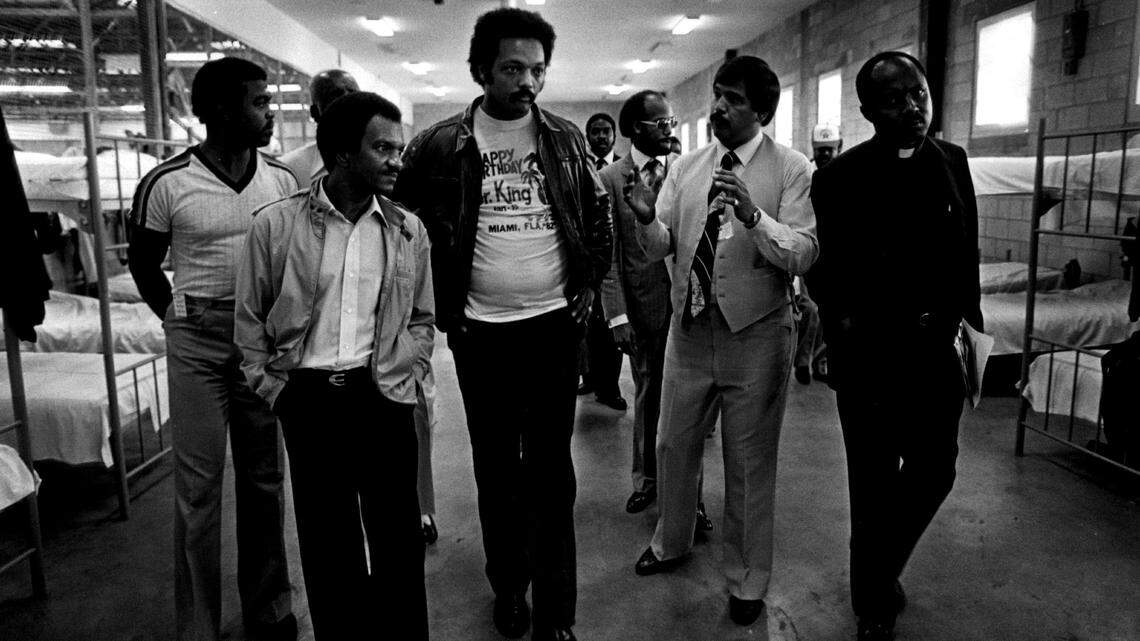
In this Miami Herald file photo, the Rev. Ray Fauntroy of the Southern Christian Leadership Conference, the Rev. Jesse Jackson, Cecilio Ruiz, director of Krome, and the Rev. Gerard Jean-Juste tour the Krome detention center.
Murry Sill
Miami Herald
On a humid afternoon in August 1982, the Rev. Jesse Jackson arrived at the Krome Detention Center in west Miami-Dade County intent on praying with 200 Haitian refugees who had launched a hunger strike to protest their prolonged detention.
He never made it past the guard gate.
Not one to be easily dissuaded, Jackson spotted a nearby restaurant, walked in and asked to use the phone.
“The vice president had given him his private number and told him to call him anytime he needed him,” Abel Jean-Simon Zephir, who was one of four people with Jackson that day and served as his translator, recalled. “He said, ‘I’ve never asked George Bush for anything.’”
Until then. Jackson placed a collect call to the White House, and after a secretary answered, she handed the phone to George H.W. Bush, vice president to Ronald Reagan. Jackson explained he had traveled to Miami to come raise the spirits of the Haitian detainees following the suicide of a Haitian in a detention facility in Puerto Rico.
Ten minutes after he hung up, Jackson was back at Krome. U.S. Immigration and Naturalization Service officers were waiting for him. This time, they let him in.
The Rev. Jesse Jackson during a speech to Haitians on Northwest 54th street in Little Haiti. Al Diaz Miami Herald
The incident was emblematic for Jackson, the charismatic and relentless advocate who would become one of the most prominent voices in the U.S. in the post-Martin Luther King civil rights era. As he addressed racial injustices and pressed for voting rights for Black people on a national level, he also challenged U.S. immigration policy toward Haitians, equating their prolonged detention and unequal treatment to a moral issue.
After a long illness, Jackson died at his home on Feb. 17 at the age of 84.
As his family and Jackson’s Rainbow PUSH Coalition prepare memorial services in Chicago this week, Miami’s Haitian community is also remembering the leader who loudly advocated on their behalf. He saw their plight as not just worthy of a civil rights fight, but one that also demanded the attention of the nation’s highest office and his sustained activism.
“It’s a pillar we’ve lost,” said Zephir, 69, who was among the first wave of Haitians to arrive in South Florida by boat more than 50 years ago. ”The guy always worked for us. It’s going to be hard to find another.”
Little Haiti visit
Jackson’s Aug. 12, 1982, visit began in Little Haiti, where he went to see the Rev. Gérard Jean-Juste, the fiery Catholic priest and co-founder of the Haitian Refugee Center. He learned that Jean-Juste, who had the reputation of an agitator, had been barred from Krome and could not accompany him.
When Zephir later told the priest that Jackson had reached out directly to the vice president of the United States, Jean-Juste laughed in disbelief.
“And George Bush accepted the call?” he asked.
“Yes,” Zephir said.
Jackson had found the refugees to be in “massive depression,” because of the slow processing of their release and the suicide.
“It costs $22,000 a year to keep each Haitian locked up in here. Why don’t we put them out in the market and let them be productive?” he said after leaving Krome.
The Rev. Jesse Jackson, Ray Fauntroy of the Southern Christian Leadership Conference and the Rev. Jean Juste outside the Krome detention center in 1982. Murry Sill Miami Herald
The visit would not be Jackson’s last to South Florida or to Krome. Over the years, he returned repeatedly, on each visit denouncing what he called an immigration system “driven by a racist policy that’s undemocratic.” Haitians, fleeing a repressive U.S.-supported Duvalier family dictatorship, were branded “economic” migrants and detained, while Cubans fleeing Fidel Castro’s communist regime were quickly granted political asylum.
When he launched his historic 1984 presidential runs in 1988, the poor treatment of Haitians figured prominently in his campaigns, though he came under heavy criticism in ‘84 for not including Haiti in a tour of the region, which included visits to Cuba, El Salvador and Nicaragua. “As a champion of oppressed people, Jesse Jackson‘s Achilles’ heel is Haiti,” a Miami News editorial of the day read, challenging his assertion of avoiding Haiti because of safety concerns.
In this file photo, Jesse Jackson gestures to a crowd of Haitians as he leaves Little Haiti on 54th street where he had just delivered a speech on current affairs in Haiti. Al Diaz Miami Herald
In 1992, when former California Gov. Jerry Brown launched his second White House bid, Jackson accompanied him on a campaign stop to Miami’s Little Haiti. While happy to hear Brown pledge to give Haitians political asylum if he were to win the presidency, the crowd was equally elated to see Jackson. Crowding Northwest 54th Street, they chanted, “Jesse! Jesse!”
Back then, Jackson was at the forefront of the push to restore democracy to Haiti after a military coup in 1991 had deposed the country’s first democratically elected president in modern times and sent him into exile. He accused the administration of President Bush, who years earlier had facilitated his entry into Krome, of having a socially unjust and racist policy toward Haiti.
“If we can restore a royal government in Kuwait,” Jackson said, referring to the U.S. effort that repelled the 1990 Iraqi invasion of Kuwait, “we can restore a democratically elected government. Oil is not more precious than democracy.”
From Krome to Guantánamo
When thousands of Haitians, trying to escape the military junta and killings, took to the high seas only to end up in makeshift camps at the U.S. naval base in Guantánamo Bay, Cuba, Jackson went there too. He protested their harsh treatment and went on a hunger strike with detainees to demand a change in U.S. policy.
“He asked them to repeat after me, ‘I am somebody, I am somebody,’” said Tony Jeanthenor, a local activist with Veye Yo, the grassroots Haitian rights group founded by Jean-Juste. “I am a human being, just like everybody else, so don’t mistreat me.”
In 1994 when President Jean-Bertrand Aristide made his triumphant return to Haiti aboard a U.S. government jet accompanied by thousands of American troops and a high-level delegation, Jackson was at his side.
“He invested a lot of his time to show support for Haitian refugees,” Jeanthenor said. “He got frustrated seeing how they were treating other refugees. Cubans were given a red carpet treatment. Haitians were being thrown in Krome, and they didn’t know when they were going to get released.”
Beyond protests, prayer vigil and his own hunger strike, Jackson leaned on Haitians to become naturalized U.S. citizens so they could vote.
“He wanted Haitians to become U.S. citizens, to be part of the political system,” Jeanthenor said, crediting Jackson with helping to lay the groundwork for Haitian Americans’ representation in politics. The milestones included a number of firsts, including Haitian Americans elected to the Florida Legislature and the first Haitian-American mayor of a large U.S. city, North Miami’s Josaphat “Joe” Celestin, in 2001.
“All are part of Jesse’s investments in the Haitian community,” Jeanthenor said.
Haitians current plight
Jackson remain engaged on Haiti issues over the years. After the country’s devastating 2010 earthquake killed more than 300,000 people, he again joined prayer vigils and demanded U.S. support.
Today, as hundreds of thousands of Haitians face the potential once more of mass detention and deportations with the loss of Temporary Protected Status, the civil rights’ leader absence is being felt.
“I’m pretty much sure with the TPS problem we have now, if Jesse was in good health, he would have been in Miami with us,” Zephir said. “He demonstrated that in the past, without hesitation.”
The Rainbow PUSH Coalition has announced that Jackson will lie in state at its Chicago headquarters on Feb. 25 and 26. A public memorial, “The People’s Celebration” is planned March 6, followed by a service on March 7.
In Miami, longtime activists are planning their own tribute at a North Miami community center named for Jean-Juste who died in 2009. They worry that a younger generation of Haitian-American leaders don’t fully grasp the historic battles that were waged – the marches to the Miami immigration headquarters building, the lawsuits in the courts and the prayer vigils outside Krome’s gates.
“I don’t think this generation know what Father Jean Juste, Jesse and others did to put this community together,” Jeanthenor said. “They sit on a citadel, and they need to cultivate it.”
Zephir agrees. As he reflected on Jackson’s death and the community once more being at an immigration reckoning, he broke into tears. Then he recalled standing beside Jackson outside the gates of Krome, where the minister invoked both sermon and his trademark call for social justice.
“He would say, over and over, ‘Let my people go. Let my people go’.”

Miami Herald
Jacqueline Charles has reported on Haiti and the English-speaking Caribbean for the Miami Herald for over a decade. A Pulitzer Prize finalist for her coverage of the 2010 Haiti earthquake, she was awarded a 2018 Maria Moors Cabot Prize — the most prestigious award for coverage of the Americas.