
Throughout the 2010s, Ashley Toussaint taught high school in New York City and witnessed gentrification reshape Brooklyn, Harlem and the Bronx. He saw families displaced by soaring rent, brownstones skyrocketing from $500,000 to nearly $2 million, and a growing prevalence of white people in predominantly Black communities.
Then in 2017, Toussaint read aNew York Times article describing Miami’s Little Haiti, where he had grown up, as an up-and-coming neighborhood. He knew the same fate awaited his hometown if he didn’t take action.
“I was already making plans to come back home and tell people, ‘Hey, don’t sell your house, stay informed,’” Toussaint recalled.


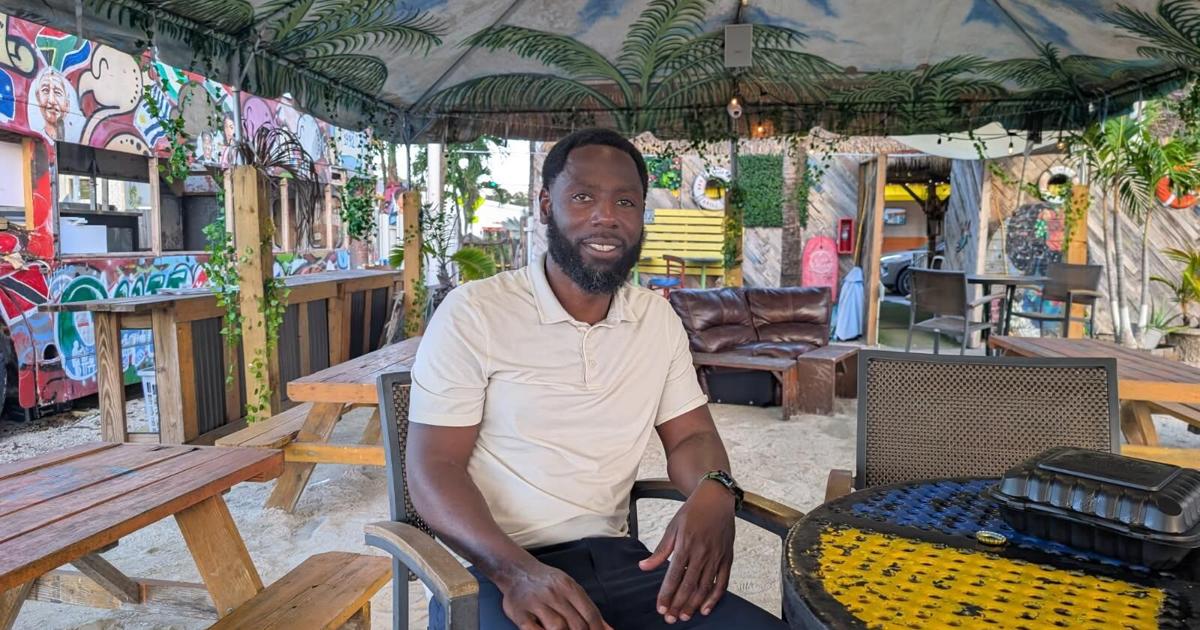
Ashley Toussaint at Chef Creole, a staple of Haitian food in Little Haiti.
(Xitlalic Montelongo)
Since moving back in 2019, the 45-year-old has become a pillar of strength in the fast-changing neighborhood.
As rising sea levels threaten to encroach upon South Florida’s wealthy coastal cities, developers are investing in neighborhoods like Little Haiti, which sits on land roughly twice as elevated as Miami Beach.
Consequently, property values are escalating. The average home in Little Haiti cost roughly $58,403 in 2012, The New York Times reported. Today, Zillow estimates the value at $578,428.
Rather than resisting gentrification, Toussaint is empowering residents to anchor themselves in the communities they’ve built.
As a community activist, he educates residents about rising rents, local decision-making and how they can fight back.
In 2021, he was appointed vice chair of the newly established Little Haiti Revitalization Trust by then-interim City of Miami District 5 Commissioner Jeffrey Watson.
Created through an agreement between the City of Miami and the developers behind the Magic City Innovation District — a $1 billion, 18-acre redevelopment project unfolding in east Little Haiti — the trust helps residents avoid being priced out of their neighborhood. That agreement also requires developers to invest $31 million into improving the neighborhood in the next 15 to 25 years.
As vice chair, Toussaint pioneered the Little Haiti Revitalization Trust Scholarship, a program aiming to award 40 grants of $2,500 to help students in the neighborhood pursue higher education or vocational training. Since its inception last year, roughly five students have been awarded the cash.
The trust also offers grants of up to $20,000 to support small businesses and funding of up to $50,000 for residential home renovations.
“A lot of small businesses in Little Haiti were able to stay because they got assistance through the Little Haiti Revitalization Trust, where Ashley sits and advocates for them,” said Moises Lambert, a community organizer for the Miami chapter of Black Men Build, a national non-profit aimed at supporting Black men, where Toussaint is a co-lead organizer.
But Toussaint’s day job is serving as a college and career counselor at KIPP Miami, a charter school on Northwest 27th Avenue, where he helps students with college applications and coaches track and cross country.
Toussaint, who speaks English, Creole and Spanish, says his upbringing in Little Haiti and Allapattah shaped his sense of community. Allapattah was a melting pot of Latin American cultures. Little Haiti connected him to his Haitian roots.
“It made me have a deeper appreciation of the diversity of Miami,” Toussaint said.
Born to Haitian immigrants, Toussaint grew up helping his father, Elisson Toussaint, at his immigration office, which assisted thousands in Little Haiti acquire legal status.
In 2017, the city declared Elisson’s home on Northeast 62nd Street an unsafe structure and slated it for demolition. However, Toussaint became a co-owner and paid the necessary fees to save it.
Following his father’s death in 2020, he received several offers to sell but chose to keep and renovate the home instead.
“My dad bought that house in 1988 for $28,000,” he said. “The house is now worth half a million dollars.”
Toussaint also fosters appreciation for Little Haiti through The Running Edge 305, an organization promoting health and wellness in Miami’s Black community.
Every Saturday at 7 a.m., roughly 40 people run through neighborhoods like Overtown, Little Haiti and Liberty City. Each year, the organization hosts the Little Haiti Heritage 5K, featuring pit stops at national landmarks and history lessons about the neighborhood.
Toussaint hopes young residents will see the value in places they know as home.
“We gotta let the youth understand the value of their neighborhood and communities now, so they can pay attention to it,” Toussaint said.
He believes information is one of the most powerful tools residents can have.
“America is a land of who knows and who doesn’t,” Toussaint said.