
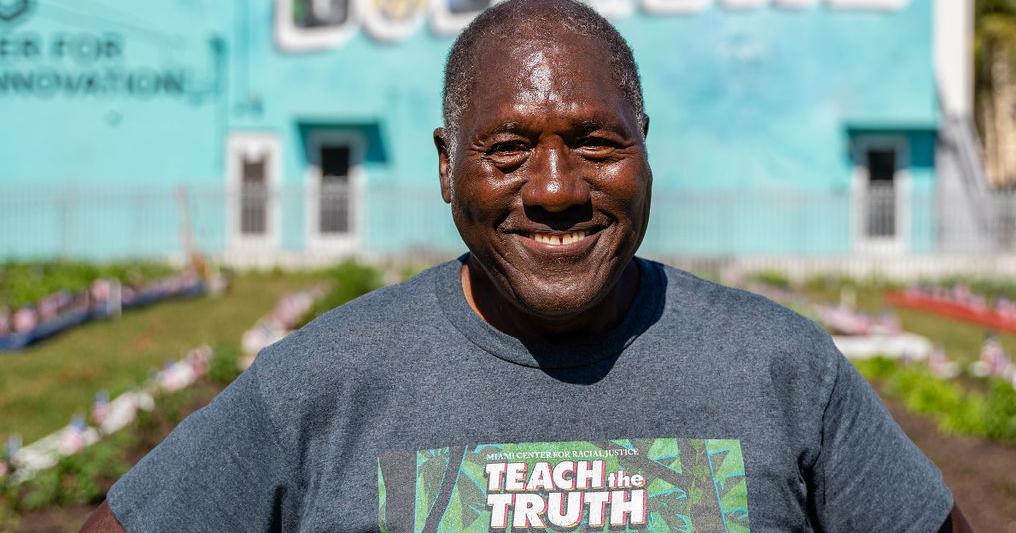
You may have heard of Marvin Dunn, the man taking legal action against Donald Trump’s presidential library, which is planned for downtown Miami. He is well known as a former naval officer, a retired psychology professor, a historian, an author and a longtime activist.
But have you heard of his gardens?
Dunn and many others have filled what once was an abandoned lot in Overtown with rows of collard greens, cabbage, lettuce, onions and potatoes.

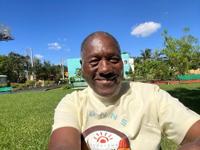
Dunn takes a selfie while standing among the garden he planted in Overtown.
(Courtesy of Marvin Dunn)
The space, known today as the Teach the Truth Garden, is the result of decades of hard work and quiet cultivation. It is far more enduring than headlines. It is the heart of the community.
“It’s a place of peace, beauty and truth,” Dunn said. “And Overtown didn’t have many spaces like that.”
The garden, located at 937 NW Third Ave., sits across from the Historic Mount Zion Baptist Church. It has existed for about three years, though it is the latest evolution of a project Dunn started in the early 1980s called Roots in the City.
The motivation for Dunn’s community work was shaped by his experience witnessing the 1980 Miami race riots, when 18 people were killed and much of the city went up in flames. At the time, Dunn spent four days observing chaos in the streets of Liberty City as a social scientist. He later co-authored a book about it. However, what stayed with him the most was how many young people he saw involved in the chaos.
“I kept criticizing the school system, asking what they were doing to keep kids in school,” Dunn said. “Then I realized I needed to do something myself.”
He began bringing students to Overtown to work in a small garden planted along the freeway embankment, just a few blocks north of the present site near Northwest Third Avenue and 14th Street. They planted shrubs and flowers, and even earned extra credit for spending four hours over four weekends working in the garden.
During the next few years, with permission from the Florida Department of Transportation, he began planting more gardens alongside the highway.
The project that had started with just two acres worked mostly by a few of his students turned into three blocks tended by many more, Dunn says.
There were many challenges. Drug paraphernalia that littered the soil had to be picked up. Newly planted shrubs were stolen and had to be replaced. Entire sections were vandalized and required repair.
Still, Dunn made a decision: the gardens would never be fenced.
Then in 2024, after a neighborhood resident pointed out the lack of fresh produce in the area, he decided to transform the garden he described as “decorative but limited” into one that grows food for the community.
“At that moment, it clicked,” Dunn said. “Overtown was a food desert.”
Years later, Dunn was offered temporary use of a block of land privately owned by a Cuban-American developer who plans to eventually build condominiums there. Dunn declined to name him. The agreement allows the garden to operate on a year-to-year basis for up to six years.
Today, this working urban farm produces vegetables for the community — but that’s not all.
The garden serves as an outdoor classroom and cultural space. Dunn regularly lectures FIU students there about Black Miami and Overtown history before leading walking tours through the neighborhood. The site also hosts pilates classes, movie nights and community gatherings.
“Green makes a difference,” Dunn said.