
Charlotte County commissioners are set to reconsider a proposed condominium development near Charlotte Harbor that was previously delayed over concerns about density and flood risks.
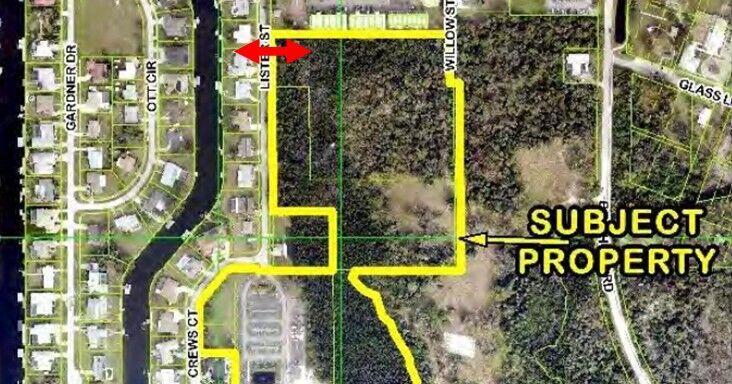
The project, known as Tarpon Waterfront Village, is scheduled for review at the Feb. 25 Charlotte County Commission meeting. The development is planned on 20.33 acres in Port Charlotte, north of the Peace River, south of Edgewater Drive, west of Bayshore Road and east of Lister Street. The site is adjacent to the Charlotte Harbor Yacht Club and about 700 feet from Charlotte Harbor.
The upcoming presentation marks the third time developer Jeffrey DiLaura has brought revised plans to county officials. The proposal has been scaled back from an original design of 156 units in six buildings rising to 65 feet, to 120 units in four buildings and now to 110 units in smaller structures.
DiLaura, represented by attorney Michael C. Haymans, also is seeking rezoning approval for four parcels along Crews Court, Willow Street and Lister Street, along with a fifth adjoining parcel without an address.
On Sept. 9, county commissioners approved an amendment to extend the Urban Service Area boundary to include 14.52 acres of DiLaura’s property and approved changes to zoning designations. The board redesignated 11.51 acres from agricultural/rural to revitalizing neighborhood and 3.01 acres to managed neighborhood.
However, concerns about building placement and flood vulnerability near the harbor prompted additional scrutiny.
Principal Planner Jie Shao previously testified that earlier versions of the proposal contained inconsistencies and did not fully comply with the county’s comprehensive plan. Commissioners also cited testimony from Emergency Management Director Patrick Fuller, who warned that the site is among the most flood-prone areas in Charlotte Harbor.
“This area is not only in the tropical storm surge area of SLOSH (Sea, Lake and Overland Surge from Hurricanes) modeling but was an area that saw some of the highest above-ground water depths totals within the harbor from both (hurricanes) Helene and Milton,” Fuller wrote.
He also noted that the property is identified as highly vulnerable to coastal flooding under the National Oceanic and Atmospheric Administration’s Coastal Flood Exposure Map and could experience overland flooding with a 1-foot increase in sea level, according to the agency’s Sea Level Rise Viewer.
Commissioners Joe Tiseo and Chris Constance previously opposed the rezoning request, warning against placing additional residents in an area they described as highly susceptible to storm impacts.

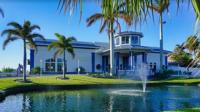
Charlotte Harbor Yacht Club sits near the proposed Tarpon Waterfront Village development site in Port Charlotte. Supporters say the project could help strengthen the club’s financial outlook.
Charlotte Harbor Yacht Club
Despite those concerns, the project has drawn strong support from some community members, particularly those affiliated with the Charlotte Harbor Yacht Club. Supporters attended the September meeting to urge commissioners to approve the development.
DiLaura, who serves as director of the yacht club, said he would offer yacht club memberships to residents of Tarpon Waterfront Village. Supporters said the project could help strengthen the club’s financial outlook.
Yacht club member Hank Killian said the organization, which pays about $80,000 annually in taxes, has struggled financially and that approval of the development could help ensure its survival.
Commissioners also expressed concerns that residents in elevated condominium units might choose to remain during severe storms rather than evacuate. If flooding cuts off access to the property, officials warned, residents could become stranded without essential services.
Even with those concerns, the rezoning request ultimately passed in a 3-2 vote. Commissioners who supported the change noted that the property is surrounded by an urban service area and is close to businesses, including a Publix supermarket and pharmacies, making the location walkable.
With zoning changes approved, commissioners must now decide whether to authorize DiLaura’s revised development plan, which proposes fewer units and smaller buildings in response to earlier concerns.
The Feb. 25 meeting will determine whether the scaled-back proposal can address the county’s concerns about density and flooding while moving the waterfront project forward.