
By Anayansy Hernandez and Maria Derchi
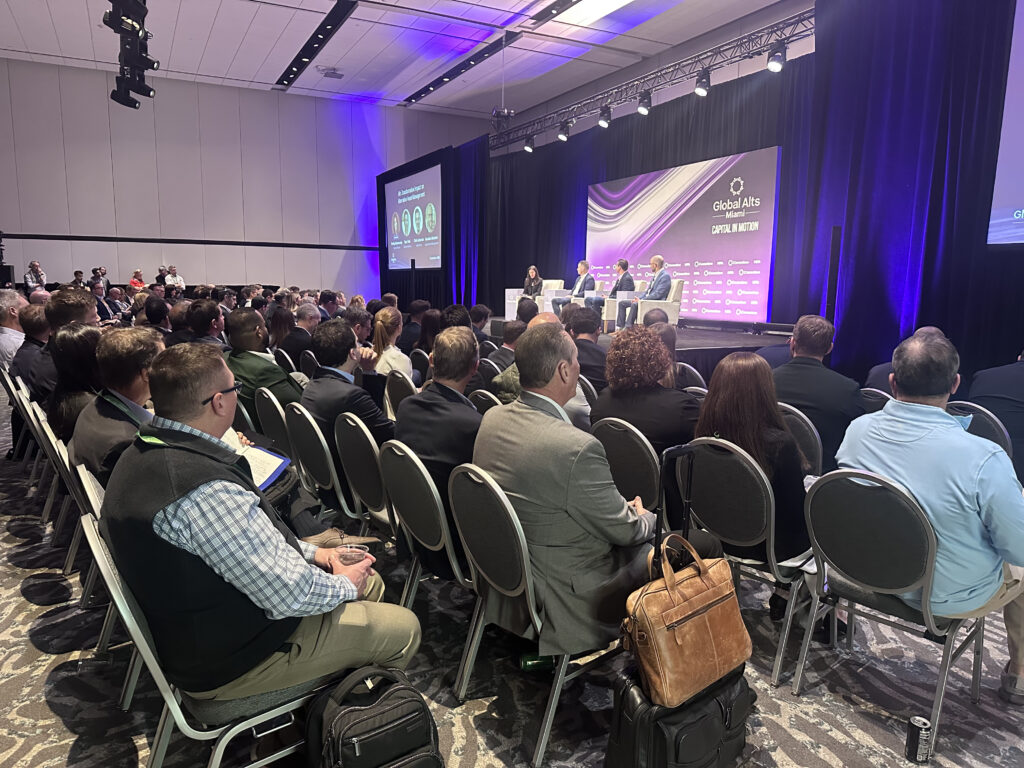
Billed as the “world’s largest cap intro event,” iConnections was back in Miami this week for their 2026 conference, and Refresh Miami had a front-row seat to the action.
The four-day event kicked off on Monday, where attendees swapped suits for athletic gear with a choice between golf or padel outings prior to the opening reception. By Tuesday, the suits were back, and the conversations were all business. Post-opening remarks, iConnections CEO and Co-founder, Ron Biscardi, interviewed Joe Lonsdale, co-founder and managing partner at 8VC, a $6B venture fund with 17 unicorns under its belt. Lonsdale, who is also the co-founder of Palantir Technologies (which recently moved its headquarters to Miami), touched on the shifting landscape of building in the modern era.
The conversation covered the difficulties of building in the defense industry, as well as navigating the artificial intelligence wave. For Lonsdale, two things are key when building a great business: working with top talent and asking yourself what is possible to create today that wasn’t possible a few years ago. He referenced Uber as a prime example of this, noting that without the rise of the smartphone, the company would not have been able to exist. Lonsdale, who lives in Austin, also spoke about the University of Austin, a private institute he founded, which is entering its third class. While the curriculum leans heavily into AI and STEM, the first year is focused on the intellectual foundations of the U.S.
Defense tech draws growing investor interest
Later panels focused on capital allocation, with defense technology emerging as a recurring theme. Panelists described the U.S. defense market as a roughly $1 trillion opportunity that extends beyond weapons systems to include energy infrastructure, advanced manufacturing, rare-earth supply chains and autonomous systems. As defense budgets rise, investors are increasingly treating the sector as a long-term allocation.
But defense tech is not a category you stumble into and scale overnight. Panelists were candid that building something great is not enough. This is a relationship-driven market where success depends on navigating layers of procurement. Unlike other sectors where companies compete directly, defense technology firms often work together to meet the Department of War’s complex procurement needs. Startups frequently partner with larger contractors, known as “primes,” to deliver integrated systems rather than isolated products.
“This is relationship-driven,” said Lily Kim, head of investments at the University of Utah. “You have to have been in this like 10, 15, 20 years ago. You have to have the relationships in existence. You can’t do it alone.”
Terry Monis, chief investment officer at ICG Advisors, said the funding model has also evolved. For decades, the government absorbed much of the risk through cost-plus contracts, but today that burden is increasingly shifting to private capital. “People in this room are actually paying for the innovation,” he said.
 Defense tech panel: (from left) Ali Javaheri, seniorr. research analyst at Emerging Spaces; Lily Kim, head of investments at University of Utah, Erik Kreissman, partner at Altimeter Capital; Terry Monis, co-chief investment officer at ICG Advisors.
Securing the economic foundation: The digital dollar revolution
Digital assets were another major topic. During a panel titled “Digital Dollar Revolution,” former Miami Mayor Francis Suarez said clearer federal rules are helping the crypto industry mature. He referenced the GENIUS Act, a federal legislation that creates the first comprehensive regulatory framework for payment stablecoins, as a driving force in increasing adoption.
Speakers said regulatory clarity has encouraged broader institutional participation beyond retail trading. Despite recent price volatility in digital assets, several panelists said adoption of stablecoins and tokenization continues to expand. Joe Armao, senior portfolio manager of the Galaxy Fintech Fund, said infrastructure development is advancing even during market downturns. “This is the first downturn that we’ve seen in digital asset markets where price and infrastructure are decoupling,” Armao said. “The pace of institutions adopting stablecoin tokenization of real-world assets is really accelerating.”
AI’s Transformative Impact
AI was also featured prominently in discussions about how investment firms operate. Amadeo Alentorn, head of systematic equties at Jupiter Asset Management, said generative AI is accelerating research processes that traditionally required teams of analysts. Chris Ackerson, senior vice president at AlphaSense, said investors should expect AI tools to significantly expand analytical capacity.
“We should assume that every investor will have effectively infinite analyst capacity,” Ackerson said. “I think this will radically transform the industry.”
Ryan Teal, head of operational due diligence at Albourne Partners, shared how his team deconstructed the entire due diligence workflow into various tasks and subtasks, and determined that approximately 90 percent of operational due diligence work can be augmented by AI and machine learning or agents.
However, as these tools become more pervasive, the industry faces the rising risk of “AI washing,” he deceptive practice of firms overstating their technological capabilities in marketing materials to mislead allocators, making human judgment and rigorous governance more vital than ever. While AI can now augment of traditional due diligence tasks, such as benchmarking and smart document review, it cannot anticipate unprecedented structural or crowding risks that fall outside of historical data patterns. Across panels, participants emphasized that alternative asset management remains a relationship-driven business where trust and human judgment remain central.
 Global transaction panel: (from left) Owen Lau, equity research at Clear Street; Reeve Collins, co-founder and chairman at STBL; Joe Armao, senior portfolio manager at Galaxy Fintech Fund; Salmaan Jaffrey, chief business development officer at Dubai International Finance Centre; Francis Suarez, former Mayor of Miami.
READ MORE IN REFRESH MIAMI:
 I am a University of Florida graduate and Miami native who is passionate about writing stories that highlight Miami’s thriving tech ecosystem. I especially enjoy writing stories about technologies creating a social impact, digital assets, and EdTech. Have a story to share? Contact me via Twitter @anathemarketer or
[email protected]. Latest posts by Anayansy Hernandez (see all)