
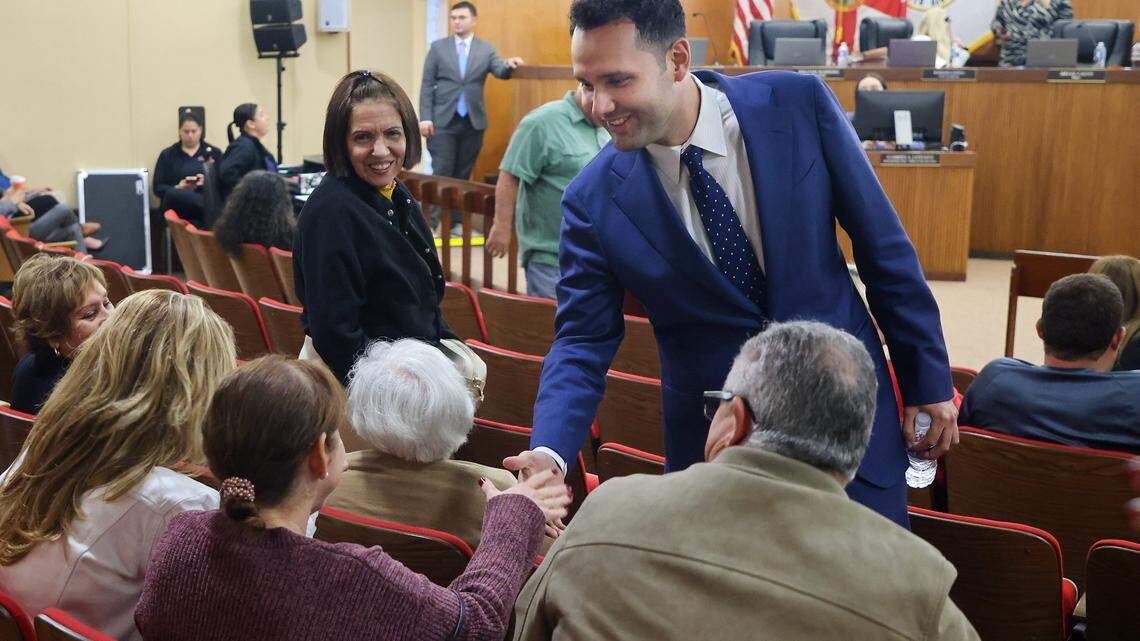
Hialeah Mayor Bryan Calvo, center, greets residents and supporters as he attended his first city council meeting on Jan. 13, 2026, at City Hall.
Carl Juste
cjuste@miamiherald.com
The City of Hialeah unanimously approved a one‑time property-tax relief program that will send stimulus‑style rebate checks to qualifying senior homeowners, though the measure still needs a final vote.
Under the ordinance, eligible residents 65 or older with a homesteaded property and income below a specified threshold will receive a rebate calculated on the city’s portion of their 2025 property tax bill. The city estimates the cost at about $1.2 million, funded from surplus general fund revenue — specifically savings the city achieved by making early pension payments that reduced long-term costs.
Although the mayor initially told the Miami Herald that 5,141 residents would benefit from the relief, the ordinance estimates it will benefit approximately 2,225 senior households, based on property tax payment data provided by the Miami-Dade County Tax Collector’s Office. Rebates are expected to average $539 per household, though the exact amount will depend on each resident’s property tax payment. The 2,225 households represent 6.9% of all households in Hialeah.
Last year, under interim Mayor Jacqueline Garcia-Roves, the city had proposed a broader $200 rebate for approximately 32,100 homeowners, a measure estimated to cost $6.4 million. That proposal ultimately failed and was never implemented.
Although the council approved the stimulus payments on first reading Tuesday evening, a final vote is scheduled for March 10.
Legal questions
Lawyers say the program could face legal challenges if opponents argue it constitutes an impermissible use of property tax revenue, known as ad valorem taxes, to provide a benefit to a narrow class of residents.
“A city may not give ad valorem taxes to any particular group. A city may use federal funds, Community Redevelopment Agency dollars, or other revenues to assist low-income or needy residents, or for a legitimate public purpose,” said Jose Smith, a former municipal attorney for the cities of Miami Beach and North Miami. “But only non-ad valorem revenues should be used, and it cannot be designed to help just one group of people. There has to be a public purpose.”
Florida’s Constitution says: “Neither the state nor any county, school district, municipality, special district, or agency of any of them, shall become a joint owner with, or stockholder of, or give, lend or use its taxing power or credit to aid any corporation, association, partnership or person.”
Asked about the legal interpretation, Hialeah Mayor Bryan Calvo told the Herald: “Who is going to sue? The theory is very interesting, but who’s going to sue and say it’s unconstitutional?”
He added: “It’s not unconstitutional. We’re providing a relief program, which has been done in the past, although the amounts were different, and the groups were different, but it’s something that has been completely vetted by our legal department.
“A determination of unconstitutionality requires a judge to make that decision,” he added. “And I don’t think there’s a realistic chance anyone’s going to take that to court, but other than that, it’s legal, completely legal. Our city attorney says it’s legal.”
The legality argument centers on the fact that the funds are coming from the city’s general fund. “The checks come from the city’s operating account, which is the General Fund. That fund receives money from various sources. That doesn’t mean those funds are restricted. It’s the only place where you can issue those checks.”
City officials maintain that because the rebates are issued from general revenue rather than a new property tax, the program is considered a budgetary appropriation, satisfying the constitutional requirement that public funds be used for a legitimate public purpose.
The proposal, approved on first reading on Tuesday night, would be implemented as soon as the end of March if the City Council adopts it on final reading, a vote that appears likely, given the lack of opposition now that Calvo holds the mayor’s office and has consensus support on the council.

el Nuevo Herald
Verónica Egui Brito ha profundizado en temas sociales apremiantes y de derechos humanos. Cubre noticias dentro de la vibrante ciudad de Hialeah y sus alrededores para el Nuevo Herald y el Miami Herald. Se unió al Herald en 2022. Verónica Egui Brito has delved into pressing social, and human rights issues. She covers news within the vibrant city of Hialeah, and its surrounding areas for el Nuevo Herald, and the Miami Herald. Joined the Herald in 2022.