
Despite back-to-back hurricane seasons and persistently high homeowner insurance costs, real estate experts say Charlotte County’s housing market remains resilient, buoyed by migration trends, economic strength and stabilizing prices.
Shelton Weeks, Lucas Professor of Real Estate at Florida Gulf Coast University, and Anthony Antuono, 2026 president of the Realtors of Punta Gorda-Port Charlotte-North Port-DeSoto Inc., said demand for property in the region continues for a variety of reasons.
Weeks said residents from northern states are relocating to Florida because of high living costs, political climates and cold weather. At the same time, he noted, interest rates have been easing, helping support purchasing activity.
Antuono pointed to Florida’s broader economic standing as another driver. He said the state is now the world’s 15th-largest economy if measured as a country. According to the Florida Chamber Foundation, Florida’s gross domestic product exceeds $1.7 trillion, placing it ahead of Spain when ranked independently.
Charlotte County, once known primarily as a retiree destination, is attracting a broader demographic, Antuono said. While retirees continue to purchase first, second or even third homes in the area, younger buyers also are moving into the market.
He also addressed concerns that Canadian buyers might retreat from Florida because of tariff disputes and currency exchange challenges.
“The Canadian exodus never materialized on a large scale in Charlotte County,” Antuono said. “The Canadian market is still here; there has been no significant decline.”
He acknowledged that the exchange rate has not favored the Canadian dollar, making purchases more expensive for Canadian buyers, but said demand from that segment has remained steady.
Insurance and storm risk remain top-of-mind for many buyers. Antuono said he advises clients directly about flood risks when considering waterfront properties.
“I’m not going to sell you waterfront property without telling you that the property is in a flood zone,” he said.
In the wake of hurricanes Ian, Helene and Milton, many flood-damaged homes have been rebuilt or hardened to better withstand future storms, he said. New construction, in particular, is designed to meet updated building standards intended to improve storm resilience.

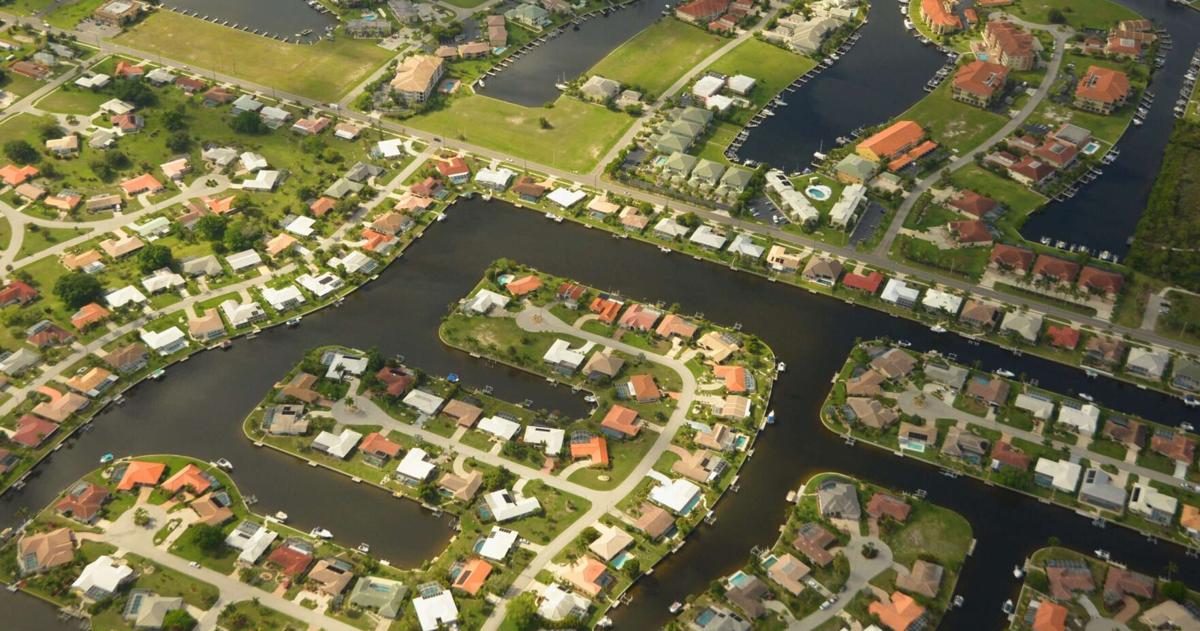
An aerial view shows waterfront homes and canals in Punta Gorda. Real estate experts say the Charlotte County housing market remains resilient despite recent hurricanes and high insurance costs.
Getty Images
Antuono described Charlotte County as an opportunity market for both buyers and sellers. While price appreciation has slowed compared with the rapid gains seen several years ago, he said demand remains solid and prices have stabilized.
Weeks also commented on proposed legislation in Tallahassee that would expand property tax exemptions for homesteaded residents. While the proposal could benefit homeowners by reducing monthly expenses, he cautioned that long-term impacts should be considered.
He said homeowners could potentially save about $200 per month, which could be applied to mortgage payments. However, he warned that such savings could be capitalized into home prices, meaning lower taxes could ultimately be reflected in higher property values.
Insurance rates, which have climbed sharply in recent years, may be showing signs of relief. Weeks said homeowner insurance premiums have begun to decline in some cases, offering another positive signal for the market.
Local sales data reflect a market settling into more typical seasonal patterns. According to the Realtors association, there were 392 closed single-family home sales in January, down from 466 in December, which is traditionally a strong sales month. January sales were 18.8% higher than January 2025.
The median sale price for single-family homes was $346,250 in January, little changed from December’s $350,000 and down 1.1% year over year. Sellers received 93.3% of their original list price on average, slightly higher than December and 0.5% higher than a year ago. Homes spent an average of 102 days on the market.
Inventory for single-family homes totaled 3,371 active listings in January, up from December but down 10.7% compared with a year earlier. The months’ supply of inventory stood at 7.4 months, 16.9% lower year over year.
The condo and townhome market also is presenting opportunities, Antuono said. The median sale price for those units was $239,450 in January, down 0.6% from a year ago.
However, some condominium owners are facing higher association assessments due to hurricane-related repairs, with costs passed along through homeowners associations.
There were 1,010 active condo and townhome listings in January, up from December but 9.1% lower than a year earlier. Inventory stood at 10.6 months, up slightly month over month and nearly 20% lower year over year. Like single-family homes, units averaged about 100 days on the market.