
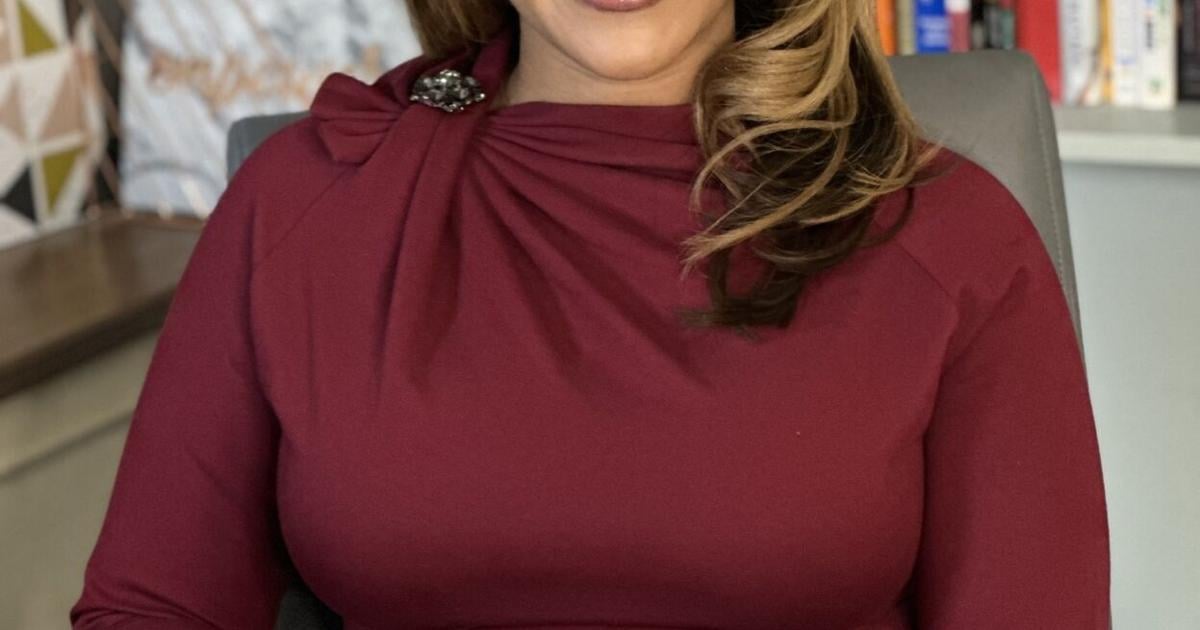
From Carol City to the courtroom, attorney Loreal Arscott is dismantling misconceptions about affirmative action and reshaping ideas of female success one case at a time. The accomplished advocate and mother of two has devoted her life to helping those without a voice, and she never misses an opportunity to help her community.
When Arscott was seven years old, her father, Laurie “Larry” Belfo, passed away from AIDS-related complications.
She remembers being in and out of hospitals, the invasive tests, and her mother asking her not to cry in front of her father when he eventually reached his end.

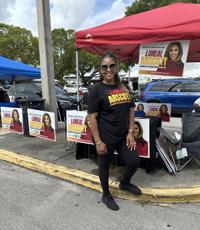
In Miami Gardens, Loreal Arscott tables for her 2024 Florida House campaign outside the North Dade Regional Library, meeting and talking to voters passing by.
(Courtesy of Loreal Arscott)
“My family surrounded us with love and support, so they tried to do everything they could to nurture us through it,” Arscott said. “But it was hard as a kid. I was angry.”
While she was still grieving her father’s death, she experienced one of her first encounters with racism. She was one of only two Black students in her middle school math class, and the teacher was “really nasty,” she says. She couldn’t understand why, or even recognize that it was tied to her race.
The experience sharpened her sense of justice and inspired her to begin advocating for children through the legal system.
Arscott completed her undergraduate degree at Florida State University and attended the University of Florida Levin College of Law. Soon, she recognized the severe underrepresentation of Black people in law. Only 11 of the 200 students in her law school class were Black.
While discussing affirmative action during a lecture, one of her white classmates commented that “a lot of their friends weren’t able to get into the University of Florida’s law school because of affirmative action,” Arscott said.
Yet, Arscott made the dean’s list every semester and graduated early in the top 2% of her class.
“When I looked around, there were only a handful of people that looked like me,” Arscott said. ”It’s more weight and responsibility for you to represent for everyone.”
After graduation in 2008, she joined the Florida Department of Children and Families. There she practiced dependency law and represented abused and abandoned children at court hearings. This was particularly difficult for her since only two years later, her first child, Leia, was born.
Arscott remembers appearing in court for a shelter hearing, in which children are removed from their parents due to risk of neglect.
“I had my daughter with me, and I didn’t have any childcare,” she recalls. “She was two at the time, and I remember one of the other attorneys, who I’m still good friends with now, had to hold her… So my daughter’s first time in court, I’m like, ‘Here, hold the baby.’”
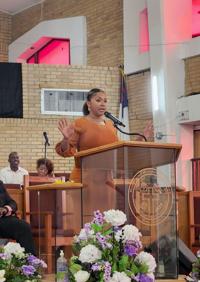
Mount Olive Primitive Baptist Church in Miami held an event to install their new pastor, allowing elected officials and candidates like Loreal Arscott to speak to the community.
(Courtesy of Loreal Arscott)
Arscott was promoted to division chief in 2011. Two years later, she had her son, Detry.
In 2015, she founded the Judicial Diversity Initiative, a coalition of all the Black bar associations in South Florida. The group was dedicated to promoting diversity on the bench.
She became an assistant city attorney for the City of Miami Gardens in 2016, where she drafted resolutions and ordinances, represented the city for land use and development matters, and held administrative hearings on issues such as red-light cameras.
In May 2019, she left her position as city attorney and opened her own law firm.
“It’s very rewarding. I’m a very zealous advocate for my clients,” Arscott says. “I’m your priest, I’m your rabbi, I’m your big sister, your mommy, I’m your therapist.”
In 2021, she was appointed chair of Miami-Dade County’s Independent Civilian Panel (ICP) by Commissioner Oliver Gilbert. The ICP was established to investigate misconduct associated with the Miami-Dade Police Department, but it was shut down by Gov. Ron DeSantis in July 2024.
She and her peers wrote letters, spoke to people, advocated to representatives, and went to Tallahassee to present arguments to the committee, but the efforts proved futile.
In 2024, Arscott ran to represent the predominantly Black District 107 in the Florida House of Representatives, but lost. She raised $45,000 and garnered a respectable 17.5% of the vote.
“A lot of people don’t even know the issues we’re facing right now in our community,” says Arscott. “Unless we organize, inform people, get them to really understand how this impacts us, we’re going to be spinning our wheels…This can’t be it, we got more work to do.”