
A half-billion dollars in sports debt at a public university should set off alarms.
Instead, in big-time college football, it barely causes a shrug.
According to a recent report by Sportico, Florida State University closed fiscal year 2025 with $437 million in athletics-related debt — a $200 million increase from the prior year and, at the time of reporting, the highest total of any public FBS program.
Even more striking, FSU’s total institutional debt for 2025 stood at $617 million. Athletics accounted for 71% of that figure.
Five years ago, FSU’s athletics debt was $17 million. In half a decade, it has increased 2,470%.
If that doesn’t force a reckoning about the economics of modern college football, what will?
The Tallahassee Democrat reported that Florida State ’s athletic leadership is insisting that $437 million is planned debt, not “survival debt.” The borrowing largely funded renovations to Doak Campbell Stadium and construction of a new football operations center. Revenue bonds. Fixed assets. Premium seating projections. Booster commitments. A long-term play.
It’s the same at Penn State, which since the Sportico story was published, has surpassed FSU as the most debt-ridden public-school athletic program in the country. The Nittany Lions have about $534.7 million in total athletics-related debt — a more than threefold increase from $163.1 million in fiscal year 2024 — primarily driven by the massive $700 million Beaver Stadium renovation project.
I get it. In theory, this is leverage; not desperation.
Universities borrow for buildings all the time. Dorms. Labs. Student centers. Why not stadiums? If those facilities generate revenue and enhance competitiveness in an era increasingly resembling professional sports, then the logic tracks.
But here’s the rub: infrastructure debt may be planned, but it’s still debt. And debt requires revenue growth. Sustained growth. Not hope. Not nostalgia. Not booster optimism.
The question is not whether the borrowing was strategic. The question is whether the underlying business model can sustain it.
We’ve heard for eons that college football is a financial engine. Television contracts. Conference payouts. Ticket sales. Merchandise. Licensing. Donations. And, yes, at the very top, it works. But beneath the surface, the economics are far less romantic.
The dirty little secret is that very few of the 130 FBS athletic departments operate in the black when factoring total revenues, expenses and debt service. Most require subsidies — direct institutional support or mandatory student fees — to survive.
At FSU, roughly 16% of athletics expenditures in FY25 were covered by campus subsidies. That’s a dramatic shift from prior years. In effect, tuition dollars and general university funds helped underwrite sports operations, including legal fees in the school’s lawsuit against the Atlantic Coast Conference.
If football is truly a self-sustaining commercial enterprise, why is it increasingly in need of academic lifelines? That college football cash cow we always hear about is starting to resemble a cash drain. When these spendthrift college ADs squeeze the udder of these so-called cash cows, there is no milk; only dust.
It’s no secret that the transformation of college football into a quasi-professional model has only intensified financial pressure. Pay-for-play, er, NIL contracts now command multi-million dollar budgets. Revenue-sharing mechanisms are expanding following legal settlements. Recruiting operates like free agency. Coaching salaries mirror NFL contracts.
In Florida, the state’s Board of Governors recently modified regulations to allow universities to loan funds internally to athletic departments to cover athlete revenue-share payments.
Pause there.
When a university must lend money to its own sports arm to cover compensation, are we still talking about a cash cow?
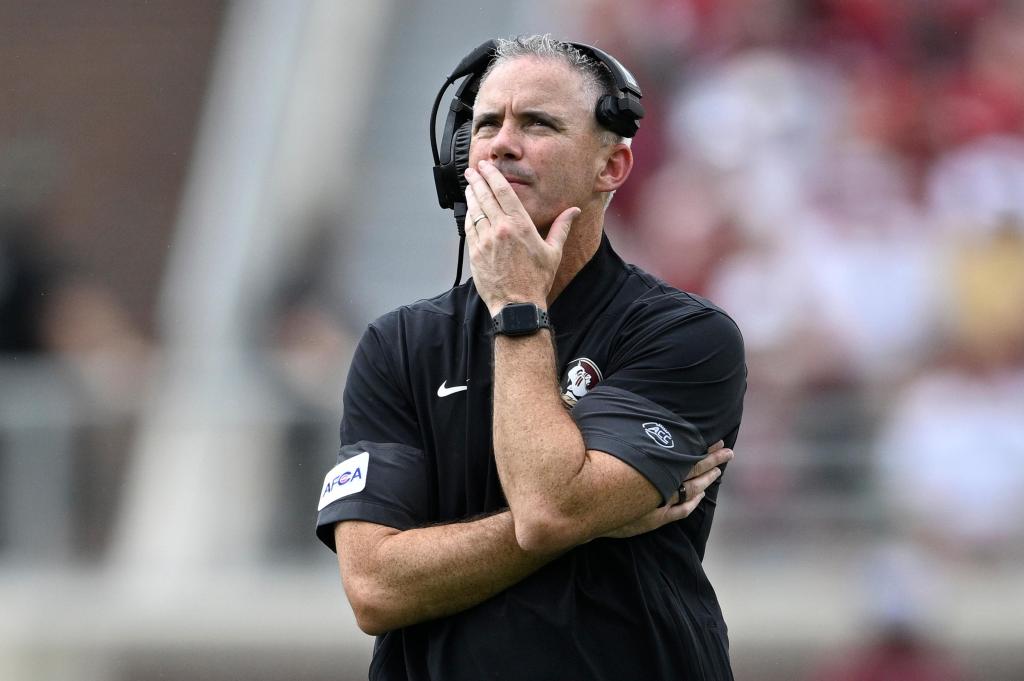
Meanwhile, buyouts have become financial landmines. FSU head coach Mike Norvell reportedly carries a buyout north of $60 million. Most believe that the only reason Norvell still has a job is because FSU would have to apply for another loan just to fire him.
When leadership decisions are constrained not by strategy but by amortization schedules, something fundamental has shifted. And here’s the thought experiment that college administrators, like FSU AD Michael Alford, are already experiencing but don’t dare to articulate publicly:
What if TV rights plateau?
What if cord-cutting accelerates?
What if donor fatigue sets in?
What if NIL collectives cannibalize traditional booster giving?
What if on-field performance dips and ticket demand softens?
Debt models assume rising revenue, but stagnant or declining revenue turns into a downward spiral of crippling debt. Exhibit A: The University of California’s long-standing stadium debt of more than $400 million illustrates how quickly ambition can become a burden. If Cal’s athletic department were a regular taxpayer instead of a university brand, the repo truck would’ve shown up a long time ago.
Meanwhile, Rutgers University recently reported a record $78 million operating deficit for the 2024-25 fiscal year. The department has accumulated roughly $500 million in total deficits since joining the Big Ten conference in 2014.
Even the big, bad, hoity-toity University of Michigan is facing significant financial pressure, requiring a $15 million subsidy from the university to balance its projected $266.3 million budget for the 2025-26 fiscal year.
We could go on and on. And these aren’t rinky-dink Group of 6 schools we’re talking about; these are proud programs from the biggest, richest conferences in the country.
The most radical question remains hypothetical: could a major public university ever shut down top-level athletics because it’s just too expensive? Today, the answer feels politically impossible. Football drives alumni engagement, brand visibility, legislative support. It occupies cultural space no marketing department could replicate.
But financially is it worth the cost?
Universities exist to educate and research. When athletics consumes 71% of institutional debt, doesn’t the state government need to at least start asking questions?
Florida State’s leadership insists its debt is strategic infrastructure investment designed to ensure long-term competitiveness in a professionalizing sport.
That may be true.
But when athletics debt grows 2,470% in five years, … when universities modify state rules to loan money for athlete compensation … when coaching buyouts resemble private equity exit packages … and when conference membership becomes a litigation battlefield, isn’t it fair to question whether the cash cow is actually producing milk?
Or whether this cow has turned into a pig?
Because pigs, you see, don’t produce milk.
They just devour whatever is put in front of them and then squeal for more.
Email me at mbianchi@orlandosentinel.com. Hit me up on social media @BianchiWrites and listen to my new radio show “Game On” every weekday from 3 to 6 p.m. on FM 96.9, AM 740 and 969TheGame.com/listen