
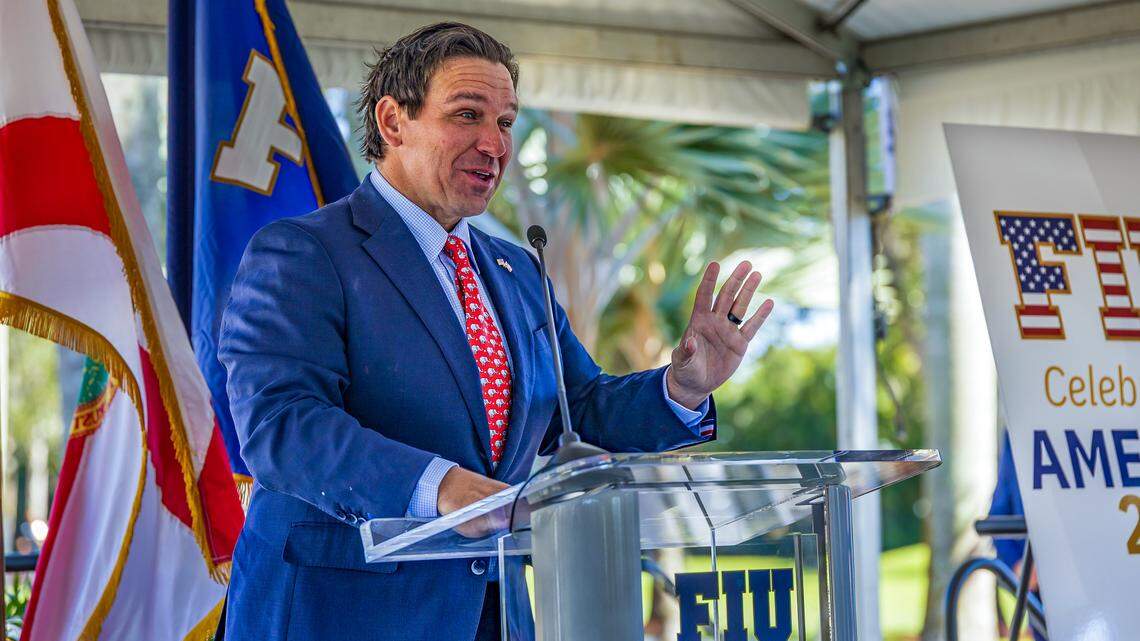
Florida Gov. Ron DeSantis speaks during the unveiling ceremony of a statue of former President Ronald Reagan at Florida International University on Feb. 6, 2026.
Pedro Portal
pportal@miamiherald.com
Gov. Ron DeSantis may be on his way out the door, but his culture wars live on. There’s another round brewing in Tallahassee.
Once again, lawmakers, pushed by the governor, are going after DEI (diversity, equity and inclusion) at the local level. A bill under consideration by the Legislature would prohibit cities and counties from funding, promoting or taking official actions relating to DEI.
Crucially, the legislation would allow the governor to remove anyone from office who violates these provisions. This kind of power should be reserved for the most serious offenses committed by local officials, such as corruption, not for funding LGBTQ+ pride parades.
This is an overly broad and vague bill that could have enormous implications for local government, which are already facing a potential crisis if property taxes are repealed — as DeSantis wants.
And it’s a power grab by a governor who won’t be in power much longer. DeSantis, who is term-limited, will leave office at the end of this year, something lawmakers should remember.
Senate Bill 1134 is so alarming to local officials that the entire Miami Beach City Commission sent a letter of concern to the governor and leaders of the House and Senate. The bill, the letter said, is so expansive it could interfere with all sorts of programs and activities and could be seen “as prohibiting the most basic and routine actions of local governments.” It would restrict the ability of local officials to respond to the needs of their constituents, the letter said.
The letter raised a litany of serious concerns about just how far this bill could reach. Would a municipality be prohibited from funding an event at the South Florida Hispanic Chamber of Commerce? What about the Jewish Film Festival? Would mammogram screenings be prohibited because they are aimed at women? What about professional mentorship for women or Cuban exile history programs?
It’s hard to tell because the bill is leaves so much open to interpretation. Vagueness seems to be the default with culture war bills: Scare city and county officials with the threat of removal from office, and they will censure themselves by pulling support from any type of cultural program that a resident or activist might call DEI. The point seems to be to have them looking over the shoulder with every decision cities and counties make.
Miami Beach officials weren’t alone in raising the alarm. Miami-Dade Commissioner Vicki Lopez — a Republican and former member of the state House — said last week the bill could restrict the county from issuing grants to nonprofits that represent Hispanic businesses or staff county boards such as the Black Affairs Advisory Board.
The bill could hit Miami-Dade hard, she noted. “That would mean things like the Hispanic Chamber of Commerce,” Lopez said.
Concern isn’t limited to South Florida, either. In St. Petersburg, Mayor Ken Welch said the city is urging state lawmakers to consider the “broad economic, social, and legal consequences” of the bill. And in Orlando, there was concern among local leaders that the bill could affect the development of a permanent memorial outside Pulse, the former gay nightclub where 49 people were killed in 2016. There’s a carve out in the bill for monuments and memorials to honor individuals or groups but what about programming at the site itself? Would that be a violation of this proposed law?
The proposal, which is sponsored by Sen. Clay Yarborough in the Senate and by Rep. Dean Black in the House — both are Republicans from Jacksonville — would also allow people to sue local governments if they believe they are breaking this law. That could spur a lot of costly lawsuits that taxpayers would have to pay to defend against.
A similar bill failed to get traction last year. This year, though, the proposal has DeSantis’ support. That’s no surprise. He’s leaned heavily on anti-DEI sentiment for years: In January, he said “Florida has led the nation on DEI elimination.”
It’s legacy-building time for the governor as he looks for a political path forward. But local governments shouldn’t have to pay the price for a governor’s ambitions.
BEHIND THE STORY MORE What’s an editorial?
Editorials are opinion pieces that reflect the views of the Miami Herald Editorial Board, a group of opinion journalists that operates separately from the Miami Herald newsroom. Miami Herald Editorial Board members are: opinion editor Amy Driscoll and editorial writers Isadora Rangel and Mary Anna Mancuso. Read more by clicking the arrow in the upper right.
What’s the difference between an op-ed and a column?
Op-Eds, short for “opposite the editorial page,” are opinion pieces written by contributors who are not affiliated with our Editorial Board.
Columns are recurring opinion pieces that represent the views of staff columnists that regularly appear on the op-ed page.
How does the Miami Herald Editorial Board decide what to write about?
The Editorial Board, made up of experienced opinion journalists, primarily addresses local and state issues that affect South Florida residents. Each board member has an area of focus, such as education, COVID or local government policy. Board members meet daily and bring up an array of topics for discussion. Once a topic is fully discussed, board members will further report the issue, interviewing stakeholders and others involved and affected, so that the board can present the most informed opinion possible. We strive to provide our community with thought leadership that advocates for policies and priorities that strengthen our communities. Our editorials promote social justice, fairness in economic, educational and social opportunities and an end to systemic racism and inequality. The Editorial Board is separate from the reporters and editors of the Miami Herald newsroom.
How can I contribute to the Miami Herald Opinion section?
The Editorial Board accepts op-ed submissions of 650-700 words from community members who want to argue a specific viewpoint or idea that is relevant to our area. You can email an op-ed submission to oped@miamiherald.com. We also accept 150-word letters to the editor from readers who want to offer their points of view on current issues. For more information on how to submit a letter, go here.