
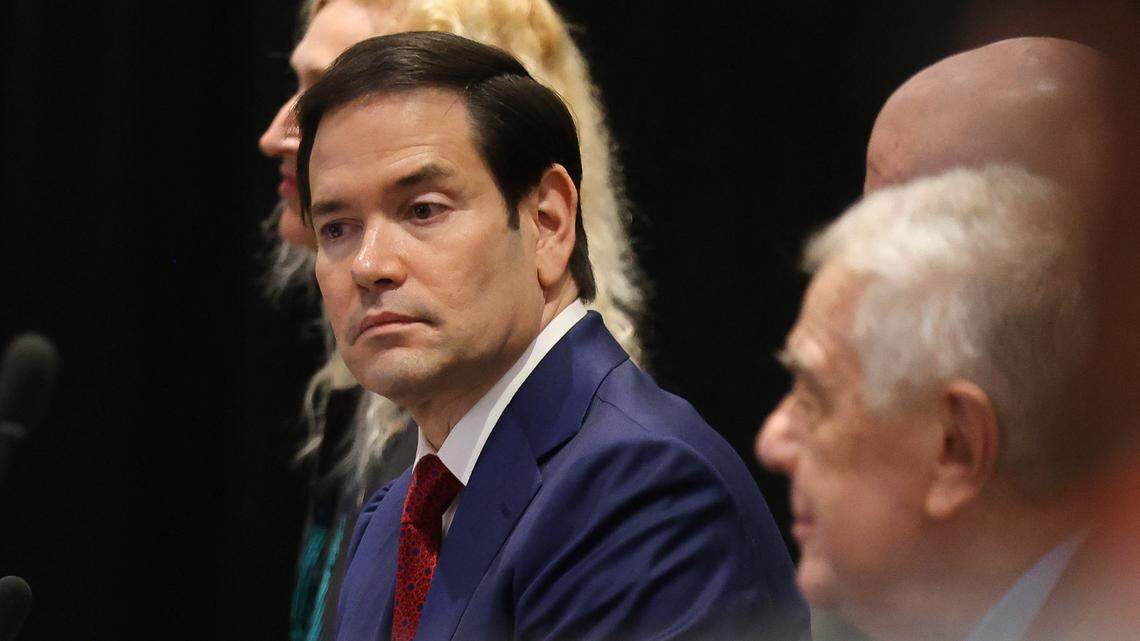
Secretary of State Marco Rubio attended a meeting with Caribbean Community leaders in Saint Kitts and Nevis on Feb. 25, 2026. Rubio met with Caribbean leaders seeking a common line on Venezuela and pressure on Cuba.
JONATHAN ERNST
POOL/AFP via Getty Images
Four people shot by the Cuban coast guard. A growing sense of outrage in Miami. Claims by the Cuban government that it was defending its sovereignty or responding to a threat in territorial waters.
The horrific news on Wednesday of four people killed in on a Florida-registered speed boat just off the Cuban coast brought back undeniable echoes from the past.
How could anyone who was in Miami back then forget? It was almost 30 years ago to the day — on Feb. 24, 1996 — that two unarmed Brothers to the Rescue planes were shot down by the Cuban military, killing four civilians from a South Florida-based humanitarian group that was distributing fliers in Cuba. The Cuban government ordered the airstrikes claiming the planes had violated their airspace, although others said the planes were in international airspace.
The effect of the shoot-down, which came at a time of escalating tensions between the U.S. and Cuba, was seismic in Miami. It remains a historic flashpoint in Cuba-U.S. relations. And the anger has not gone away. South Florida’s Cuban-American members of Congress just this week asked the Trump administration to prosecute Raúl Castro for the shoot-down, which they consider an act of terrorism.
Now we have the news — from the Cuban government itself — that it exchanged gunfire on Wednesday with the Florida-flagged speedboat that it said had entered its waters, killing four and wounding at least six others. The boat was part of a flotilla to get relatives out of Cuba, a U.S. official told the New York Times.
The Cuban government said the boat came within one nautical mile of its coast and when Cuban troops on a government boat approached to ask for identification, the occupants of the Florida boat opened fire, wounding a Cuban commander: “As a result of the confrontation, at the time of this report, four foreign attackers were killed and six were wounded.”
The shooting comes as tensions between the U.S. and Cuba have soared once again. U.S. authorities have been focusing on Cuba since the Jan. 3 capture of Venezuela’s Nicolás Maduro, threatening new international interventions in a variety of countries but especially Cuba.
The Trump administration has stopped oil shipments from Venezuela and Mexico to Cuba and has started conversations with Castro’s grandson, Raúl Guillermo Rodríguez Castro, to negotiate economic and political changes on the island, perhaps an effort to make Cuba dependent on the United States.
The increased focus on Cuba probably has a lot to do with Secretary of State Marco Rubio, a Miamian and former Florida U.S. senator whose parents are Cuban immigrants. He has made no secret of the fact that he would like to see the end of the Cuban regime. Just one day after Maduro’s capture, Rubio said in a press conference, “If I lived in Havana and I was in the government, I’d be concerned.”
We don’t know the full picture of what happened in Wednesday’s shooting. The Cuban government issued a statement that said it was reaffirming its “commitment to protecting its territorial waters, based on the principle that national defense is a fundamental pillar for the Cuban State in order to protect its sovereignty and stability in the region.”
But U.S. Rep. Carlos Gimenez, a Miami Republican, wasted no time Wednesday in calling for an investigation of the shooting near the Villa Clara coast, saying on X that the “regime in Cuba must be relegated to the dustbin of history for its countless crimes against humanity.”
He did sound one note of caution, wisely, saying that the U.S. government must determine “whether any of the victims were U.S. citizens or legal residents and establish exactly what occurred.”
The U.S. relationship with Cuba is like no other. And in Miami, memories are long. Even as we wait for U.S. authorities to provide more information — and full transparency —about this latest tragedy, we cannot forget what came before.
BEHIND THE STORY MORE What’s an editorial?
Editorials are opinion pieces that reflect the views of the Miami Herald Editorial Board, a group of opinion journalists that operates separately from the Miami Herald newsroom. Miami Herald Editorial Board members are: opinion editor Amy Driscoll and editorial writers Isadora Rangel and Mary Anna Mancuso. Read more by clicking the arrow in the upper right.
What’s the difference between an op-ed and a column?
Op-Eds, short for “opposite the editorial page,” are opinion pieces written by contributors who are not affiliated with our Editorial Board.
Columns are recurring opinion pieces that represent the views of staff columnists that regularly appear on the op-ed page.
How does the Miami Herald Editorial Board decide what to write about?
The Editorial Board, made up of experienced opinion journalists, primarily addresses local and state issues that affect South Florida residents. Each board member has an area of focus, such as education, COVID or local government policy. Board members meet daily and bring up an array of topics for discussion. Once a topic is fully discussed, board members will further report the issue, interviewing stakeholders and others involved and affected, so that the board can present the most informed opinion possible. We strive to provide our community with thought leadership that advocates for policies and priorities that strengthen our communities. Our editorials promote social justice, fairness in economic, educational and social opportunities and an end to systemic racism and inequality. The Editorial Board is separate from the reporters and editors of the Miami Herald newsroom.
How can I contribute to the Miami Herald Opinion section?
The Editorial Board accepts op-ed submissions of 650-700 words from community members who want to argue a specific viewpoint or idea that is relevant to our area. You can email an op-ed submission to oped@miamiherald.com. We also accept 150-word letters to the editor from readers who want to offer their points of view on current issues. For more information on how to submit a letter, go here.