
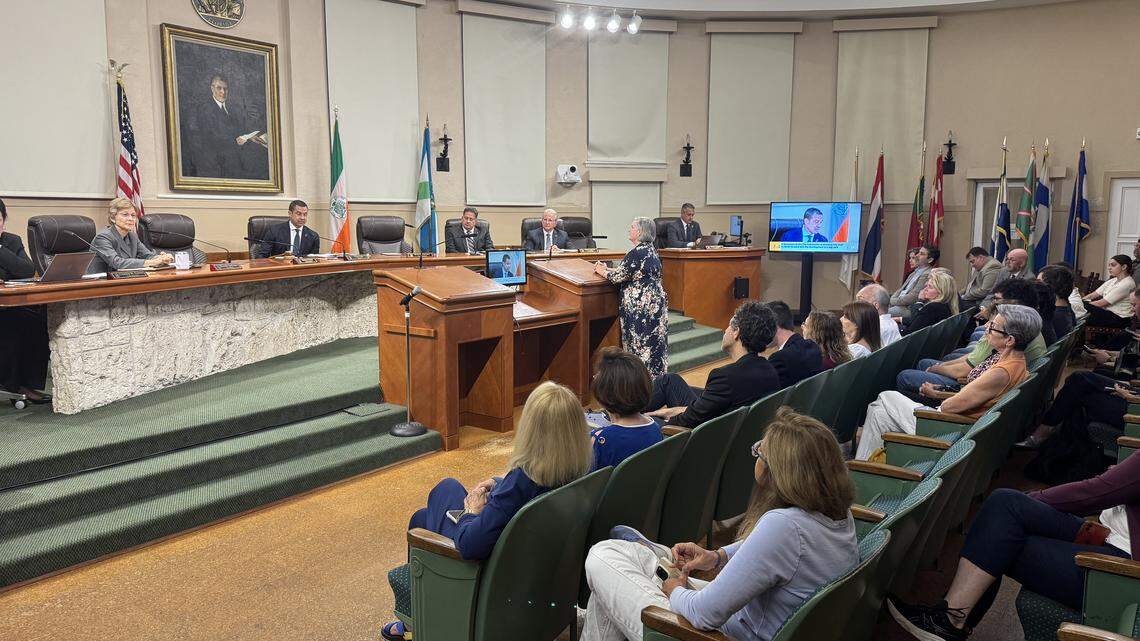
Deena Bell-Llewellyn, assistant director for Coral Gables Greenspace Management Division of Public Works, tells commissioners the proposed plans for a dog park near the city’s library on Tuesday, Nov. 18, 2025.
Michelle Marchante
mmarchante@miamiherald.com
A group of disgruntled neighbors are taking the city of Coral Gables to court over an already-approved dog park that they say will negatively impact property values, reduce access to green space and cause parking chaos.
The group claims that the city, through Vice Mayor Rhonda Anderson, worked “behind the scenes” to ensure that only supporters would be present for the Nov. 18 dog park approval vote and that it sidestepped existing city and county zoning laws that prohibit standalone off-leash dog parks.
The lawsuit was filed earlier this month in Miami-Dade Circuit Court by Gables resident Jose Val Cohen, who lives across from the planned dog park, and the University Green Neighbors Association, a nonprofit formed by residents ahead of the city’s February meeting to discuss design plans for the site at 520 University Drive, adjacent to the Coral Gables public library.
Anderson, who sponsored the resolution to create the dog park, in last month’s city meeting stated that there “was broad support” for the park. She told the Miami Herald on Monday that the allegations in the lawsuit were “false statements.”
A spokesperson told the Herald that the city has not yet been served with the suit.
“The city is aware of the lawsuit and is confident in the actions taken,” the city said in a statement.
Here’s what you need to know:
The lawsuit allegations
The more than 20-page lawsuit raises three main issues with the approved dog park:
1. The city allegedly did not properly notify residents in a timely manner about the proposed dog park. The suit alleges that only dog park supporters knew about the Nov. 18 meeting and that opponents did not know about the proposal until after the vote.
Anderson “deliberately avoided contacting” residents on Cadima Avenue, Harlano Street, University Drive, Segovia Street and Riviera Drive that she knew would not support a dog park in the area ahead of the Nov. 18 meeting, the lawsuit alleges.
The suit claims that Anderson in 2024 told residents that the city would not pursue a dog park in the area due to lack of support. Residents who are part of the lawsuit say they were unaware that a dog park was back on the table and say the city did not notify residents with a reasonable amount of time about the proposal.
The group argues that while the city gave “meaningful advance notice and encouragement” to dog park supporters about the meeting, known opponents were “supposed to scour the agenda items of the City on a virtual daily basis in the off chance that the City might try to build a bark park.”
Anderson, meanwhile, told the Herald that residents had “contacted me and said they were interested in pursuing the dog park,” and said that she told them to gather support, and if there was enough support, she would put it on the agenda for a vote.
“Which I did,” she said.
“There were no directions by me on who to see, who not to see,” she added.
2. The property is not zoned to be a dog park. Since 1972, the grassy area has been zoned as overflow parking for the nearby public library and Coral Gables War Memorial Youth Center, with restrictions to ensure it remains as an accessible green space for nearby residents, according to the lawsuit. The ordinance associated with the land’s zoning also has a provision that would revert it back to a single-family residence designation if the city determined that overflow parking was no longer needed, the lawsuit states.
3. The commission should have voted on an ordinance, not a resolution. The lawsuit alleges that the city “acted without authority to amend, repeal, or otherwise alter existing zoning and enact a new zoning category” through the use of a resolution, which only requires a one-time majority vote, instead of an ordinance, which would require two separate readings in front of the commission, along with a 10-day public notice prior to the vote.
When was the dog park approved?
Mayor Vince Lago, Vice Mayor Rhonda Anderson and Commissioner Richard Lara in November gave the green light to create the dog-friendly park after seeing overwhelming support from residents who packed the commission chambers, an unusual sight at City Hall, noting that there were over 225 petition signatures in support.
In January, the chambers were once again packed with residents. This time, it was from a group of people who said they were blindsided during the process and were never asked for input, including some who live across from the future park site.
“We did not circumvent the process,” Lago told residents at the meeting.
Anderson, Lago and Lara held firm on their previous vote to approve the dog park plans. The three shut down Commissioner Melissa Castro’s proposal to rescind the dog park approval until more discussions were held with residents. Lago also asked the city to host a town hall with residents to discuss the park’s design plans.
That meeting was held earlier this month.
Why do residents oppose or support the dog park?
The lawsuit alleges that residents like Val Cohen “will suffer direct economic harm” from the dog park, including through lower property values.
It also states that residents will lose a “crucial buffer zone” that “currently protects their homes from noise, traffic and frequent activity on University by the Coral Gables Library and Youth Center.” Residents who oppose the dog park also raised health, noise and parking-related concerns during the January meeting.
The initial design plan that was presented at the commission meeting does include a 25-foot native tree and landscape buffer that is meant to act as a physical barrier.
Mary Powell, who spearheaded petition efforts to get the park, has previously described the addition of a neighborhood dog park as a “quality of life improvement.”
Like the vice mayor, Powell has said that traffic and parking should not be an issue because the park is intended for people who live within walking distance to the park.
“It’s important for golfers to have a golf course. It’s important for children to have their own play areas. It’s important for dogs to have their own parks,” Powell told the Herald after the November vote.

Miami Herald
Michelle Marchante covers the pulse of healthcare in South Florida and also the City of Coral Gables. Before that, she covered the COVID-19 pandemic, hurricanes, crime, education, entertainment and other topics in South Florida for the Herald as a breaking news reporter. She recently won first place in the health reporting category in the 2025 Sunshine State Awards for her coverage of Steward Health’s bankruptcy. An investigative series about the abrupt closure of a Miami heart transplant program led Michelle and her colleagues to be recognized as finalists in two 2024 Florida Sunshine State Award categories. She also won second place in the 73rd annual Green Eyeshade Awards for her consumer-focused healthcare stories and was part of the team of reporters who won a 2022 Pulitzer Prize for the Miami Herald’s breaking news coverage of the Surfside building collapse. Michelle graduated with honors from Florida International University and was a 2025 National Press Foundation Covering Workplace Mental Health fellow and a 2020-2021 Poynter-Koch Media & Journalism fellow.
Support my work with a digital subscription