
Construction crews continue crafting the metallic skeleton of the six-story Crimson Crossing student housing complex — which will likely become the Florida Institute of Technology’s most-visible landmark to the surrounding Melbourne-Palm Bay community.
And Crimson Crossing represents the first structure of a potential wave of buildings that — if funded and built sometime in the future — would expand and modernize Florida Tech’s 130-acre campus.
This master-planning vision includes an elevated pedestrian bridge spanning Babcock Street. A student welcome center, replacing the Mobil gas station at the University Boulevard intersection. And a new on-campus home for the Nathan M. Bisk College of Business.
Crimson Crossing: Florida Tech future six-story, 556-bed student housing complex to open in August 2026
Backdrop: Florida Tech enrollment is on the rise. Fall-semester enrollment of traditional and online students has increased from 7,863 students in 2019 to 10,021 students this academic year.
“With that kind of growth, we need more housing. And we are at full capacity in our housing right now,” President John Nicklow said, gesturing at a livecam view of the Crimson Crossing construction site on a monitor inside a Miller Building conference room.
“So this opening Aug. 26 is really vital to continue our growth. And it’s the first part of our master plan,” Nicklow said.
After starting work as Florida Tech’s sixth permanent president in July 2023, Nicklow announced plans to launch a master plan to assess campus infrastructure as part of a broader “Forward Together, Boundless Potential” strategic initiative.
The university partnered with Credo, a national architectural firm, and created a multi-phase campus master plan. Florida Tech officials have launched a campus master plan page on the university website that showcases artist’s renderings of possible future buildings — which are not yet tied to fundraising or financing. Among the highlights:
The student welcome center, serving as “a front door to campus” housing admissions, registrar, financial aid, academic support and other functions.
A research and innovation “hive,” across Babcock Street from Crimson Commons.
The elevated pedestrian bridge just north of University Boulevard, which would connect both aforementioned buildings. On Wednesday, Oct. 22, the Florida Tech Board of Trustees Finance Committee recommended spending up to $5.9 million on the project. The full board will vote on the bridge Oct. 30.
A new home for the Bisk College of Business between Evans Library and the Miller Building. The business college is located close to ½-mile north of campus.
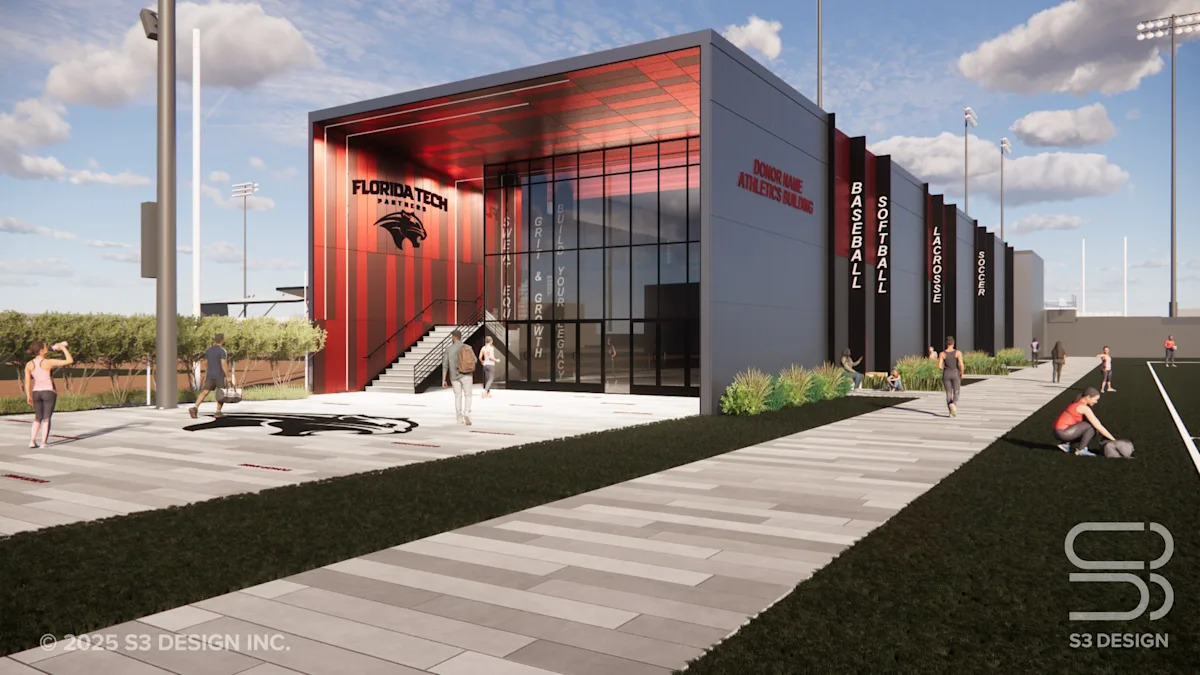
An athletics fieldhouse between Andy Seminick-Les Hall Field and Rick Stottler Field.
More student housing, a psychology building, more parking spaces and an addition to the Gleason Performing Arts Center.
“What does this campus look like in 20 years? From an engineering perspective, that’s important, I think. Because if you’re patchworking things together over time, then nothing looks consistent and you end up with a fragmented layout,” Nicklow said.
“So if we have an ultimate vision in mind, then we stepwise that and we go on a phased approach,” he said.
Student enrollment up 27% since 2019
Florida Tech officials say the student-housing supply of 2,048 beds is strained to capacity at the Melbourne campus. The past seven years, fall semester in-person and online enrollment has increased more than 27%, according to data submitted to the federal Integrated Postsecondary Education Data System:
That seven-year span covered the COVID-19 pandemic, two permanent presidents, an interim president and an acting president. During some previous years, Florida Tech officials publicly reported enrollment totals as high as 16,000 that were actually “students served,” a metric that is not kept in official university records.
More data sets: “First-time in college” students at Florida Tech have jumped from 702 in fall 2019 to 1,007 this fall. And the IPEDS fall-to-fall retention rate increased from 79.8% in fall 2024 to 83.3% this fall.
“That means more of our students are sticking around. They’re voting with their feet. They’re coming back,” Nicklow said.
This data does not include the Burrell College of Osteopathic Medicine, the Space Coast’s first osteopathic medical school based at the L3 Harris Commons building. The first class of future physicians debuted in July 2024, and students have access to campus housing, libraries, dining services, health and fitness facilities.
Crimson Crossing construction well underway
Meanwhile, construction crews are installing yellow exterior wall panels at the 84-foot-tall Crimson Crossing residence hall, which is scheduled to open in August.
“As a civil engineer, I get really excited when I see all that steel. It’s like an Erector Set,” Nicklow said.
Construction kicked off March 31 on the $96.1 million residence hall, which will house 556 beds and boost on-campus housing space by 27%. By comparison, the Columbia Village freshman complex contains about 350 beds, while seven-story Roberts Hall has 250 beds.
Most Crimson Crossing students will live in three-bedroom and four-bedroom suites with two bathrooms and full kitchens.
Florida Tech joins state space research group
Looking ahead, Florida Tech has joined the Florida University Space Research Consortium in partnership with NASA’s Kennedy Space Center. This organization debuted in November 2024 with three members: the University of Florida, University of Central Florida and Embry-Riddle Aeronautical University.
Florida Tech is a new member alongside Florida State University, the University of South Florida and Florida International University. The expanded group will foster “interdisciplinary and cross-university research in spaceflight, space engineering, human spaceflight, astrobiology, astronomy and the wide range of associated sciences.”
“We’ve asked (KSC) the question, ‘What kind of expertise are you looking for collaborations?’ They gave us some areas, and we also took an inventory of areas of our research for Kennedy Space Center,” said John Z. Kiss, Florida Tech’s provost and senior vice president for academic affairs.
“And that’s very good. But I think leveraging it with this larger entity, the Florida University Space Research Consortium and the partners in that, is very exciting,” Kiss said.
Rick Neale is a Space Reporter at FLORIDA TODAY. Contact Neale at Rneale@floridatoday.com. Twitter/X: @RickNeale1
This article originally appeared on Florida Today: Florida Tech planning campus expansion over 20-year span in Melbourne