
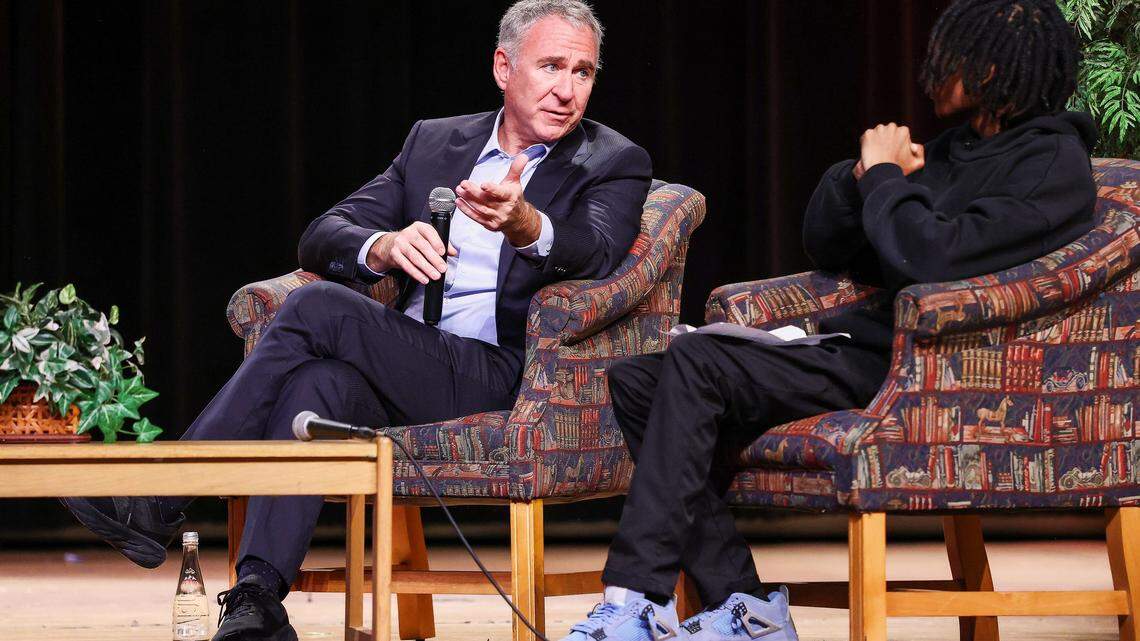
Billionaire Ken Griffin, left, answers Sebastian Mejia’s question as he speaks to students during an assembly at Booker T. Washington Senior High School in Miami.
Carl Juste
cjuste@miamiherald.com
After teaching a lesson on billionaire investor Ken Griffin, Booker T. Washington Senior High teacher Malik Padgett decided to take a chance and reached out to Griffin’s firm, Citadel, to see if the financier might speak to his students. To his surprise, the company replied with a yes.
Griffin took the stage at the Overtown high school on Tuesday for a wide-ranging conversation about money, artificial intelligence and opportunity, joined on stage by Padgett and students SkyyLynn Windhauser and Sebastian Mejia.
Since purchasing a $75 million Miami home on Star Island in December 2021, Griffin moved his global hedge fund Citadel to South Florida and began getting involved in the community. He has since donated millions to local charities, established Partnership for Miami, a group of prominent local leaders who come together to solve social issues, and gotten involved in Florida’s school choice movement by lobbying to bring Success Academy charter schools to Miami.
Griffin, whose net worth since starting Citadel in 1990 has grown to $51 billion, offered students advice on finances and told them that young people should avoid credit card debt and learn the importance of investing.
Ken Griffin, third from left, during his visit to Booker T. Washington Senior High School. Carl Juste cjuste@miamiherald.com
“Entrepreneurs really are the life of the American business community,” Griffin said. “Many of you in this room are going to be future entrepreneurs. You’re going to have an idea and a business that you will create, and you’re going to make that happen.”
The audience reaction was mixed. Some attendees appeared unfamiliar with Griffin, while others listened quietly and reservedly.
Jacob McLeroy, a 10th grader who took Padgett’s class, had been following Griffin’s work for some time. McLeroy, a Miami Shores native, asked Griffin what he did to grow his fortune over the years.
“You’ll see a lot of people with thousands or millions of dollars,” he said. “I wanted to know what he was doing that helped him pass thousands and millions and make it into the billions.”
Sophomore Jacob McLeroy, 16, asks a question to billionaire Ken Griffin during an assembly at Booker T. Washington Senior High School. Carl Juste cjuste@miamiherald.com
Griffin responded to McLeroy’s question with the example of a pro football player, noting that young people often spend too much money in a short period of time. To avoid that, Griffin believes that planning is essential for accumulation of wealth.
“There’s something to be said for deferred gratification,” Griffin said. “There’s something to be said for thinking about 30 or 40 years down the road and to make sure that you’re setting aside money for that moment in your life.”
In response to Padgett’s question about gentrification and Miami’s changing economy, Griffin spoke glowingly about Miami’s future. Even though tech layoffs have affected an industry that was considered highly stable, Griffin believes those jobs will play a vital part in Miami’s future.
“Everybody in this room has a much better chance of landing a really well-paying job in this city today than ten years ago,” he said. “The most important thing we can keep in mind is that as this city becomes more prosperous, the number of us in this room who will call Miami home in the prime of our careers, will increase.”
Windhauser asked Griffin about the challenges that artificial intelligence (AI) can present to workers. Griffin emphasized the need to learn how AI can improve one’s work so that a person can stay competitive in the job market.
Ken Griffin, third from left, answers questions from student SkyyLynn Windhauser, left, teacher Malik Padgett, and student Sebastian Mejia, right, during his visit to Booker T. Washington Senior High School. Carl Juste cjuste@miamiherald.com
“I think you need to think very clearly about how AI will transform this field, and where I want to go in this field with the threat of AI transformation happening,” he said.
Griffin believes that there is a continued strengthening of the economy and that there is a “need to solve for the issue of higher housing prices” that can be addressed by building more houses and condos. Roads can also be improved and he also believes that self-driving cars will improve the quality of life for Miami residents, though he did not say how.
“Autonomous vehicles will help tremendously,” he said.
As hundreds of students filed out of the auditorium and back to class, their chatter filled the room before gradually tapering off.
Moments like this underscore Griffin’s growing presence in Miami and his efforts to invest in the city’s next generation.
This story was originally published February 24, 2026 at 3:56 PM.
 Cropped.jpg)
Miami Herald
Michael Butler writes about minority business and trends that affect marginalized professionals in South Florida. As a business reporter for the Miami Herald, he tells inclusive stories that reflect South Florida’s diversity. Just like Miami’s diverse population, Butler, a Temple University graduate, has both local roots and a Panamanian heritage.