
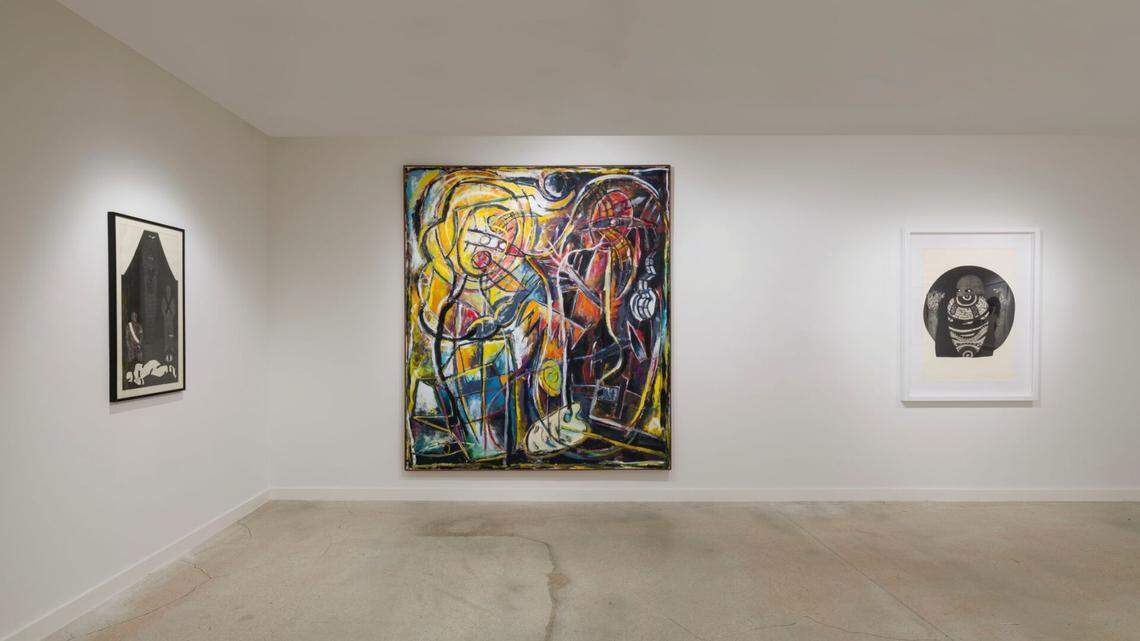
Two of the most significant artists of 20th-century Cuba are being brought together for the first time at Freedom Tower.
Carlos Alfonzo and Belkis Ayón, who each gained art world acclaim outside of Cuba before dying young, are the dual subject of the latest exhibition at the Museum of Art and Design (MOAD) at Miami Dade College, which is headquartered in the downtown landmark.
The exhibition, titled “Carlos Alfonzo and Belkis Ayón: Odyssey,” pairs expressive abstract paintings on canvas and paper by Alfonzo with Ayón’s signature collagraph prints featuring imagery and iconography sourced from the Afro-Cuban Abakuá fraternal religious order.
A painting by Alfonzo,”Thirst,” next to a print by Ayón depicting a woman removing a mask. Alfonzo’s painting exemplifies his darker later work from the time before he died of complications from AIDS. (Photo by Oriol Tarridas, courtesy of MOAD)
Both Alfonzo and Ayón have seen reappraisal in recent years: Alfonzo received retrospectives at the Pérez Art Museum Miami in 2016 and the Institute of Contemporary Art, Miami in 2022, while Ayón’s art world reputation has soared ever since a traveling exhibition in 2016. LnS Gallery and David Castillo, two local galleries that represent the estates of Alfonzo and Ayón, respectively, have also mounted solo shows for the two artists.
Those familiar with both artists and their sharp stylistic differences may find themselves confused by such a pairing. At first glance, Ayón’s moody figurations and dark, muted colors feel a world away from Alfonzo’s energetic and bold abstract scenes.
“Odyssey” is MOAD’s second presentation at Freedom Tower since the building debuted a sleek renovation. (Photo by Oriol Tarridas, courtesy of MOAD)
But Amy Galpin, the museum’s executive director and chief curator, explains that the two have more in common than one might expect. The curator points to a mutual interest in mythology, both of the Western Greco-Roman tradition and of Afro-Cuban origins, as well as influences from European and Cuban art shared among the two artists.
“I thought it would be interesting to pair them together and maybe surprise people a bit,” says Galpin. “I hope that when people come to the show, if they’re skeptical, they might be surprised by the connections that they see in their work.”
The show is the museum’s second presentation at Freedom Tower since the building debuted a sleek renovation. The historic landmark now hosts new interactive galleries highlighting its onetime role as the Cuban Refugee Center, as well as a soccer-themed exhibition presented by the FIFA Museum ahead of the 2026 World Cup. While those exhibitions are fixed, the MOAD gallery features changing exhibitions.
Three collography works by Belkis Ayón. The artist lived in Havana until her death in 1999. (Photo by Oriol Tarridas, courtesy of MOAD)
MOAD’s programming thus far has tied into the historical overtones of its home, with an initial group show focusing on migration. “Odyssey” likewise ties into the national origin of its subjects and their journeys outside of Cuba. Alfonzo exiled himself to the U.S. during the Mariel Boatlift in 1980, while Ayón traveled out of the country for residencies and exhibitions while maintaining residency on the island.
“The title of the show is Odyssey, and (it) was chosen because both artists were aware of Greek myth, and very complex storytelling is at the core of both of their works,” says Galpin. “But this notion of journeys too, I think is really a big part of our exhibits…(and) that is a bit of a connection here, this notion of movement, of journeys. I think also resiliency, both artists experienced challenges in their lives and in their work and being committed to what they wanted to make and getting recognition for that.”
Two works on paper by Carlos Alfonzo, each titled “Self Portrait.” The artist migrated to Miami during the Mariel boatlift in 1980. (Photo by Oriol Tarridas, courtesy of MOAD)
Alfonzo’s work in particular reflects those struggles. After leaving Cuba during the Mariel Boatlift, Alfonzo settled in Miami and began developing his career and practice. He earned public art commissions, including murals at the Santa Clara Metrorail Station and at Florida International University that are still on view. His work became darker as he struggled with AIDS, eventually passing away in 1991 shortly before appearing in the Whitney Biennial.
Two works in the show from this era speak to the artist’s state of mind at the time. “Circolo #1” (1990) features geometric shapes and circular lines in white and grey against a black backdrop, with a composition recalling a hurricane spiral and, alternately, a human skull. “Thirst” (1986), a more chaotic earlier canvas in which a swirl of abstracted bodies attack each other with knives and arrows, meditates on the human propensity towards violence.
Carlos Alfonzo (1950–1991), “Circolo #1.” Oil on canvas, 1990, 60 x 60 inches. Collection of Craig Robins. (Photo by Oriol Tarridas, courtesy of MOAD)
Both works come from the collection of Craig Robins, the property developer and arts patron most famous for revitalizing the Miami Design District. The two were friends during the artist’s lifetime, and Robins speaks fondly of their relationship.
“I was thrilled to be able to help him have a studio space during his first years in Miami,” Robins says. “That was a special time in Miami Beach, and my friendship with Carlos was an exciting component of it all. I would visit him in his studio almost daily, and we spent hours there talking about art and life. He helped forge my sensibility towards art and artists – I am forever indebted to him.”
If you go:
WHAT: “Carlos Alfonzo and Belkis Ayón: Odyssey”
WHERE: Museum of Art and Design at Miami Dade College, Freedom Tower, 600 Biscayne Blvd., Miami.
WHEN: 10 a.m. to 6 p.m. Wednesday through Sunday. Through May 10, 2026.
COST: $18 for general admission; $14 for seniors; $12 for students with ID and children ages 7-18; free for MDC students and employees with ID, children 6 and under, active U.S. military and veterans, and disabled visitors and caregivers.
INFORMATION: 305-237-7700 and moadmdc.org
ArtburstMiami.com is a nonprofit media source for the arts featuring fresh and original stories by writers dedicated to theater, dance, visual arts, film, music and more. Don’t miss a story at www.artburstmiami.com