
St. Petersburg’s annual Downtown St. Pete Development Summit took place Tuesday, outlining residential, workforce, transportation and industry trends, accompanied by panels of speakers who do not just talk about St. Pete’s future but actively shape it. Here are some of the major highlights from the 2026 summit.
Overview: population, residential, office and income statistics
Part of measuring Downtown St. Pete’s current and projected efficacy is what one speaker called “confidence in St. Pete via repeated investment.” That confidence is measured through actions like restaurant groups returning for another concept, office tenants expanding rather than shrinking and business retention, like ARK Invest, highlighted during panel discussions, planting institutional roots. Other businesses across sectors maintaining or growing their downtown footprint add to that signal.
Downtown supports approximately 1.7 million square feet of office space, with 66% classified as Class A. Average asking rent sits near $37 per square foot, and vacancy hovers around 9%. Notably, downtown has not delivered a major multi-tenant office tower since 1990, a drought now being addressed by projects in the development pipeline.
Employment growth follows that investment. Nearly 39,700 employees work downtown. Five supersectors, health services, finance and professional services, leisure and hospitality, government and science, comprise roughly 85% of those jobs. Since 2020, overall job growth downtown has risen more than 15%, with retail job growth alone increasing over 50%, significantly outpacing citywide trends.
More than 170,000 students are enrolled in postsecondary institutions in close proximity to downtown. And Florida consistently ranks among the top states for higher education outcomes, creating a steady, capable workforce stream, available to tap.
The issue is not supply. It is retention. If housing options do not match lifestyle and affordability, graduates leave for competing metros.
Downtown’s population has grown roughly 11% since 2020, now totaling 18,500 residents with a median age of 43. That breakdown is reflected in development patterns: approximately 64% rental, 32% condo and 4% townhome. Median income downtown sits just under $70,000, while owner-occupied households report substantially higher median incomes. Renter incomes have steadily trended upward since 2019, according to the city data.
The population boom, however, has informed development-types, which is overrepresented by residential developments. The result has strengthened vibrancy and activity, but at the expense of office space. Office and hotel projects in the pipeline, including the first major commercial office towers in decades, may recalibrate a more diversified downtown in the coming years.
Developer panel discussion, investment theses
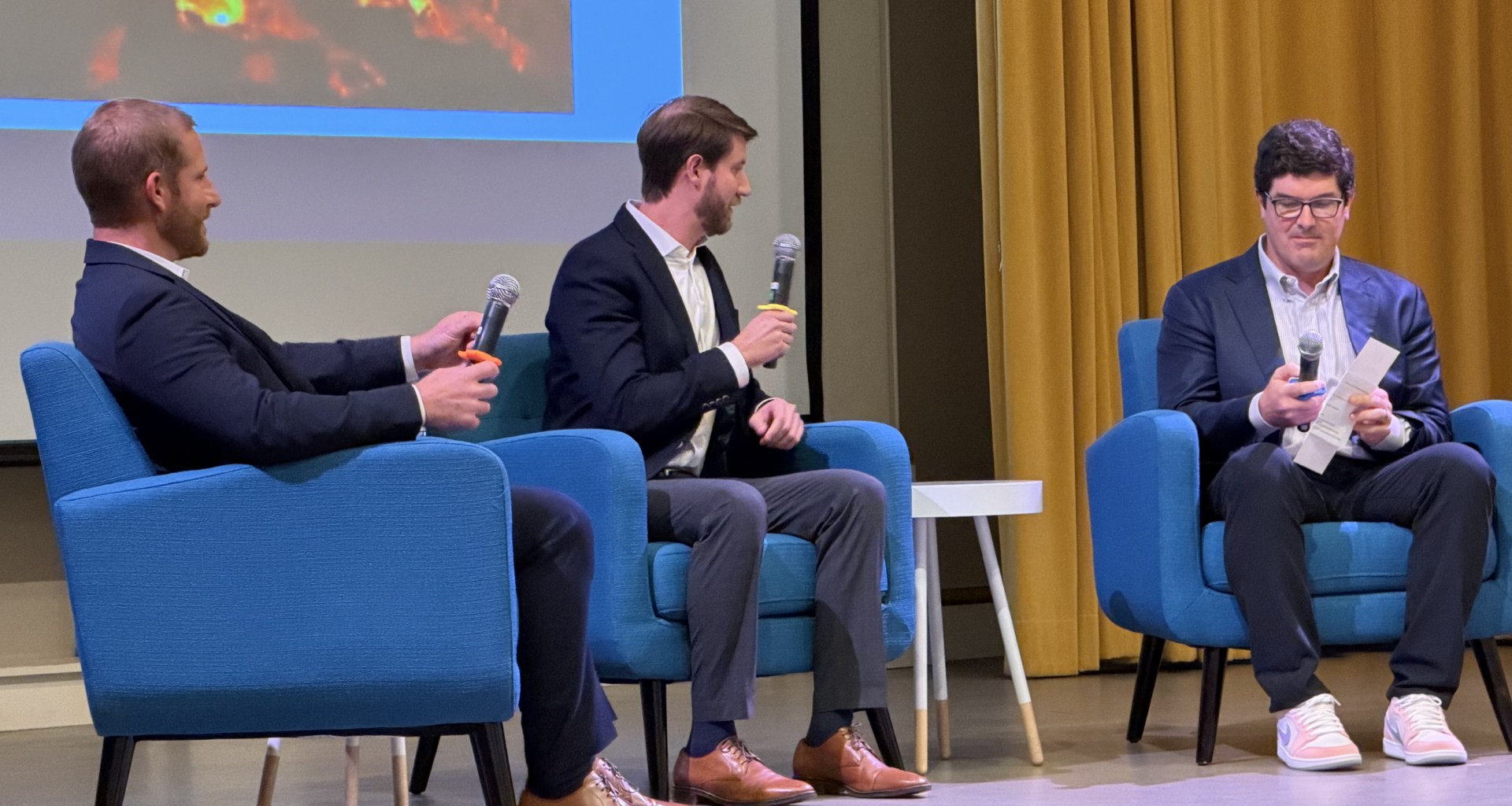
A panel consisting of Peter Van Warner and Cole Sones – both developers with Blake Investment Partners – alongside Will Conroy of Backstreets Capital, discussed the trajectory of downtown development over the past year and where it may be headed next.
“Why do we do what we do?” Conroy asked.
Warner laughed. “That’s a question my wife asks me every day. But the truth is it’s pretty cool. These buildings will be here 100 years – much longer than any of us.”
The discussion then shifted to a central question: Why do some developments move forward while others do not?
Warner explained that projects tend to fall into two primary “buckets.” The first is construction escalation – inflation in material costs, labor shortages and supply chain delays – all of which squeeze margins and chip away at profitability. The second bucket is interest rates. Rates recently climbed as high as 8 percent, creating serious friction in financing. While they have cooled, developers are watching closely, hopeful they settle closer to 4 percent where projects become more feasible.
Conroy pointed to another pressure point – land costs. As land values rise, so too does the baseline needed to make a project pencil. Referencing an early waterfront acquisition in the Innovation District, he noted that condo pricing once modeled in the “high fours” per square foot is no longer realistic. “You can barely build a foundation for four hundred dollars a foot right now,” he said, illustrating how dramatically input costs have shifted. “As stewards of this city we have to be thoughtful about how that comes together.”
Sones added that most projects in St. Pete involve outside capital – whether from within the city or beyond it – and convincing investors has grown more complicated. “Before, development was easy,” he said. “You built a building, it generated a return, you sold the building and the investor made a profit.”
Now, he said, things are far less predictable. Interest rates, uncertain exit pricing and fluctuating valuations make underwriting more complex. Developers are not just building for a quick sale. In many cases, they must be prepared to hold projects for years – even decades – depending on how the market evolves.
Transit development: SunRunner overlay
Transportation infrastructure is increasingly shaping where and how density occurs. The SunRunner Bus Rapid Transit overlay introduces a Transit-Oriented Development (TOD) framework within a quarter-mile of designated stations.
Within these zones, projects may reach up to 5.0 FAR with bonuses, parking minimums may be reduced or eliminated, and height allowances can extend up to 150 feet in select areas. The overlay reflects a broader shift toward walkability and reduced car dependency.
Public hearings on the overlay and related zoning adjustments are scheduled through May 2026, signaling that implementation is moving from concept to action. If adopted, these corridors are expected to absorb much of the next wave of vertical growth.
Condo market trends
Development pricing illustrates the trajectory of Downtown’s growth. In 2018, projects averaged roughly $600 per square foot. By 2023, that figure rose to approximately $750 PSF. In 2025, new developments are averaging between $950 and $1,000 PSF, with Waldorf Astoria units approaching $1,500 PSF.
In 2025:
Average sold price per square foot reached $824
The highest new construction sale approached $4.94 million
The highest resale exceeded $6.99 million
Closed sales increased 57% year-over-year
Listings increased 72%
Average PPSF rose 2.2%
Despite expanded inventory, pricing has remained resilient – suggesting that demand has kept pace with supply.
Districts to eye
Beyond the traditional downtown core area – where acquisition challenges and elevated pricing limit opportunity – several surrounding districts are poised for evolution as density increases and population and development sprawl.
Districts to eye:
The Gas Plant District remains one of the most significant long-term redevelopment opportunities, with major programming and RFP processes underway.
The EDGE District continues expanding as a retail and hospitality hub, offering comparatively more accessible entry points for investment.
Mirror Lake is experiencing moderate but meaningful growth that may reshape perceptions of that submarket.
Meanwhile, Salt Creek is seeing increased density and consolidation of property ownership, setting the stage for the emergence of a more defined neighborhood identity.