
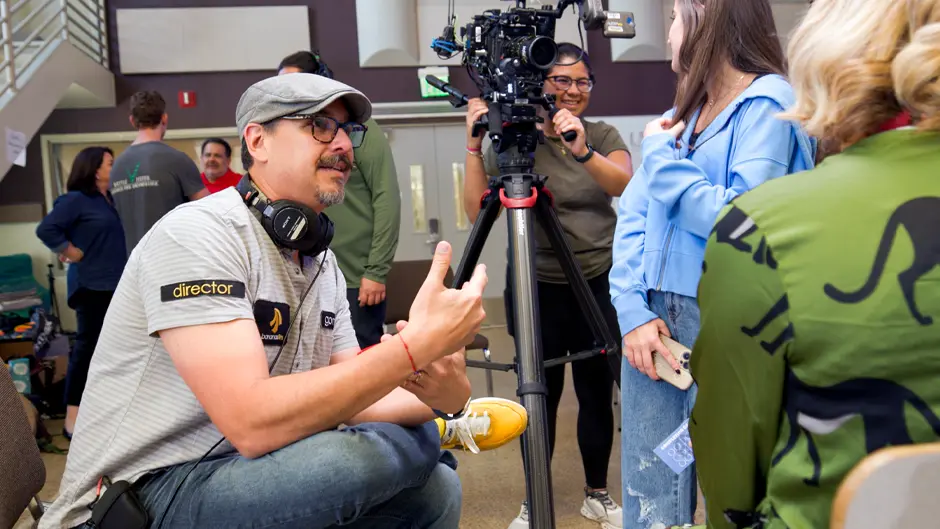
Transplanted from Ecuador where he’d grown up and with little more than a dream in his head, Gonzalo Mejia began his undergraduate studies at the University of Miami by making a vow: “I will craft a feature film before graduating.”
That dream took two decades, a multitude of detours, and painstaking persistance while pursuing his M.F.A in filmmaking, yet has triumphantly manifested in “Por la Vida,” a bilingual movie filmed in large part on the University’s Coral Gables Campus.
“I was just 18 and didn’t have much direction when I arrived, but I made it my conviction and goal in life to make a feature film,” said Mejia, director of production services for the Frost School of Music.
“My best friend would later tell me—‘What do you mean? You always wanted to be a filmmaker. Don’t you remember how you watched MTV videos all day long and you were always talking about techniques?’—I guess everybody knew but me,” Mejia joked.
 The son of an Ecuadorian father and Cuban mother, Mejia was born in Tampa, Florida, yet moved with his family to Ecuador at just two weeks old.
“In Ecuador, a Third World country in many ways, filmmaking wasn’t ever one of those things that you see as a career or a way to make a living,” Mejia said. “Everybody needs to be a doctor, a lawyer, or a banker—like my father was. I wasn’t an odd child, but I was creative and never felt like I fit in, always a fish out of water.”
With his Ecuadorian high school diploma in hand, he followed his sister, already studying architecture at the University, to Miami. He took a few classes in film and met some filmmakers in his first semester and decided: “OK, cool, this is what I’ll do.”
Mejia earned his undergraduate degree in 2000 in what is today cinematic arts, merging film and video.
“I always said that when I started college I was kind of naive, and in college is where I became smart,” Mejia said. “I learned a ton—all the film editing skills, image composition—everything that to this day is the base for my work. And the most important were my connections with my professors, many of whom I’ve kept in touch with over the years.”
Still the idea of a making a film glimmered on a far distant horizon.
 “Video was just becoming popular back then, but making a movie was still ‘go to Hollywood, pitch an idea, make a pilot’—that’s how it worked. So I focused on video and at the end of the day it worked out because of the technology. Today everything is video,” he explained.
He spent the next few years after graduation moving back and forth between Miami and Ecuador for work, a stint with Univision, and then the Discovery Channel and production work in Ecuador. In the midst of it, a friend who aspired to be a sports journalist invited him on an adventure.
“Ecuador was playing in the upcoming World Cup against Italy, Croatia, and Mexico, and since I’m the only filmmaker he knows, he said, ‘Let’s make one TV show per country.’ At 23, my pre-fontal cortex wasn’t very developed, so I quit my job and said ‘OK cool, let’s go.”
The duo traveled and interviewed some of the top footballers in the world, and the show did well enough. He moved back to Ecuador and spent five years doing advertising until, nagged by his conscience to become a filmmaker, he headed to New York City, seeking gigs as a production assistant. But the Big Apple proved too expensive, so he moved then to Atlanta where his sister lived, again doing jobs in the industry.
When the Ecuadorian government passed new laws that all media production needed to be done by Ecuadorians, he got that passport and headed back. He pitched a slough of ideas, but none prospered. Still, he’d formed a production company doing commercials and web content and was doing well enough until, in 2016, an earthquake rocked the country.
“By then I’d married, had adopted two daughters, and suddenly time stood still—there was no work. I got scared and starting calling contacts back in Miami,” Mejia recounted.
One of his favorite professors, Ali Habashi, who had traveled to Ecuador assisted by Mejia on several occasions for his own filmmaking, told him about an opening at the Frost School. He was hired to manage the school’s production work and has been there for the past 10 years.
“But again, I’m always pursuing a movie and so think if I’m at UM and enroll for the M.F.A., I can make a movie. And I won’t leave the program until I have one,” he noted.
Along with making three narrative shorts and a documentary, he’s been working on the film for the seven years he’s been in the program. The script has evolved, the characters’ roles have shifted, but the main theme—the relationship of a dad and his daughter—has remained solid.
“Just as writers are told to ‘write what you know,’ I’ve followed the same guide. Family dynamics is at the heart of my work, and one thing that I set myself to do is to move emotions through film,” he said.
“As a man living in a household with three women, I’ve clashed a bit, would always say the darnest things or say things at the worst time possible, have these arguments—a household of drama,” Mejia explained. “There are a lot of mom stories, though not a lot about dads. As fathers, we’re all flawed, and I’ve certainly made my share of mistakes.”
But, as in his own life, he highlighted that the dad-and-daughter bond can be incredibly strong, a relationship he explored in “Por la Vida.”
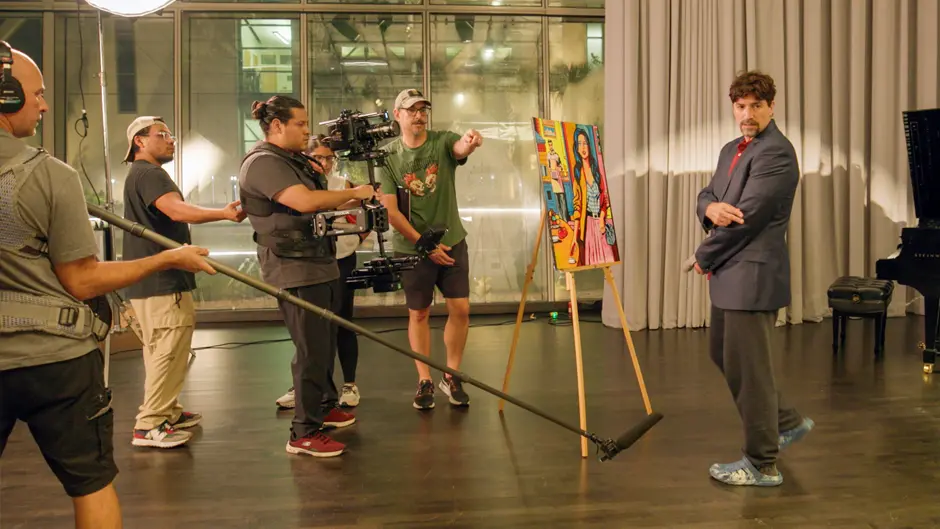
The “100 percent bilingual” 87-minute indie film was shot primarily on or nearby campus.
“I showed it to some Frost staff last December, and they were all laughing so hard to see all the recognizable locations,” he said.
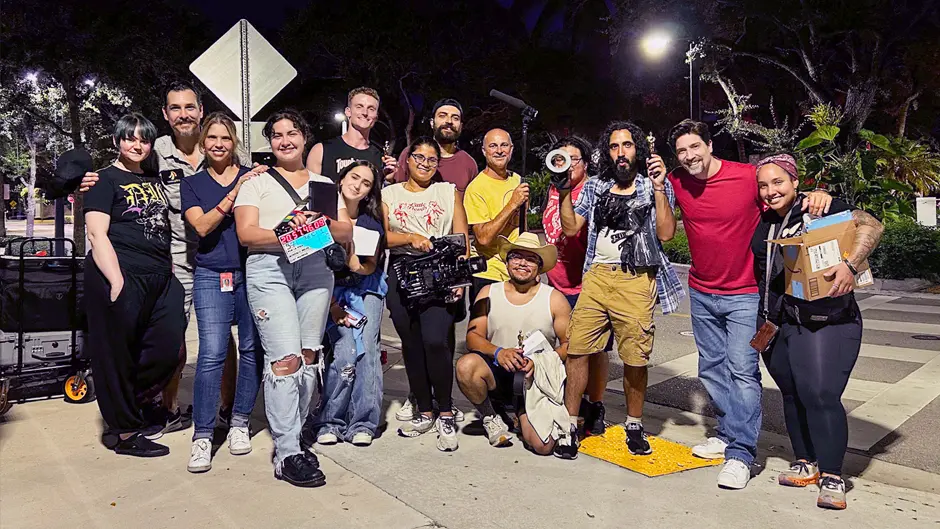
Mejia credited his thesis chair, Rechna Varma, for mentoring him throughout his degree and other program professors for their expertise as well. Friend and Frost School alumnus Austin Hammonds produced the music score, and Catherine Mairena, a University employee who also earned her M.F.A., served as director of photography.
Mejia fortuitously landed well-known Hispanic TV actor David Chocarro for the lead male role and Eleny Reyes, from the Backstage actors portal, for the daughter lead. His wife, Daniela, a professional event planner, is the executive producer of the film and has been tremendously supportive of his filmmaking and career goals.
“The film came naturally and solidified as the years passed; I realized this is the type of film I want to do,” Mejia said. “It’s just like my life here. I speak to my daughters in Spanish, and they speak to me in English.
“A number of the students from my film program were on the set. They’re all in their 20s—I’m much older—and they were laughing as we were shooting scenes, saying, ‘Oh, my God, it’s just like my mom and dad.’”
“Por la Vida,” produced by Bananas Films, premieres in April in a local film festival.