
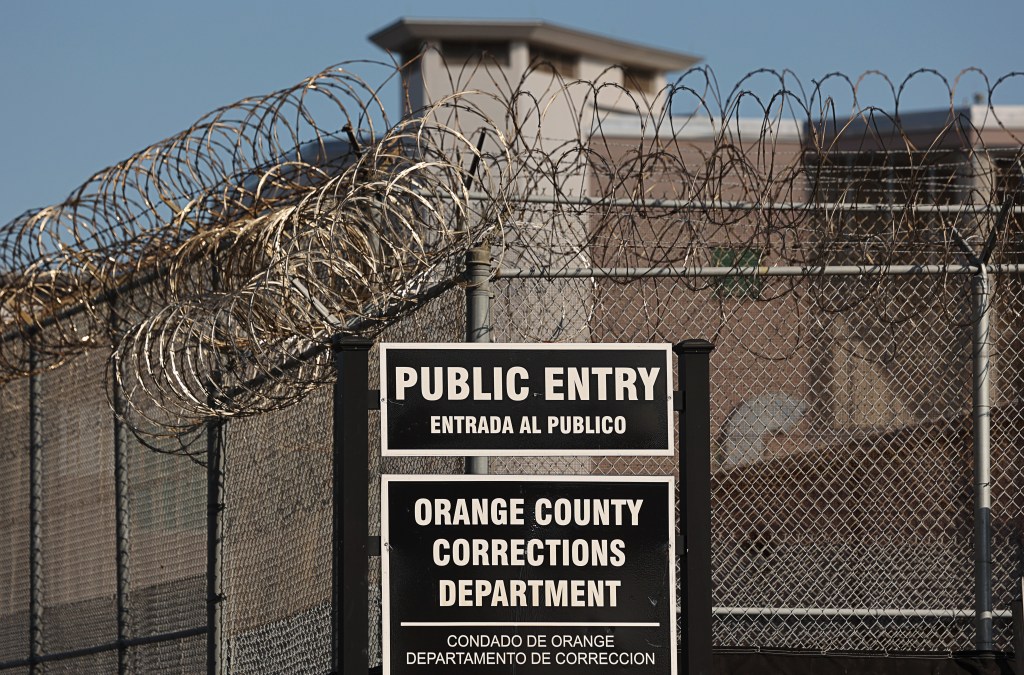
The tidal wave of undocumented people booked into the Orange County Jail without criminal charges has dropped dramatically following a letter from Mayor Jerry Demings to ICE officials setting new rules for the feds.
An average of 142 people per day were detained at the jail without criminal charges in January, according to jail records. That number dipped to 48 in February – a nearly 200% decrease.
 Orange County Mayor Jerry L. Demings speaks during the groundbreaking ceremony for Ivey Flats, a 137-unit affordable apartment community, on Tuesday, Sept. 23, 2025. (Ricardo Ramirez Buxeda/Orlando Sentinel)
In addition, no ICE detainee was booked into the jail more than once in February, a county official said, after Demings said he would close the loophole Immigration and Customs Enforcement was abusing in recent months that led to detainees being booked and re-booked multiple times.
Holding federal immigration detainees was straining Orange County resources, Demings and others said, because ICE does not fully reimburse the jail’s costs and because its re-booking practice meant people who should have been at the jail no more than three days ended up there for three weeks or more.
But federal officials seem to have complied with the mayor’s demand that its practices change.
“Even though the mayor’s letter clearly gave them the date of March 1, ICE was immediately responsive within days,” said Danny Banks, Orange County’s Public Safety Director. “The numbers have gone way down and they’ve stayed consistent.”
Demings sent the letter on Feb. 3 to Norman Bradley, ICE’s Assistant Field Office Director based in Orlando, informing him the jail would cap the number of detainees to 66 men and 64 women and no longer accept people booked more than once on non-criminal charges.
On the day of Demings’ letter, jail data shows there 134 people held with only an ICE detainer and no criminal charges. By Feb. 6 it had dipped to 39, and fluctuated between 30 and 60 for much of the month. On Feb. 23, the count was just nine.
Banks said ending the rebooking loophole was a key in bringing the count down to a level that doesn’t strain jail staffing and resources.
Under the county’s long-held agreement with the feds, the jail is free to release detainees after 72 hours if ICE hasn’t taken them into custody. But to prolong somebody’s stay at the jail, ICE would pick up a detainee just before their time was up, drive them around and bring them back hours later with a fresh 72-hour timeline.
In January, more than two-thirds of ICE-related bookings were people booked more than once, Banks said.
“Clearly, they’ve changed their logistics program to be sending them somewhere else,” he added.
The rebooking maneuver, which was first revealed by the Orlando Sentinel last summer, was a challenge for families to keep track of the location of their loved ones. It also tested jail resources as it kept people incarcerated far longer than they were supposed to, Demings wrote in his Feb. 3 letter.
“This practice strains OCCD resources, disrupts workflow, and circumvents the intended operation of the agreement,” he wrote. “We believe these measures are necessary to preserve safe operations, ensure appropriate allocation of staffing and space, and maintain an efficient jail environment for Orange County residents while continuing to support federal immigration enforcement within the parameters of the IGSA.”
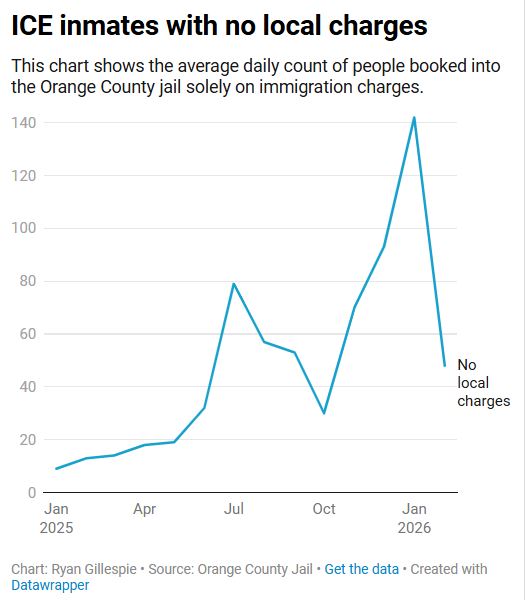 The number of inmates booked into the Orange County Jail on solely immigration charges took a steep decline in February.
Through court filings, the Orlando Sentinel can detail the clearest picture yet as to how ICE shuffled people around to keep them in the county jail longer.
Reynel Bautista-Anzola was detained for 24 days using the loophole, as opposed to the three days the county’s Intergovernmental Service Agreement calls for.
He was first booked into the “Orlando Hold Room” – which is thought to be the ICE facility at 9495 Delegates Drive – on the afternoon of Jan. 12. Bautista, of Colombia, was arrested in Jacksonville with no criminal record. After five hours at the facility, he was taken to the Orange County Jail that evening for the first time.
He stayed there until Jan. 14, when he was taken back to the “Orlando Hold Room.” Later that evening he was taken back to the Orange County Jail for three more days.
He was apparently taken from the jail at 6:30 p.m. on Jan. 17 and then rebooked again 45 minutes later.
On Jan. 20, he was booked again into “Orlando Hold Room” for six hours before being taken back into the jail for three more days.
On Jan. 23, he spent about nine hours at “Orlando Hold Room” and was booked back into the jail that night until Jan. 26.
On that day, he spent two more hours at “Orlando Hold Room” before being taken back to jail one more time. Ultimately, a federal judge released the Colombian national from custody on Feb. 9, as he awaited an asylum hearing.
County Commissioner Mayra Uribe said ending rebookings was a key factor in bringing down the jail numbers.
“I think those numbers were inflated because of how many rebookings there were,” County Commissioner Mayra Uribe said. “I thought, honestly, when that letter went out, I thought we were going to get pushback.”
The county remains in negotiations with the Trump administration in the hopes of increasing its reimbursement for housing federal inmates and detainees at the jail. The county is paid $88 per day per inmate, compared to its costs of $180 per day to house them, they say. Those negotiations are expected to run through March.
ICE is also considering purchasing a warehouse in east Orlando to convert into a processing center. Such a facility is part of a plan to drastically increase detention space across the country and could be an alternative to booking detainees at the jail.