
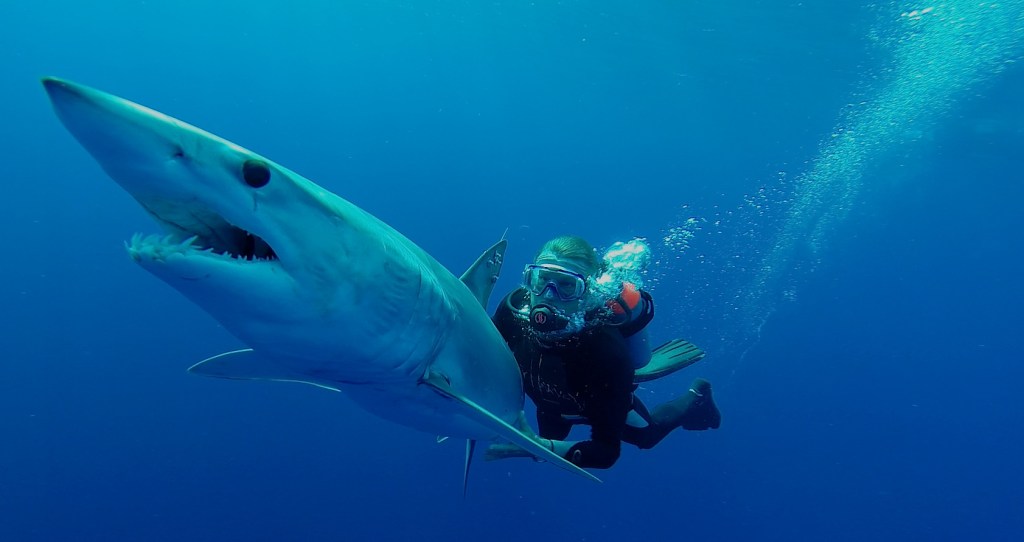
It’s been 40 years since Guy Harvey printed the first T-shirt of a marlin at an Oakland Park shop that would spark a multimillion-dollar apparel business and support his other mission at the Guy Harvey Foundation.
An artist whose marine-themed work can be found on a roller coaster, cruise ship, Florida license plate and in art galleries, the 70-year-old conservationist is the subject of “Guy Harvey: The Documentary” by Emmy-winning director Nick Nanton. The new film has two screenings as part of the Fort Lauderdale International Film Festival, which ends this weekend.
In advance of these screenings, Harvey answered a few questions from his home on Grand Cayman during an interview that’s been edited for clarity and brevity.
‘A Caribbean person’
Harvey seems to be everywhere in South Florida, from his retail locations to the Guy Harvey Oceanographic Research Center at Nova Southeastern University in Davie. But while he has an office in Fort Lauderdale, he’s never actually lived here. Why did he first come to Florida?
I’m very much a Caribbean person. I love my island. Our family’s been in Jamaica since the 1660s, as farmers, cattle farmers mostly. I grew up with parents who loved the outdoors, hunting, fishing, all the rest of it,” he says.
“Back in the early ’80s, we restarted some of the fishing tournaments after the Michael Manley years in Jamaica, when the entire middle class left the country because of his … principles, so to speak. We got the tournaments going and, of course, a lot of people from Florida came to fish. And I would try and sell up these little 12-by-10 oil paintings of a marlin jumping and stuff like that, for like $15 to $20. And some guys saw it and said, ‘Hey, I know a guy in Florida who could really use your art.’
“And that’s how I got to Florida, through all the connections in the fishing world. Scott Boyd of Boyd’s Tackle Shop, Kaye Pearson from the Fort Lauderdale International Boat Show. He gave me a berth in the show in 1986 and I never looked back.
“My hobby became my profession over a period of time, and I gave up academia to follow the business, but then went back into it in the late ’90s through Nova Southeastern University. So the connections have been very strong ever since. I have art in Fort Lauderdale, but I commute back and forth. It’s just an hour away.”
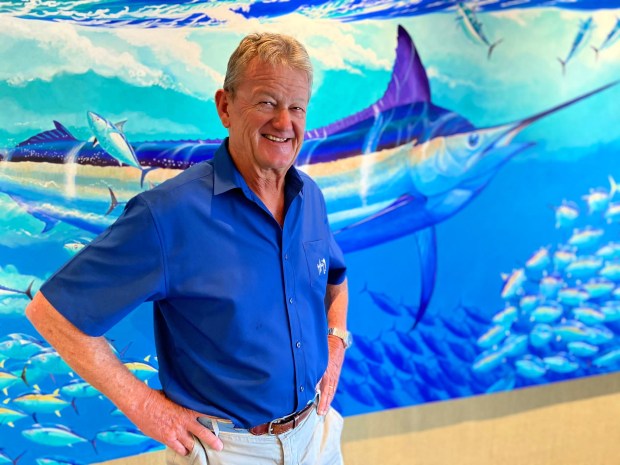 Artist and marine conservationist Guy Harvey has been infatuated with the blue marlin since boyhood. (FLIFF/Courtesy)
Drawn to Hemingway
Harvey’s career as a visual artist began with words, when his mother, a naturalist and artist, gave him a copy of Ernest Hemingway’s “The Old Man and the Sea.” He still has that copy in his office. What was so inspirational about that book?
“We grew up fishing in western Jamaica, with people who caught big fish from small boats. And Hemingway wrote so eloquently about the blue marlin, the fish with which I was really infatuated then at the age of 12, 13, 14, and now, of course,” he says.
“By the time I was 16, having read the book many times, from a copy that didn’t have any illustrations, by the way, I said, ‘I can illustrate this book for them.’ Then I found an older copy, with illustrations done by two British line artists. And, to be honest with you, the accuracy of the marlin was awful, and I said, ‘I can do a much better job at this.’
Between high school and university, I was 17 and 18 years old, I did 44 drawings to cover the entire book. I did nothing with them. I just executed it as something to do. And 10 years later, we got it into an art gallery in Kingston, Jamaica, as the basis of my first one-man art show. So it kind of ignited the whole opportunity to become a full-time marine wildlife artist. … Those pen-and-ink illustrations are right now on display in Key West, at the Custom House Museum.”
Science vs. art
Harvey is an artist who happens to have a Ph.D. in fisheries biology and a mission to educate. How do those things interact?
“First and foremost, I think the importance is in the execution of the art. I began as a fish illustrator, if you like. Many people have commented on the, they use the word ‘accuracy,’ but I prefer ‘authenticity’ of the work, because they are very lifelike. You know, accurate scale counts, fin ray counts, etc.
“I’ve studied that all my life and that knowledge of the anatomy, the physiology and, of course, the ecology of the animal is the basic building block to composing a realistic reenactment of the life history of a marlin or a shark or a tuna and portraying it to the public,” he says.
“I started out in only pen-and-ink doing these detailed illustrations, but the subject matter are large. They’re large fish. They’re large marine creatures. So I graduated to canvas to have a bigger format, and nowadays I’m just as comfortable doing 20-foot-long canvases as I am doing 6-inch watercolors.
His artist idol
Harvey is one of the most popular and prolific wildlife artists in the world. Does he have any artist idols himself?
“Oh, yes, it’s hard not to have them,” Harvey says. “One in particular is Kent Ullberg from Sweden. He lives in Corpus Christi, Texas, and is probably America’s most famous wildlife sculptor. I met Kent back in 1987 when he was installing the big statue by the Fort Lauderdale Convention Center, “Sailfish in Three Stages of Ascending.” … We became very good friends. Even though he works in metal, whether it’s bronze or stainless steel or whatever, and I’ve never been a sculptor, he really influenced how I painted.”
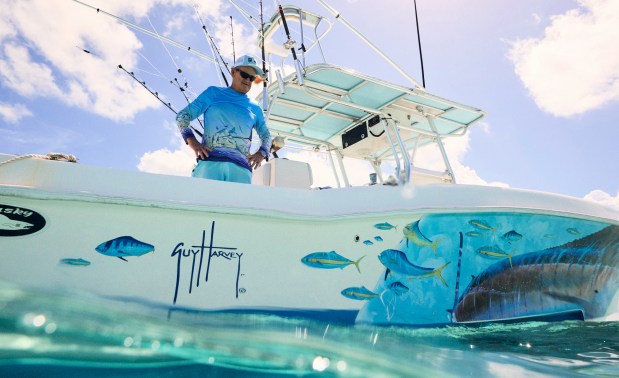 Guy Harvey, in a scene from “Guy Harvey: The Documentary,” is concerned about the future of the world’s oceans and the creatures in it. (FLIFF/Courtesy)
Ocean trends ‘very scary’
In the documentary, Harvey speaks about ocean conservation and says, “Time is running out.” As a species, does he think we are winning or losing the fight to protect the health of the sea and its inhabitants?
“We have to remain hopeful. I would say, while there are pockets of abundance in the ocean in different places, overall the picture is gloomy,” he says. “Because there are so many people consuming marine life in many different ways, shapes and forms.
“Which is why we made the pivot back in the year of the pandemic to go into marine-science education, to reach out to the kids. Having generated hundreds of hours of great video content of marine life underwater through our different TV shows, different documentaries, we turned them into short-format snippets for educating kids.
“While we extract marine life to consume, there has to be education of people about how valuable marine life is, the fact that marine life should be treated as wildlife and not really to be consumed in the way that it is. We must spend more effort in research of economical fish farming, rather than consuming wild animals.
“When you think about it, everything we eat, just about, is farmed, packaged, made available to you, except for fish. We’ve got to improve on that. I’ve seen some devastating impacts on reef destruction, fish destruction, populations gone in my lifetime, which is very scary.
“Experts reckon we need to have 30% of the oceans protected in order to accommodate the amount of exploitation. You’ve got to have protections in place while you’re exploiting resources. [Currently] shockingly little, maybe 2% to 3%, of the world’s oceans are protected. It’s just astounding how slow it’s been for legislators in different countries to get together to have more of a consensus about what to do.”
“Guy Harvey: The Documentary” is screening at 6:30 p.m. Saturday (sold out) at the Museum of Discovery & Science, 401 SW Second St., Fort Lauderdale, and 2 p.m. Sunday at Savor Cinema, 503 SE Sixth St., Fort Lauderdale. Tickets for Sunday’s show are $13. Visit FLIFF.com.