
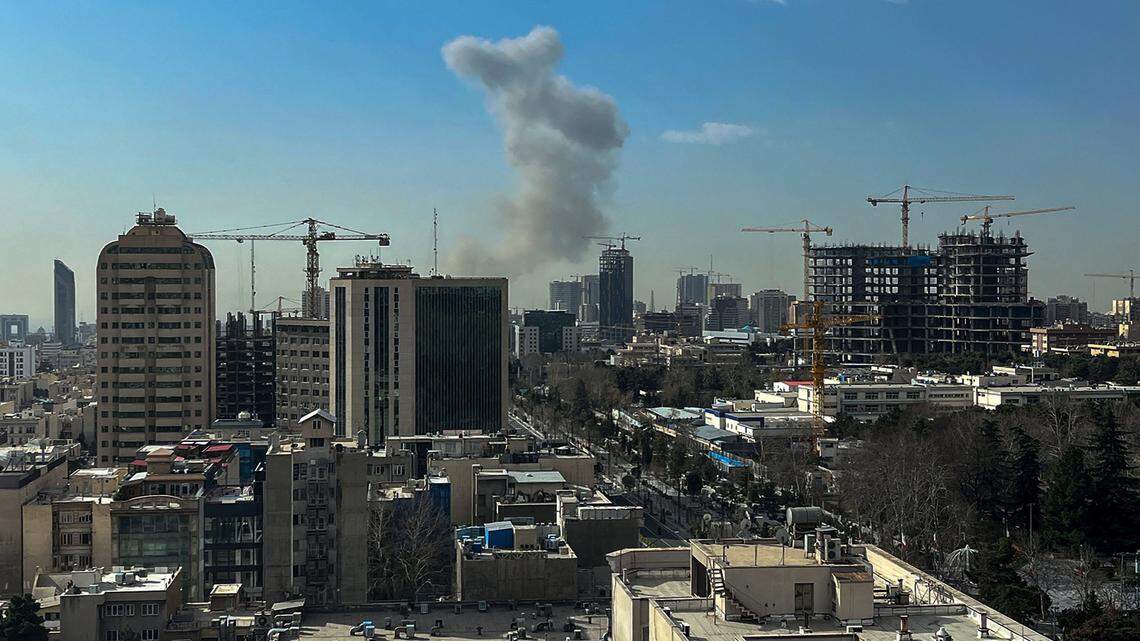
A plume of smoke rises following a reported explosion in Tehran on Feb. 28, 2026. Israel’s defense ministry announced Feb. 28 it had launched a “preemptive strike” on Iran as sirens sounded in Jerusalem and people across the country received phone alerts about an “extremely serious” threat.
-/AFP
TNS
Fear for loved ones in bomb shelters, grief over children caught in airstrikes, anger at widening attacks — and cautious optimism after President Donald Trump announced that Iran’s supreme leader, Ayatollah Ali Khamenei, was dead — rippled through South Florida as U.S. and Israeli strikes on Iran ignited a deeply personal and mixed response across Iranian and Jewish communities.
The U.S. and Israeli assault on Saturday targeted Iran’s top leadership and military infrastructure, with President Donald Trump calling the campaign “massive and ongoing” and urging Iranians to “take over your government” after the military strikes ended. Iran retaliated with waves of strikes against Israel and U.S. military bases across the Middle East.
Mojdeh Khagan, 58, an Iranian-American Jewish attorney in Miami who left Iran at age 11 during the 1979 Iranian Revolution, said she has followed the unrest closely, though she has no contact with people inside the country due to communication shutdowns amid the attacks.
“I’ve always known that Iranian people deserve better than the oppression and the terror that they’ve survived,” she said.
Khagan called this moment “now or never” for change, arguing that outside intervention may be the only path to dismantling the regime, now that Ayatollah Khamenei was killed in the strikes, which Trump announced Saturday evening.
Khagan hopes one day to return to Iran and show her children the culture and heritage she left behind — a trip she never got to take with her father before he died last year.
In South Florida’s Jewish community, the reaction was cautious with concerns about the retaliatory strikes aimed at Israel.
Jeff Levin, executive vice president of the Greater Miami Jewish Federation, said Iran has been “the greatest threat to peace in the Middle East since the Islamic Revolution of 1979,” accusing its leadership of sponsoring terror and repressing its own citizens.
Levin described the mood as “a combination of cautious optimism that this will lead to better days, and deep concern for the civilian population of Israel.”
For Levin, the crisis is not abstract. His daughter is in a shelter in Jerusalem, helping steward a group of 18-year-olds on a gap year program.
“She reports high spirits,” he said, even as missiles threatened Israel’s major cities.
Running for cover in Israel
Ofer Lichtig has been running in and out of a safe room as bombs roared overhead of his home in Mevaseret Zion, a suburb of Jerusalem. He was sheltering with his wife and two grown daughters, one of whom came from Tel Aviv because she did not have a safe place to hide.
“Unfortunately, we got used to [the bombings] over the last two-plus years,” Lichtig told the Herald. “Our spirits are high. Iran and its regime has been horrible to us in Israel, to Americans, and to its own people for so many years, orchestrating so many deadly terror attacks by Iran itself and its allies.”
Lichtig works as the representative in Israel for the Greater Miami Jewish Federation, partnering with Israeli Civil Society organizations to treat children and help evacuees.
He believes the strike on Iran was necessary as the nation has “become an existential threat.”
“Israel and the U.S. took the only step possible to neutralize this threat, and to free the Iranian people. We pray for the safety and success of the American troops and the Israel Defense Forces,” he said.
Trauma for Iranians
Dr. Bita Pishervar Haynes, a trauma psychologist who was born in Iran and came to the United States as a child during the Iranian Revolution, said Iranians are experiencing “collective trauma in real time.”
“Everyone’s nervous system doesn’t distinguish between physical proximity and repeated exposure to distressing images,” she said. “Many people are experiencing secondary trauma and grief and survivors’ guilt.”
Haynes, who has lived in South Florida since 1993 and trained in child and adolescent trauma after Hurricane Andrew, said resilience is as much a part of the Iranian story as suffering. “We’ve endured generations of political instability and displacement,” she said. “Resilience is not the absence of pain…it’s the capacity to remain value-driven under pressure.”
She believes the strikes could be a “pivotal moment” for democratic change, arguing that many in the Iranian diaspora see outside intervention as necessary to end decades of repression.
Let Iranians change their country
But Abdy Javadzadeh, an Iranian political sociologist and associate professor at St. Thomas University’s Biscayne College for Liberal Arts and Social Sciences, said Trump has no intention of helping the Iranian people.
“I’m not happy by any means that the U.S. has attacked Iran. Nor am I ever happy when the U.S. attacks any place. But I think every country that has an issue, whether it’s political, economic, socio-economic, even in international affairs, it’s up to the population to take care of that problem.”
He points to changes for Iranian women. In the years after the monarchy was overthrown, the government required women to wear dark, long, baggy cloaks with socks and sensible shoes. Not a strand of hair could show, and nail polish and lipstick were also forbidden.
The last time Javadzadeh was in Iran, in December, he said the majority of women had their hair out. Women are getting higher positions in professional settings and the majority of university students are women.
“That’s an achievement. A lot of things Iranian people have achieved without the help of any other foreign nation,” Javadzadeh said.
Calls to end the attack
For some, the attack on Iran was horrific and has to be stopped.
The Washington, D.C.-based Council on American-Islamic Relations, which has a South Florida branch, called the military campaign in a statement “another unnecessary, unjustified and unconstitutional regime-change war launched against Iran for Israel’s benefit.”
It accused the Trump administration of acting under pressure from Israeli Prime Minister Benjamin Netanyahu, who has called Iran’s Islamic republic a sworn enemy of Israel.
CAIR urged Congress to back the Massie-Khanna War Powers Resolution, which seeks to prohibit the use of U.S. military force against Iran without congressional authorization. Congress has yet to vote on the resolution.
“Stop this war of choice,” the advocacy group said.
Donna Nevel, a member of Jewish Voice for Peace South Florida, also denounced the U.S. and Israeli attacks.
“This morning’s strike against an Iranian school, with 85 casualties and counting, mirrors the same tactics Israel employs in their genocide against the Palestinian people. We call for an end to this imperialist aggression against Iran, to the genocide in Palestine, and to the American arms and funding that make Israel’s brutality possible,” Nevel, who is Jewish and lives in Miami Beach, said in a statement to the Miami Herald.
Many in the Jewish Orthodox community back President Trump and his pro-Israel policies, but they could not be reached on Saturday as it is the Sabbath.
Safety concerns in South Florida
Miami-Dade Sheriff Rosie Cordero Stutz said the agency is increasing patrols across the county.
“In light of recent international events involving Iran, the Miami-Dade Sheriff’s Office is taking immediate security measures by increasing patrols to ensure the safety of our residents. At this time, no local threats have been identified in our community,” Cordero Stutz said.
Deputies have increased their presence around places of worship, cultural centers and schools. The sheriff’s office said it remains in close coordination with federal, state and local partners.
Miami-Dade Mayor Daniella Levine Cava said the attacks were a serious risk to regional stability and international security. She said her thoughts are with the people of Israel and the Jewish community in South Florida, who are watching the situation with concern. She also expressed support for the Iranian people, saying they deserve peace, safety and freedom from repression.
The mayor cautioned that military action taken without congressional authorization sets a dangerous precedent and urged efforts to restore stability through diplomacy rather than further violence.
Ryan Radmehr, 47, who left Iran 15 years ago to come to the United States and got his citizenship, is particularly concerned about his family in Iran. His mom, sister, two brothers, uncle and aunts all live in Iran. He last spoke with his family the night before Saturday’s attack.
He hasn’t been able to reach them or his friends, likely because phone lines have been cut. During their last conversation, however, his family expressed hope that this moment could mark a turning point after 47 years under the control of the Islamic Republic.
“My immediate family and all my friends, actually, they see that as a rescue operation from the Islamic regime,” Radmehr said. “They don’t see this as a war or attack. They see this as a rescue operation.”
Miami Herald staff writer Lauren Costantino and Devoun Cetoute contributed to this report.
This story was originally published February 28, 2026 at 5:10 PM.
Miami Herald
Milena Malaver covers crime and breaking news for the Miami Herald. She was born and raised in Miami-Dade and is a graduate of Florida International University. She joined the Herald shortly after graduating.