
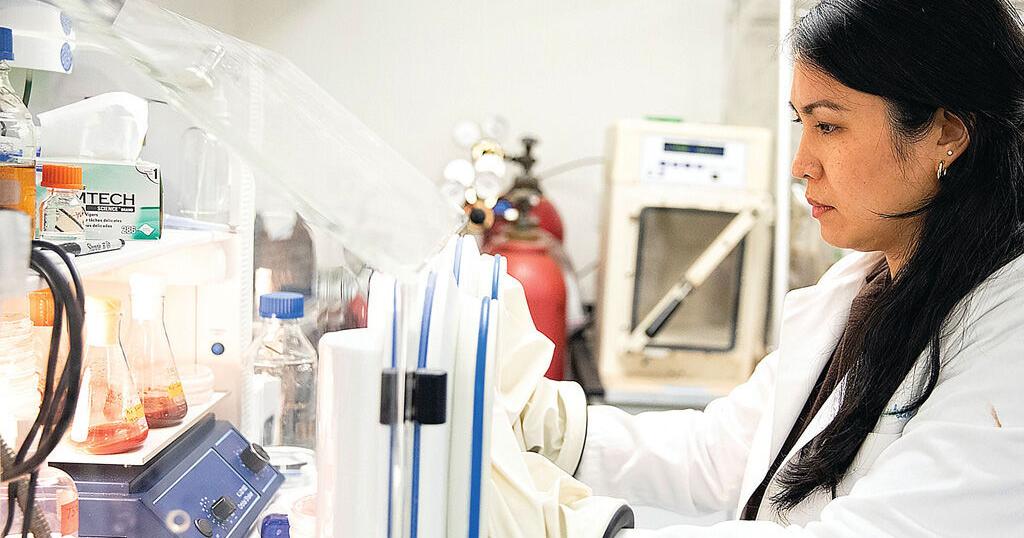
In a laboratory at a Cape Coral industrial park, biochemist Delvia Lukito helps lead a team of scientists who develop strains of bacteria and optimize them to clean up water and soil across the globe. The final products are manufactured in liquid form, often packaged in plastic jugs with colorful labels and sold as all-natural alternatives to chemical products for municipal wastewater and large-scale agricultural operations, home fish tanks and sometimes polluted Southwest Florida canals, among a growing number of uses.
As vice president of research and development for the 50-year-old, family-run biotech manufacturer Ecological Laboratories Inc., Lukito and her employers are tapped into an international market — including an e-commerce boost via Amazon — that has proven hungry for natural solutions to chemical cleaners.
“The power of Ecological Laboratories is in the consortium of the bacteria and its stability,” Lukito says. In layman’s terms, that means its products are effective and have a long shelf life, lasting unopened for two years. That stability gives the company’s signature Microbe Lift-brand formulas a competitive edge, CEO Matthew Richter said.
In the same way that an alternative energy company seeks to replace traditional fuels, Richter explained, ELI offers all-natural answers to chemical products that may have adverse environmental effects. The company develops consortiums of high-performing strains of bacteria, such as Rhodopseudomonas palustris, for use in its proprietary formulas, and one of ELI’s latest commercial products is designed to generate biogas from agricultural waste for use as an energy source.
ELI has steadily acquired space on its Cape Coral campus over the years. Now, Richter is looking for more room to grow, potentially by occupying an off-site lab in a biotech corridor and further expanding the company’s product lines into markets such as koi ponds.
“We’ve already outgrown, in 20-something years, our site here,” Richter says while offering a tour of the company’s lab, warehouses and manufacturing facilities on a bright January morning.
Richter is the second-generation leader of the company. It was founded by his father, Michael Richter, and uncle, Barry Richter, in 1976 in Freeport, the village on Long Island, New York. Both are now retired but serve on the company’s board of directors.
In addition to wastewater treatment, ELI’s initial clients included hog farmers seeking environmentally friendly solutions for manure management. The company continued to modify its formulas for other purposes such as aquaculture and hydroponics.
ELI relocated to Cape Coral in the late 1990s, growing from an initial handful of employees to about 50 today. “We’re still a mom-and-pop company,” Richter says, but with a long-standing international clientele. ELI contracts with businesses and government entities in dozens of countries, along with clients in Florida and elsewhere in the United States.
Its products have not always been an easy sell, Richter admitted, however useful they proved to be. From a marketing perspective, bacteria may be intrinsically unappealing for some.

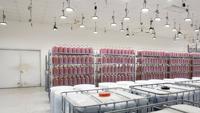
Manufacturing containers and packaged products are stored at Ecological Laboratories Inc.’s Cape Coral facility, where bacteria-based formulas are produced for wastewater treatment, agriculture and environmental applications.
Evan Williams
“It’s not easy to sell bacteria,” he says. “Is it on your shopping list for the week?”
Lukito suggested thinking of it as “the good bacteria,” akin to that popularized by yogurt or probiotics, only for the environment.
For clients, ELI’s five decades in business may be proof enough of concept. Its ongoing success also has caught the attention of officials and researchers who are seeking solutions to the red tide and blue-green algae outbreaks that have plagued coastal waterways, threatening the environment, human health and the economy.
With support from state agencies, ELI aims to use its bacteria to control harmful algae in waters from inland Lake Okeechobee to the Gulf. Nitrogen and phosphorus, nutrients from agricultural runoff and urban growth, fuel the outbreaks; ELI’s microbes are designed to compete with the harmful algae for food, ultimately destroying it.
“It’s going to take a toolbox of mitigation control options for any harmful algal blooms, and this could be one of those in that toolbox, for sure,” says Kevin Claridge, vice president of sponsored research and coastal policy programs for the nonprofit Mote Marine Laboratory in Sarasota.
ELI is also one of more than 30 private and public organizations that have engaged with Mote and the Florida Fish and Wildlife Conservation Commission to fight the red tide blooms that can kill fish, cause respiratory illness in humans and shut down beaches.
Variations of ELI’s commercial products have shown promising results for eliminating harmful algae, according to Mote Marine, but still need to undergo official regulatory testing before they can be used in state or federal waters.
For her part, Lukito sees potential in consortiums of bacteria to solve clean water problems on a global scale. “If you find the right strain for the job, we can pretty much do anything,” she says.