
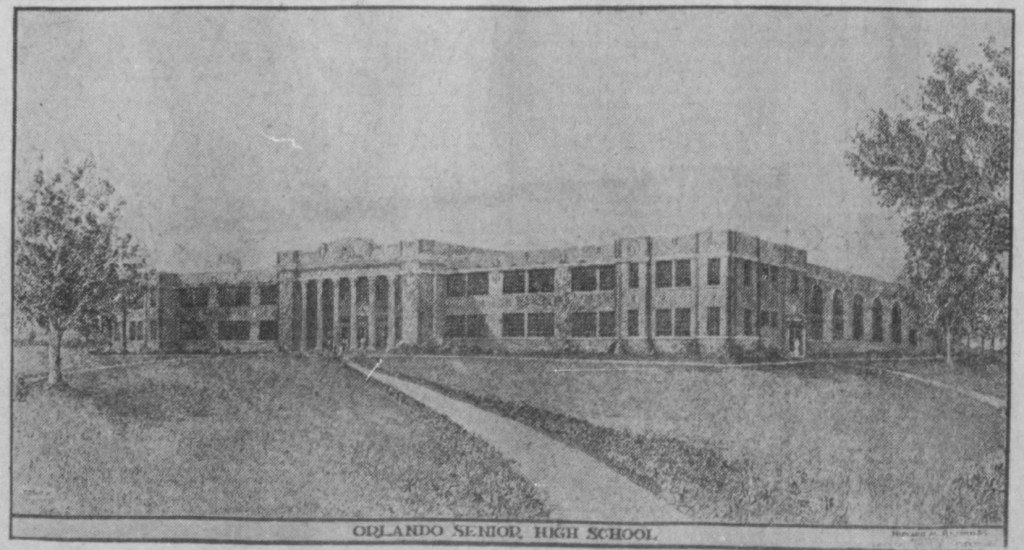
Next year, the Howard Middle School building will mark its 100th anniversary. As the campus undergoes renovations and prepares for centennial events, it offers Orlando an opportunity to reflect on how one structure has quietly shaped generations of the city’s residents.
When it opened in 1927, the Robinson Street campus housed the new Orlando High School, a senior high constructed during the height of the Florida land boom. Designed by architect Howard Montalbert Reynolds, whose work helped define several of Orlando’s early civic buildings, the school reflected both a growing population and a commitment to expanding public education.
The contract for the school was signed and the cornerstone laid in the fall of 1926. Construction concluded swiftly the following May, with a formal dedication on June 1, 1927. Students began attending classes in the new building that September. By the following June, the school graduated what was then Orlando’s largest senior class, with 85 young women and 75 young men crossing the auditorium stage that remains in use within the building today.
A report in the Orlando Morning Sentinel described the new senior high school as “crowning the schools of not only the Orlando district, but of Florida.” The half-million-dollar campus, equivalent to more than $9 million today, was designed to function as both an academic and civic space, with a large auditorium and athletic fields reflecting the city’s growing expectations for public education. Its design showcased the Mediterranean and Colonial Revival influences common in Reynolds’ work and in Florida school architecture of the 1920s, which emphasized regional forms adapted to climate as well as community use.
At the time of the building’s construction, Clarence Everett Howard served as chairman of the Orange County school board of trustees and advocated for the inclusion of subjects such as music and art at a time when they were rarely treated as essential parts of public school curricula. A photographer and former newspaperman, Howard argued that public education should extend beyond traditional academic subjects to include creative and practical skills needed for civic and professional life. In 1952, when Orlando High School was converted into a junior high, the Robinson Street campus was renamed in his honor.
Over time, Howard Middle School developed into a performing arts magnet program, giving the building a new role while maintaining its educational purpose. Today, students study music, theater, dance and visual arts within its walls. The presence of a photography program offers a particularly poignant connection to Clarence Howard’s legacy, echoing both his early work behind the camera and his belief that arts education should be accessible to all public school students.
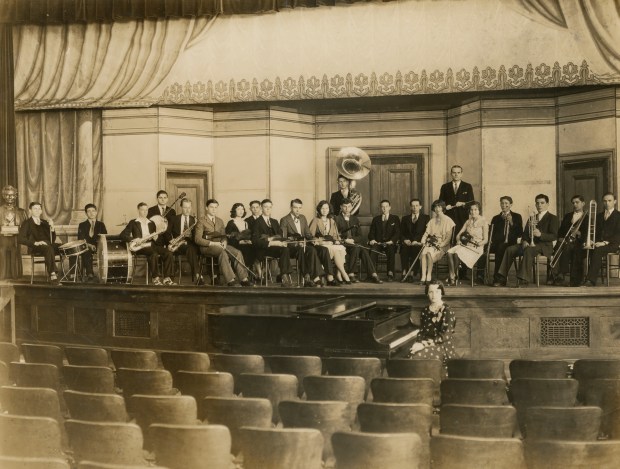 Orlando High School band and orchestra on the Robinson Street campus auditorium stage, 1930. The stage remains in use today as part of Howard Middle School’s performing arts program. (Courtesy of the Orange County Regional History Center)
As the Howard Middle School building approaches its second century and undergoes significant renovation, it stands as more than a place of instruction. Like many of Orlando’s early civic structures, it represents an investment made by previous generations in what public education could become. Nearly 100 years after its cornerstone was laid, the building continues to serve the same essential function envisioned in 1926 by preparing Orlando’s young people for the future while carrying forward a legacy shaped by the belief that access to education, including the arts, should remain a central part of civic life.
Sarah M. Boye is a graduate research assistant and teaching assistant in UCF’s history department.