
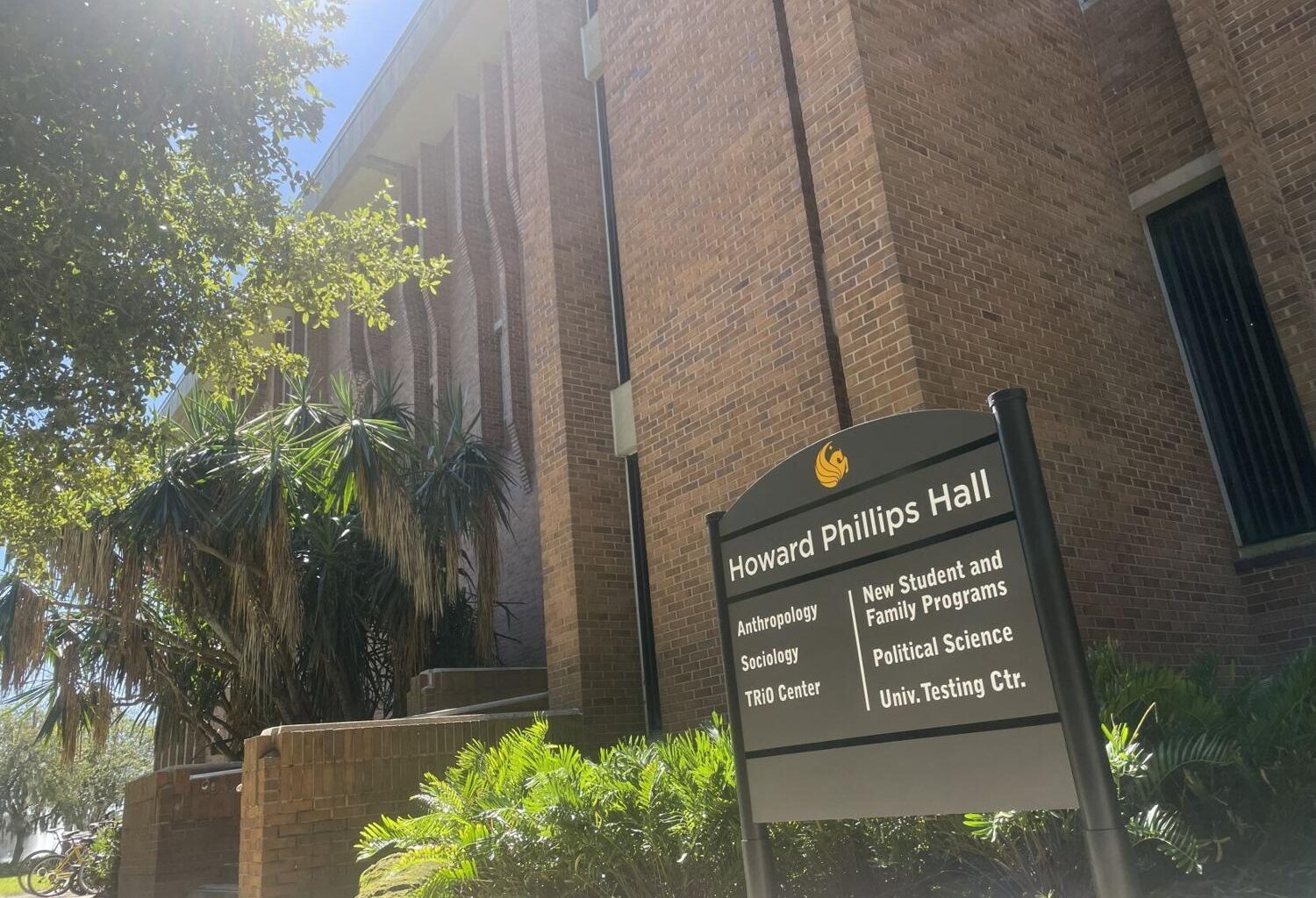

Howard Phillips Hall houses the anthropology department and Native American History courses at UCF.
Benjamin Huber
The Florida Board of Governors created and distributed a sanitized version of a sociology textbook for state-university usage in general education courses in January and February, which may affect sociology at UCF.
A common textbook, “Introduction to Sociology 3e,” was cut from 669 pages to 267 pages to comply with Senate Bill 266, which was signed into law in May 2023. The bill limits general education courses from the discussion of topics that may “suppress or distort significant historical events” or include curriculum based on theories that systemic racism, sexism, oppression or privilege are inherent in U.S. institutions.
Currently, UCF is not adopting this textbook, leaving faculty with a lack of clarity.
According to an article by Insider Higher Ed, the textbook removes chapters on race, gender, sexuality, social stratification, media and technology. The word “racism” was written in the book 115 times, but now only appears six times and the usage of the word “transgender” dropped from 68 to one.
“The textbook they are recommending has removed an entire chapter on gender, race, and removed two chapters, one on inequality in the United States and one on global inequality, and removed significant sections elsewhere in the book,” Michael Armato, associate lecturer of sociology, said.
In a sociology webinar hosted by the United Faculty of Florida, the discussion on this topic went more in-depth about the textbook. The revised version not only removes certain topics but also reframes established sociological theories to make the content easier for students at the introductory level, professors said.
“They have shifted the language from conflict theory to other conflict perspectives to weaken its academic merit,” said Evan Lauteria, assistant instructional professor in sociology at the University of Florida.
The revised version of the “Introduction to Sociology 3e” textbook raised concerns across the state and in the UCF sociology department. The Florida Board of Governors removed content early this year, addressing race, gender, sexuality, social stratification, media and technology to comply with Senate Bill 266.
Courtesy of the Sociology Department
The sociology department at UCF has received no written guidance from its administrators and has been told only verbally about not being required to use these materials, which Armato said is alarming.
“Allowing the Board of Governors to work on a censored textbook is giving up far too much ground when it comes to academic freedom,” said Robert Cassanello, president of the United Faculty of Florida and history professor at UCF.
“There was not a lot of transparency in this process,” Cassanello added. “I don’t even know how they arrived at the idea of creating an edited textbook in the first place.”
The topics being removed put students at Florida universities at risk of not gaining full knowledge of the basis of sociology, which could affect their education and careers in the future, Armato said.
“They are asking us not to teach things that are, frankly, bread-and-butter topics in the field. Basic sociology concepts that are part of our discipline,” Armato said. “That is troubling because faculty are supposed to have academic freedom to teach in areas of expertise that we have Ph.D.s in.”
While UCF is not currently requiring faculty to use this revised textbook, the lack of written guidance has left professors uncertain and cautious.
“This is not ideology. This knowledge is produced through decades of research, peer review, and the scientific method,” Armato said. “Restricting that produces ignorance about how the world works.”