
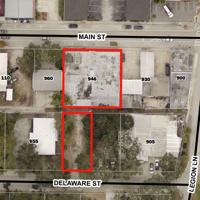
SAFETY HARBOR — The City Commission voted 4-1 on Feb. 17 to approve a site plan for The Barking Lot, a 1,058-square-foot tavern and “dog dining” facility planned for the corner of Main Street and Delaware Street, despite a wave of testimony from neighbors who say the area has reached a “critical mass” of flooding and traffic congestion.
The project, represented by P. Ely Payne of Bayside Engineering LLC, involves a tavern at 946 Main St. and an accessory parking lot on an unaddressed parcel on Delaware Street. While the city’s Technical Review Committee found the application consistent with the Land Development Code, the hearing revealed a deep disconnect between what is permissible on paper and what residents say is sustainable for the neighborhood.
The most pointed opposition came from those dealing with the downstream consequences of Main Street’s commercial success.
Austin Simmons, owner of the adjacent property at 960 Main St., described the area as a “funnel” for stormwater. He told the commission that a neighbor, Maria Platow, has waded through standing water once a month for 20 years. “It’s unconscionable,” Simmons said. “It really is a force of nature, and it’s just regular rain.” He argued that while the developer promises “positive flow,” the current drainage design often leaves neighbors “buying the negative flow.”
The developer made adjustments following a January Planning and Zoning Board meeting, agreeing to route all parking lot traffic through Delaware Street to avoid an unimproved alleyway. Payne said the team met with neighbors on-site to hear their concerns, opting to widen the driveway to 23 feet and modify the parking surface to improve site conditions.
But for residents of Delaware Street, the bigger problem is parking. Mike Wixted, who lives on the street, said that on a typical Friday night, every available space is taken and vehicles park on sidewalks just so two cars can fit.
“There’s no way a fire truck or an ambulance can get up the street when it’s parked in like that,” Wixted said.
The tension was compounded by the legal constraints of the hearing. As a “quasi-judicial” proceeding, the commission was required to evaluate the application based on “substantial competent evidence” regarding existing city codes. City Attorney Sarah Johnston reminded the board that members could not “attack the policy” they were sworn to apply, leaving several commissioners visibly torn.
Commissioner Andy Steingold, the sole dissenting vote, argued that safety should be the ultimate arbiter. “I think safety outweighs whatever’s written, and I’m certain the law would support a safety issue being overwhelming as to a specific code,” he said. “I’ve seen with my own eyes … I just don’t believe that the code and the lack of appropriate mitigation for on-street parking is satisfactory.”
Safety concerns extended to the animals the business intends to serve. Crystal Marrs, speaking on behalf of professional pet caregiver Diana Geiver, warned that the proposed 4-foot fence for the off-leash area was inadequate for a high-traffic location. “It takes only one dog escaping onto Main Street for a serious accident to occur involving a dog, pedestrian, or driver,” Marrs read from a prepared letter.
The majority of the commission concluded that denying a project meeting every technical requirement of the code would expose the city to legal liability. Vice Mayor Carlos Diaz noted that a tavern of this size is “minimally invasive” compared to the larger structures the code allows. “The alternative is that there may be a bigger building … that’s going to take up the same amount of space as the last building,” Diaz said.
The commission approved the plan with conditions requiring a 23-foot driveway width on Delaware Street and a formal agreement for five staff parking spaces at a nearby financial services lot. Mayor Joe Ayoub acknowledged the community’s frustration, saying, “Our job is to evaluate the site plan as it relates directly to our code … but the code may not be serving our residents and our community right at this point.”
The commission also promised to investigate parking enforcement and alleyway improvements — cold comfort for residents who see the approval as a stark example of a neighborhood struggling to balance growth with the basic safety of its streets.