
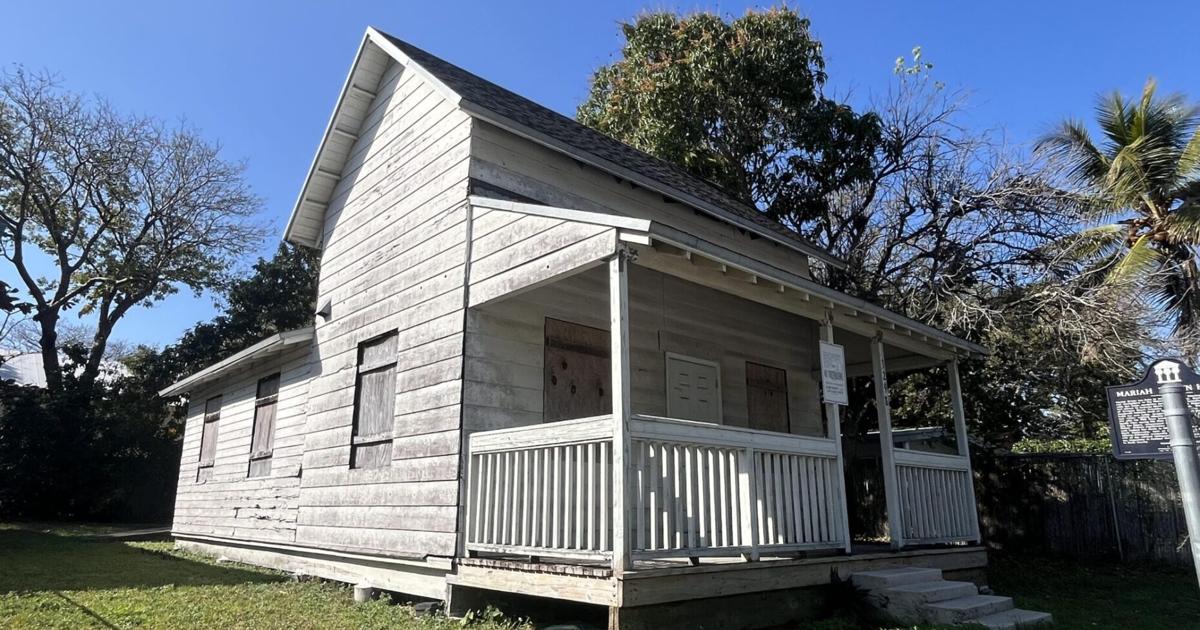
Of all the cases of preservation efforts gone wrong in Miami – and there are plenty — the Mariah Brown House in the West Grove might be the worst example.
The house at 3298 Charles Ave. – a half-block from the Coconut Grove Playhouse – is one of the oldest in Miami-Dade, built in 1890 for a Bahamian woman who worked at the Peacock Inn.
Today it’s a dilapidated wreck of rotting wood. So are quite a few historic houses. What makes this house unique is that the wreck is itself a complete restoration of the original house.

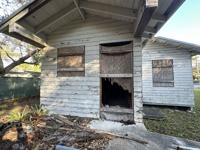
The back of the Mariah Brown House on Charles Avenue.
(John Dorschner for the Spotlight)
The redo was done a quarter-century ago with much volunteer labor and more than $100,000 spent mostly on materials. A bureaucratic entanglement about windows held up completion, and for the past two decades the expensive redo has been decaying.
“A Miami disgrace,” says Andy Parrish, a longtime West Grove developer closely connected with those who did the renovation.
The owner of the property, the Coconut Grove Cemetery Association, continues to search for funds to restore the house – again.
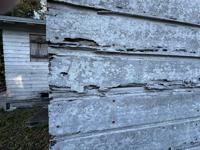
Weathered siding on the exterior of the Mariah Brown House.
(John Dorschner for the Spotlight)
“It’s been a challenge,” said Leon “Bo” Leonard, the association’s president.
This saga began in 1889 when Mariah Brown and her family moved to Coconut Grove. Born in Eleuthera, she was close to 40. She lived at the Peacock Inn for a while, then bought a 50-by-100-foot lot for $50 on what was then called Evangelist Street.
She built a small, 800-square-foot structure with a broad front porch and windows placed to allow flow-through breezes. There, she lived with her husband and four children until she died in 1910.
The house passed through several owners, who made alterations and additions. Eventually, the building began deteriorating.
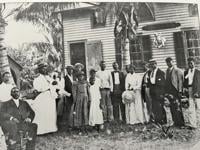
An undated photograph of Mariah Brown (standing left, holding a baby) with others, taken in front of Commodore Ralph Munroe’s boathouse./
(Courtesy of Andy Parrish)
For decades, Esther Armbrister, a West Grove activist, battled to have the house preserved. Finally, in 1995, the county offered a grant, and the house was purchased for $60,000 by the nonprofit cemetery association. It was designated an historic site.
“We are finally seeing some light at the end of the tunnel,” Armbrister told the Miami Herald.
A lot needed to be done. “It was in very bad shape,” recalled Tucker Gibbs, the association’s pro bono attorney. “It was a Dade County pine house – which is just like rock, it can last forever – if it’s properly maintained.”
Clyde Judson, a local Black architect, charged nothing to come up with plans to restore the house to its original condition, with some modern-day out-of-sight updates, including interior plumbing for a bathroom. The plan was for the structure to serve as a museum about Grove Bahamian culture.
Gibbs: “City Commissioner J. L. Plummer said, ‘Let’s see what we can do.’” His staff found state, local and federal grants to restore historic housing.
Mario Benitez, a general contractor who had worked frequently in the West Grove, agreed to oversee the work for free. He found the house in such bad shape that “it was not really safe to walk in there.”
The roof had collapsed, and the wooden boards on the exterior were in such bad shape they had to be replaced. Exact replicas were designed and made at a local lumber yard.
Starting in 1999, the house was completely rebuilt. Much of the labor was provided by University of Miami architecture students, who did the work as a classroom project. Air conditioning ducts and plumbing were roughed out inside. A new roof was put on.
“It came down to the windows,” Benitez said.
The original windows had been double-hung sash. Post-Andrew county code required hurricane-strength windows. That meant finding old-fashioned windows that fit the modern code.
“We did find a company that produced the windows, but they were not hurricane-rated windows,” Gibbs said. The out-of-state company had no interest in developing and getting certified windows that would pass the code. Parrish recalled that the manufacturing and rating process would cost $50,000.
At one point, Benitez said, there was a suggestion of getting a “one-time exception” to historic preservation standards and attaching shutters for hurricane protection, but that came to nothing.
All this happened two decades ago. Gibbs, Benitez and Parrish have slightly different recollections about which government entity was the primary holdup, but the end result was that the nonprofit association “didn’t have the money to meet the code,” Benitez said.
There were other problems, recalled Gibbs. The handicap ramp, necessary for regulations, was in the back of the house but stuck out a bit and could be seen from the street. “That would affect its historic quality.” It would have to be cut back.
More complicated was the parking situation. Charles Avenue is narrow and historically designated with no on-street parking. “The city of Miami wanted five parking spaces, and a handicapped space next to the house,” Gibbs said.
Next door was the United Christian Church of Christ, with a grassy area that could be used for parking.
That property too is historic: It was built in the 1890s as a two-story Odd Fellows Hall and served also as home for the Colored Literary Library Association. When the church took over the site in the 1960s, the second story was decaying and was removed.
“I thought of making a deal with the church,” Gibbs said. “We could work together and have parking.”
Then Commissioner Joe Carollo “had a bee in his bonnet” about unimproved land in the city not being used for parking, Gibbs said. He worked with Parrish to come up with a plan for a mixture of concrete and grass, with nighttime lighting. That required an electric connection and a water meter – for sprinklers on the grass. “And then paying for the permits. We didn’t have the money.”
The renovation was stuck. Plywood covered the windows.
“I kept it up over five or six years,” Benitez said. “I kept sending people to paint the outside. But I just gave it up. They kept saying they would find the money.”
The association was a small group of volunteers whose main focus was making sure the graves were kept clean. They didn’t have the skills to find grants or deal with the bureaucratic complexities.
“So it just stopped,” Gibbs said.
Occasionally, discussions revived. In 2007, the Coconut Grove Village Council talked with the Village West Homeowners and Tenants Association (HOATA) about how to finish the project, but that led to no money.
In 2021, Dade Heritage Trust, which has a 50-year history of protecting and renovating historic houses, presented a proposal to the Cemetery Association.
“Given our mission … and our access to funding, we thought we could make it work,” said Christine Rupp, the trust’s executive director.
“The best way to preserve an historic building is to have someone there every day,” Rupp said. “We thought it would be a home for an author in residence program,” perhaps involving the area’s Bahamian influences, “curating the space for community education. We thought we had a great proposal. We volunteered to operate it in on some kind of lease arrangement, and we volunteered to find funding.”
But, she added, “We were not embraced.”
Rupp said some cemetery association members were suspicious of the offer.
“In the West Grove, there’s a good amount of distrust – and for good reason – of people who come from outside the neighborhood.” She presented the proposal again in 2024 and was rebuffed.
Leonard, president of the cemetery association, said he preferred that the group keep control directly with the city. The staff of District 2 Commissioner Damian Pardo recently recommended that the house gain 501(c)(3) tax-exempt status to make it easier to receive grants and donations. That’s been done, Leonard said.
One piece of good news: Ken Kalmis, the city’s preservation officer, told the Spotlight that the window and parking problems did not need to be deal-breakers today.
He said present code does not require wooden double-sash windows for historic structures. Such windows that are hurricane proof can be made of aluminum “as long as they match the pattern of the original style.” Such windows are available, he said.
What’s more, Kalmis said the city’s Historic and Environmental Preservation Board “has the authority to grant a parking waiver to protect the character of an historic place.”
Gibbs noted that a deal might be worked out with the nearby playhouse to use its parking, when that project gets completed.
So, where’s the money come from?
“That’s still the big question,” said Leonard, the association president.
The exterior has to be completely redone, and an engineer needs to be hired “to go inside and see how much has to be done.”
For decades, the association has been paying the house’s property taxes, which run about $6,000 a year (based on the value of the lot), but it’s running out of funds, not just for the Brown house but also for maintaining the cemeteries with such costs as tree-trimming.
Kalmis said the city has started a fund to provide historic preservation grants, but it prioritizes homesteaded residences. State grants are another option, he added.
Rupp at Dade Heritage Trust said private foundations might be interested. Several association directors said they’d consider reaching out to the trust again.
Or the City of Miami itself could step up.
“District 2 has funds available for projects of this size or larger – normal funds,” said George A. Simpson Jr., the association’s treasurer.
Whether District 2 or the city would be interested in funding the project is an open question. Pardo’s District 2 office did not respond when contacted by the Spotlight.
“That says a lot about how things are done in the district,” Simpson lamented. “We are moving as slow as molasses.”
This story was produced by the Coconut Grove Spotlight, a nonprofit newsroom covering Coconut Grove and Miami City Hall, as part of a content sharing partnership with The Miami Times. Read more at coconutgrovespotlight.com.