
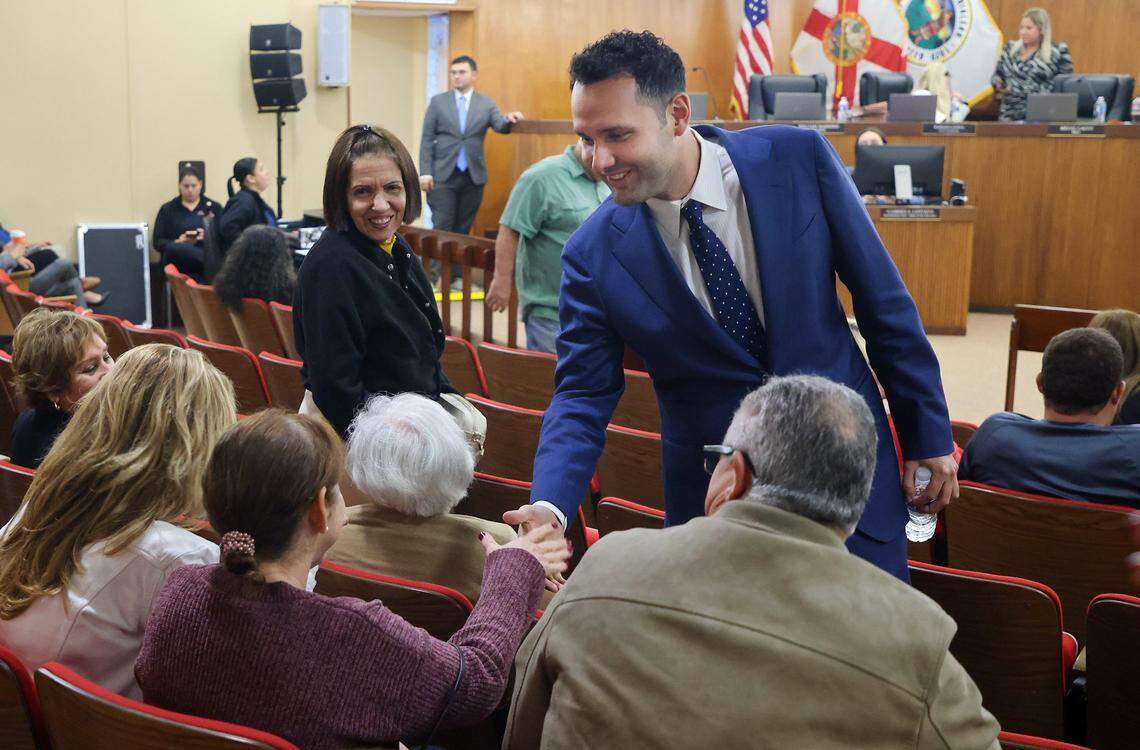
Hialeah Mayor Bryan Calvo is proposing a property-tax relief program for senior homeowners in the city, framing the initiative as a way to help elderly residents remain in their homes as Florida leaders debate eliminating property taxes altogether.
The proposal would lead to a one-time Seniors Homeowner’s Relief stimulus check for qualifying residents during fiscal year 2026. The program would cost the city an estimated $1.2 million, funded through the city’s general fund using surplus money generated by early pension payments made in prior years.
Those savings stem from a strategy implemented under former Mayor Esteban “Steve” Bovo, whose administration made early contributions to the city’s pension system, reducing long-term interest costs. At the time, those savings were largely used to finance street and infrastructure improvements. Under Calvo’s proposal, the funds would instead be redirected toward direct financial assistance for homeowners.
During a televised debate hosted by Univision 23 in October, when five candidates, including Calvo, were running for mayor, the candidates were asked by the Miami Herald whether their plans to govern included subsidies throughout their four-year terms and whether such programs would be financially sustainable for the city. At the time, Calvo, a former councilmember, rejected the idea.
“The city of Hialeah doesn’t print money, it takes it out of our pockets,” Calvo said during the debate. “What the people next to me are doing is trying to fill one hole by opening another.”
Nonetheless, Calvo as mayor is proposing a subsidy targeted to a specific group of residents, senior homeowners, many of whom already benefit from existing property tax exemptions and state-subsidized services, including meal programs and other forms of assistance.
A targeted group of beneficiaries
The proposed ordinance, scheduled for a first reading Tuesday evening, says the mayor of Hialeah “refuses to stand idle” and is “determined to lead by example” by distributing a stimulus check to eligible senior property owners. The relief would be limited to seniors 65 and older who own and live in a homesteaded property in Hialeah and meet strict income requirements. According to Calvo, 5,141 residents would benefit.
To qualify, a senior homeowner must be:
Own and live in a home in Hialeah,
Have the Florida Low-Income Senior Citizen Homestead Exemption as of Jan. 1, 2025,
Earn no more than $37,694 in household income, and
Must not have received the Florida Long-Term Resident Senior Citizen Homestead Exemption, which offers tax benefits to seniors who have lived in their home for many years.
City officials say the program is intended to help seniors on fixed incomes who have been disproportionately affected by rising property values, even in years when tax rates remain unchanged. However, the initiative excludes other groups, including renters and homeowners who do not qualify for the exemptions. At the same time, many Hialeah residents continue to struggle with housing costs and property taxes, which—depending on the area—can range from $6,000 to $12,000 a year. Those pressures have pushed some residents to rent out rooms, build accessory dwelling units, or live in RVs to make ends meet. Also excluded are many low-income residents: about 17% of Hialeah’s population lives below the poverty line, in a city where per capita income in 2024 was $26,435 and median household income was $55,559, according to data from the U.S. Census Bureau.
When asked whether the city plans to extend assistance to other groups in need, such as low-income residents or single-parent families, Calvo said his current focus is on helping the elderly.
Last year, during the 2025 mayoral campaign, interim Mayor Jacqueline Garcia-Roves proposed a one-time $200 relief payment for all homesteaded property owners. That proposal was estimated to cost the city $6.4 million and would apply to 32,100 homeowners, but it failed at second reading and was never approved during the two-month transition period after Calvo was elected and before he was sworn in.
The stimulus check for seniors with homestead exemption would amount to 33 cents for every dollar they pay to Miami-Dade Property Appraiser. Qualifying seniors would receive a rebate-style payment equal to the amount of city property taxes they paid or owed for 2025, Calvo told the Herald. The mayor is expecting to distribute the payments before the end of March, assuming the ordinance passes both its first and final readings, with a final vote anticipated on March 10.
While framed as property tax relief, the ordinance does not reduce or eliminate property taxes, which would continue to be assessed and collected as usual. Unless renewed by the City Council, the relief program would apply to only one fiscal year.
The ordinance explicitly states that it does not create, modify, or affect any property tax exemption under Florida law or Miami-Dade County ordinances, despite Calvo’s having campaigned last year on a promise to pursue a senior tax exemption.
According to the Miami-Dade Property Appraiser, the average assessed value of a single-family home in Hialeah is $223,519. With a $50,000 homestead exemption, the city’s operating property tax on such a home at the current millage rate of 6.3018 amounts to approximately $964, according to the city’s approved fiscal year 2026 budget. A non-homesteaded property with the same value would face a city tax bill of about $1,279.
The relief check program bases its calculation on an assessed value cap of $200,000, limiting the maximum benefit regardless of higher valuations.
City officials say the current program is designed to help seniors on fixed incomes who have been disproportionately affected by rising property values, even in years when tax rates remain unchanged. However, many residentes in Hialeah are struggling with the payments of property taxes, some rent rooms, other build efficiencies or event rent RV as a way to alaviate the economic huzzle
On Thursday night, the city will host an outreach event with Miami-Dade Property Appraiser Tomás Regalado to promote the use of property tax exemptions and provide personalized, one-on-one assistance to property owners and residents. The event will help eligible participants apply for homestead, senior, veteran and disability exemptions and will take place from 5 to 7 p.m. at the Milander Center for Arts and Entertainment on Palm Avenue.
The property-tax relief proposal comes as the city enters contract negotiations with three municipal unions: the American Federation of State, County and Municipal Employees, the Fraternal Order of Police, and the Hialeah Fire Union. Many city officials are concerned that the city’s financial situation leaves little cushion for emergencies, and any new increases in pension or benefit costs would further strain the budget.
Any salary increases from these negotiations would raise long-term pension obligations, forcing the city to either raise property taxes, cut services, or make future budget adjustments, directly affecting the funds available for homeowner relief. Over a decade ago, under Carlos Hernández, Hialeah faced pension funding pressures. At the time, the city implemented a 6 % pay cut for firefighters, averaging about $500 per person, to help cover pension costs without increasing taxes. The lesson from that period underscores how pension obligations and union negotiations can limit the city’s ability to provide property-tax relief.
Broader statewide context
The proposal comes after the state House of Representatives passed a bill last week seeking to repeal property taxes on everything except the portion that funds schools — a concept that closely mirrors what Gov. Ron DeSantis has been campaigning on for more than a year.
The discussion has raised concerns among local governments about how to replace a major revenue source used to fund police, fire services and infrastructure. In Hialeah, those concerns are particularly pronounced. As the second-largest city in Miami-Dade, it frequently loses fire and police personnel due to a lack of competitive salaries and benefits compared with similar, and even smaller but wealthier, municipalities throughout South Florida. Despite campaigning in favor of eliminating property taxes, Calvo has not explained how the city — which operates on a roughly $500 million budget — would offset the potential loss of revenue.
City budget data show that about 33 cents of every property tax dollar collected by the Miami-Dade Property Appraiser is actually spent within the city, underscoring the scale of the financial challenge a statewide property-tax repeal would create for Hialeah.