
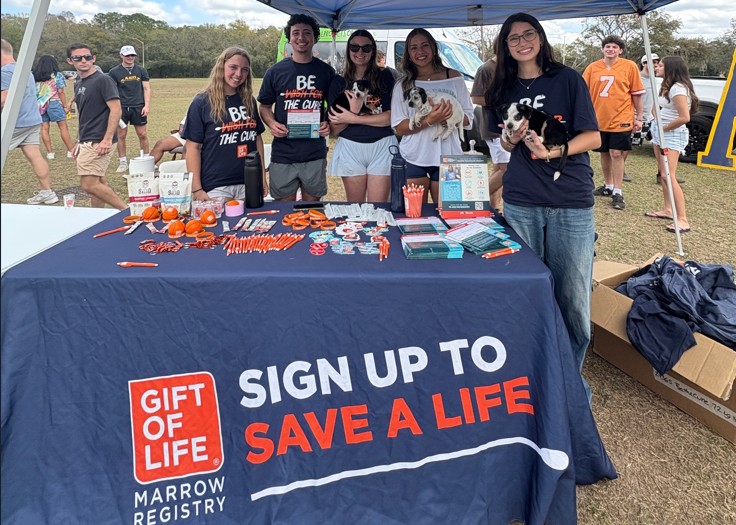
 USF’s Gift of Life Marrow Registry collects cheek swabs for DNA samples to match potential donors to patients in need. SPECIAL TO THE ORACLE/HALEIGH GILDIN
USF students are working to give blood cancer patients a second chance at life, one cheek swab at a time.
The Gift of Life Marrow Registry is a national nonprofit organization that facilitates stem cell and bone marrow transplants for patients battling blood-related disorders, such as leukemia and lymphoma, according to its website.
Haleigh Gildin is a senior global business major and the president of USF’s chapter of the Gift of Life Marrow Registry.
Gildin said the organization helps register as many potential donors as possible to raise the chances of patients finding life-saving matches.
“Our overall goal is to eliminate blood cancer,” Gildin said. “And we do that by adding everyone to the registry so patients can find matches more quickly.”
The USF chapter has collected 4,789 cheek swabs and found 172 matches with them, according to its website.
“It’s literally just a cheek swab,” Gildin said. “You fill out a short form, swab your cheek, and you’re added to the registry. It only takes a few minutes, but it could mean everything to someone waiting.”
USF students who work for the university’s chapter of the Gift of Life Marrow Registry said registering a cheek swab with the organization could be life-changing for another person.
Related: USF’s Student Health and Wellness Center sees more visits this flu season
USF’s chapter of the Gift of Life Marrow Registry will host Annie’s Army, a once-a-semester awareness event focused on expanding the registry and supporting patients, on Wednesday near Cooper Hall.
The chapter is also hosting a Mega Drive swabbing event, which started on Saturday and will end Thursday, that will collect cheek swabs from as many students as possible across the Tampa campus.
Gildin said that because matching is genetically specific, it is essential to expand the registry.
“The more people we have, the better the chances are that someone will find their match,” Gildin said. “That’s why recruitment is so important.”
Ryan Drames, a senior health sciences major and USF’s chapter secretary, said cheek swabs are used to identify genetic markers in a person’s DNA and match donors to patients through a database.
Drames said joining the registry with a cheek swab does not automatically mean someone will donate their stem cells or bone marrow — as the process is voluntary and matches are rare.
“You’re not signing a contract,” Drames said. “If you match with someone, you still have the choice to move forward. But for a lot of patients, that match is their last hope.”
He said one of the biggest challenges for recruitment are misconceptions about the donation process, including what donation is and how DNA is used.
“There’s a huge misconception about what donation looks like,” Drames said. “People assume it’s this invasive surgery, and that’s usually not the case.”
Traditional bone marrow donation involves extracting marrow from the hip bone under general anesthesia, while stem cell donation is non-surgical and draws from the bloodstream, according to Mayo Clinic.
Additionally, Dramer said participant information is added to the database with ID numbers rather than names, which helps keep data and information private.
Related: USF org supports kids whose parents have cancer: ‘A unique community’
Gianna Maikowski, a senior health sciences major and the chapter’s membership chair, joined the organization in her freshman year.
Maikowski said learning about the science behind matching made her realize how difficult it is to find specific genetic matches.
“People can’t necessarily donate from relatives or get donations from relatives,” Maikowski said. “So they rely mainly on random people.”
She said this realization reinforced how powerful small actions can be for other people.
“It takes five minutes to fill out the form and swab,” Maikowski said. “And then someone ends up saving another person’s life. Something so small could make such a big difference.”
She added that matches who choose to donate often only have to donate stem cells versus bone marrow.
Maikowski said most donations — which the organization pays for — are done through peripheral blood stem cell collection, which draws from the bloodstream rather than bone marrow collection surgery.
“It’s very similar to donating blood plasma,” Maikowski said. “Your stem cells get separated, and then your blood actually goes back into you.”
Related: USF’s new president could earn nearly $2 million in first year
Maikowski said hearing about someone she helped swab becoming a match is always meaningful to her.
“When we get emails that someone matched, I literally want to cry every time,” Maikowski said. “It makes me so happy.”
She said education is the biggest factor in getting students to donate because it raises awareness for the program and cancer prevention.
“When someone hears a story, or they can relate to it personally, or they just learn more about it and educate themselves, they’re way more interested in swabbing and making a difference,” Maikowski said.
Gildin said she hopes the Gift of Life Marrow Registry reminds students that behind every statistic is a real person waiting for a match.
“These are real patients waiting on real matches,” Gildin said. “If you have a few minutes, you could be someone’s miracle.”