
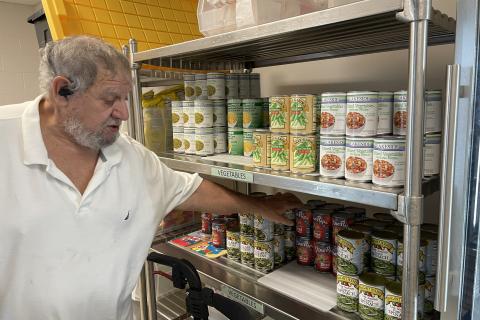
Every week, Army Veteran Robert Gerard makes his way to a place that has transformed his life in ways he never expected, the Food Rx market at the James A. Haley Veterans’ Hospital.
Just a few months earlier, Robert had been in a very different place. In January 2025, after a serious vehicle accident and an MRI, doctors told him he needed surgery. But first, they told him something even more difficult. He must lose weight before the surgery could be performed safely.
“They told me to lose 15 pounds,” Robert said. “At first, I struggled.”
Like many Veterans, Robert was facing the combined challenge of food insecurity and chronic health concerns. That’s when his VA care team stepped in and connected him to a new resource, the Food Rx program, a six‑month initiative that supports eligible Veterans experiencing food insecurity while managing chronic health conditions.
The program is simple but powerful: enrolled Veterans visit the Tampa VA campus Food Rx market once a week, selecting from fresh produce, whole grains, lean proteins, herbs and spices, and nutritious shelf-stable items like low-sodium sauces or no-sugar-added canned goods. They take home what they choose, ingredients they’ll use to prepare delicious, healthful meals themselves.
But Food Rx offers more than groceries. Veterans also receive general nutrition guidance, recipes and cooking tips with the option to join a budget friendly cooking class series and to get individual one-on-one nutrition support with a registered dietitian. And during enrollment, they work with staff to identify barriers to food security so they can be connected to additional VA or community resources.
The program is made possible through a healthcare partnership between the Tampa VA and Feeding Tampa Bay, whose broader mission includes helping healthcare partners establish food prescription programs across the region.
For Robert, it was exactly the turning point he needed.
“I was referred to the Food Rx program here and that changed my life,” he said. “I come to the VA once a week to receive my groceries. I’m eating more grains, fruits, salads, brown rice, and wheat bread. I’m getting healthier and losing weight. By changing my diet and cutting out snacks, I’ve lost 27 pounds in the last three months.”
His progress has brought him more energy, improved health, and renewed hope for the surgery he needs.
The dietitians who support him and other Veterans feel that same sense of hope every week.
“Being part of the Food Rx program and seeing the positive impacts in many Veterans’ lives has been very rewarding and motivating,” said Hillary Markey, Registered Dietitian Nutritionist and Program Coordinator for Food Rx and the Healthy Teaching Kitchen.
“For Veterans experiencing food insecurity, it can be challenging to also focus on their health and other needs in life. I know what we are doing is making a difference. Veterans report improved physical and mental health, increased fruit and vegetable intake, better blood pressure, improved diabetes labs, weight management, and even new social connections.”
Veterans can enter the program through an evaluation during their annual screening to determine food insecurity. If they screen positive, they are referred to their outpatient Social Worker and Registered Dietitian for further evaluation.
Hillary added, “The Food Rx program strives to help Veterans, like Robert, in the short term by getting nutritious foods into their kitchens, and in the long term by helping them find solutions to their barriers to food security.”
Casey Trent, Registered Dietitian and Certified Diabetes Care and Education Specialist, echoed the same sentiment: “It is rewarding to support Veterans with food security and to help them make healthy lifestyle changes.”
For Robert, the encouragement he receives each week keeps him motivated.
“I’d like to thank the staff at the VA Food Service for their support and service,” he said. “They are dedicated, helpful, and listen to our achievements.”
And for many Veterans, like Robert, a weekly visit to the Food Rx market is not just about groceries—it’s about dignity, health, community, and regaining control of their lives.