
Written by Kelly Sanchez on March 4, 2026

Advertisement
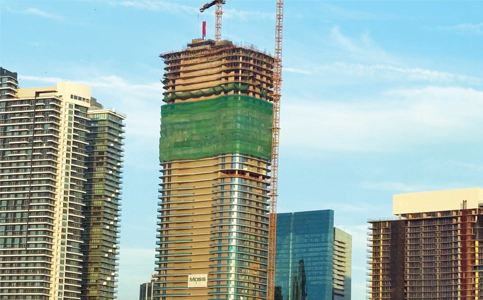
Miami is feeling a construction slowdown following over a decade of sustained growth, with high interest rates and construction costs impacting new development and the cost of living pushing more people into renting, according to commercial real estate brokerage Lee & Associates. Employment data paint a different picture of those construction trends.
Todd Cohen, a principal at Lee & Associates South Florida, said Miami is one of several locations nationally to enjoy sustained growth for the past 15 years. He also said South Florida being an unaffordable housing market for so long has benefitted rentals.
“There’s been 15 years of sustained growth not just in Miami but pretty much all over the country,” he said. “Miami has probably experienced the longest and most profound of that sustained growth over that time, and with so much being developed and rents being pushed so far, so fast, I think that it needs to take a step back and digest everything that’s happened over the time just for healthiness, because there’s so much new product out there.
“Rents, which have been gently pushed over the first 10 years of this boom, that was all exacerbated during the covid years, and then even further toward the tail end of covid while the government was still pumping so much money into the economy and inflation started to take root before interest rates even started to go up,” Mr. Cohen said.
As a result, he said, “rents were on an untenable track and owners of existing properties were pushing rents as far as they could” and “the new stuff was benefitting from it too because the developers were borrowing at ridiculously low rates and rents were able to be pushed far beyond any pro forma during that period.”
He said inflation affected people regardless of their role within the real estate market and high interest rates made new developments harder to greenlight.
“You couldn’t push rents as far because the higher interest rate environment, the inflationary environment was forcing every single person, whether they were developers, investors or just the tenants in those buildings, to have a higher expense profile, and dollars can only take you so far,” Mr. Cohen said. “Tenants couldn’t afford to have their rents pushed 10% and 15% per annum anymore, or even 50% in some cases during that time, like I had read about, and things needed to slow down.”
He added that building costs are one of the factors contributing to the slowdown in construction.
“That inflationary period of time and then tariffs after that have created a situation where building new product is super expensive and this comes on the heels, like I said, of 15 years of sustained growth,” Mr. Cohen said.
“And so just buying land now is more expensive than it ever was because everything is just up and up and up for 15 years. Expectations of sellers reflect that, and then once you own land, if you can even find it at a good basis, every aspect of building is now super expensive; it’s higher cost of borrowing, all materials that need to be imported or not cost more than they did, especially in a relative sense.”
Indeed, the producer prices for materials and services used in non-residential construction rose 2.9% in the 12-month span from January 2025 to January of this year, according to the Associated General Contractors of America. Association officials too noted that tariffs are inflating the costs of key materials.
“The steep tariffs on imported metals and products are clearly enabling U.S. sellers to push up costs for construction materials and equipment,” said Ken Simonson, the association’s chief economist.
The producer price indexes for aluminum mill shapes and steel mill products rocketed up by 33% and 20.7%, respectively, in the 12 months ended in January, the association said.
Despite those added costs, however, construction spending keeps gaining, up 0.3% nationally from November to December, the U.S. Census Bureau reported last week.
And while construction jobs in Florida as a whole fell 1.1% for calendar year 2025, in Miami-Dade County alone construction employment last year pointed to the opposite of a slowdown, rising 6.1% to an all-time high of 64,800 people working in construction, according to data from the U.S. Bureau of Labor Statistics.
Mr. Cohen said existing housing in South Florida is on the market longer, with fewer homes selling in recent years.
High-end residential and commercial real estate “are still doing okay” because “there’s still a lot of money flowing into this region,” he said, with wealthy people and companies “moving here for tax reasons,” but he said he thinks the high-end residential and high-end condo market is “weakening to an extent.” Everything else, he added, is slowing down.
“For a long time,” he said, “South Florida has been an unaffordable housing market, which has helped rentals, and then when interest rates started going up, it became even more unaffordable to buy a house.
“So now,” he added, “people are forced into renting in this environment, and even that’s getting more and more expensive because either the new developments … cost so much to build that the rents needed to be higher or older stuff was rehabbed and now costs a lot more to rent in those buildings as well as a reflection of the inflationary environment, steady pushing of rents over the covid years, and then the inflationary subsequent years after that happened and now everything just costs more.”
“Just costs of living are through the roof, so owners of buildings, you have to pay more for insurance, have to pay more for utilities, have to pay more for fixing stuff at the building, hiring people, and so everything is passed on to tenants, everything is passed on to buyers, and it creates a situation where it’s very expensive.”
As for future trends, Mr. Cohen foresees market conditions becoming more favorable for residents, investors and developers alike if interest rates slide down.
“We’ve been in a very challenging sort of market for the past two to three years with high interest rates and increased costs, and we’re also digesting thousands and thousands and thousands of new units who have come online in every type of residential real estate, be it apartments, townhomes, single-family homes, built-to-rent homes and everything in between, high-end condos, low-end condos,” Mr. Cohen said.
“We’ve had such a surge and excess build because of the huge development boom and real estate boom that we’ve experienced, and so I think as all of that inventory gets digested by the marketplace in general, things will get more favorable,” he said.
“And as interest rates continue to go down, if they continue to go down, even trickle down, it will help spur new developments, it will help spur people moving again, it will help spur people moving into this area at a more rapid clip,” Mr. Cohen said, “and I think things will improve for residents, investors and developers.”