
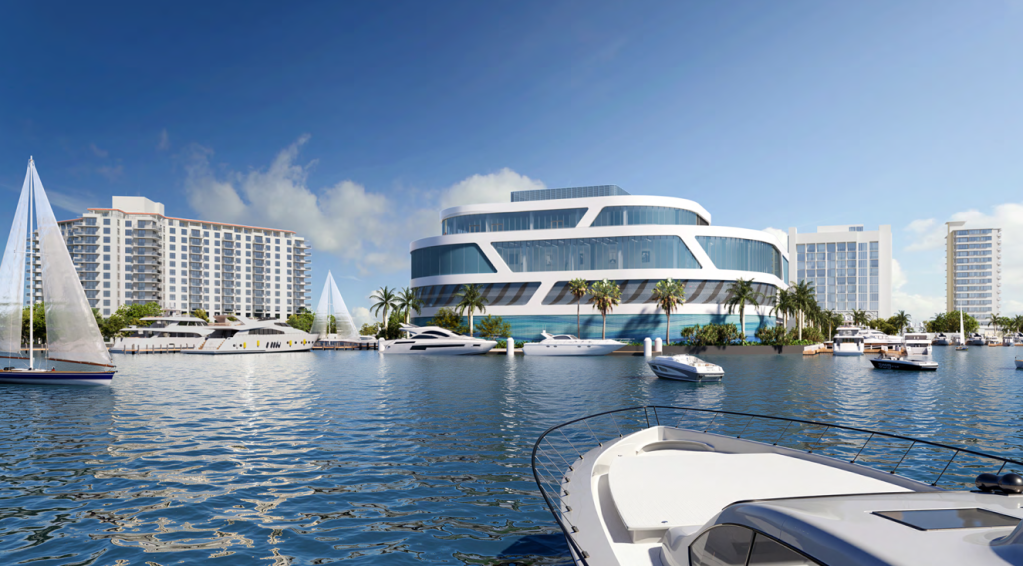
By December 2028, a new International Swimming Hall of Fame is expected to beckon tourists and locals alike with a family-friendly aquarium, museum and rooftop restaurant.
Two new Hall of Fame buildings will flank the pools and dive tower at the Fort Lauderdale Aquatic Center that all share the same city-owned peninsula at 501 Seabreeze Blvd., just a block west of State Road A1A, south of Las Olas Boulevard.
The design plans for the six-story building on the west side of the peninsula sailed through commission approval Tuesday night.
The unanimous vote came after months of back-and-forth discussions over the right height for a building that will perch so close to the Aquatic Center’s 27-meter dive tower.
In a nod to critics who worried the building would dwarf the famous dive tower, developer Mario Caprini and his team scaled back the west building’s height from the equivalent of 13 stories to six.
The redesign will mean less on-site parking for visitors, but Mayor Dean Trantalis and Commissioner Steve Glassman say it was a necessary compromise to safeguard views of the dive tower and surrounding neighborhoods.
The ambitious vision — launched more than five years ago with an unsolicited proposal to City Hall — will cost an estimated $220 million.
The new Hall of Fame is expected to have an impact of $70 million a year on the local economy, according to Caprini.
Crews will break ground on the west building as soon as June, said Caprini, CEO of Capital Group P3 of Florida and a partner in the project with Hensel Phelps Construction.
Caprini said he expects to have design plans for the east building ready for commission approval in the next six months.
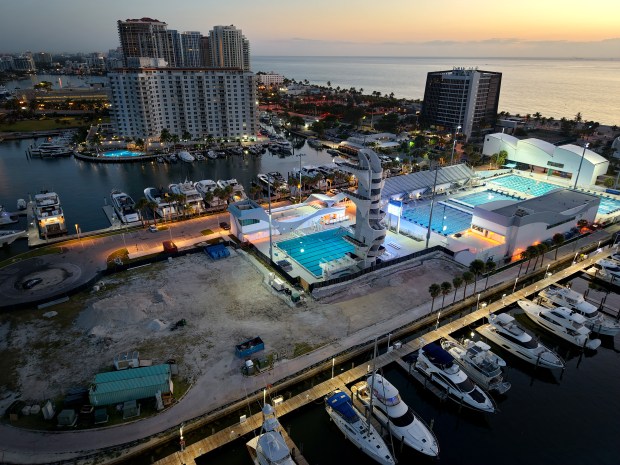 The Fort Lauderdale Aquatic Center, shown on Nov. 7, sits on the same city-owned peninsula as the International Swimming Hall of Fame. A developer plans to build two new Hall of Fame towers on the east and west end of the site. (Amy Beth Bennett/South Florida Sun Sentinel)
Plans for the east building call for a dive grandstand, retail shop and cafe, elevated promenade, dryland training and teaching pool.
Under current guidelines, the entire site requires 405 parking spaces but will only have 259, leaving the development short by 146 parking spaces.
Critics have expressed concerns about the lack of parking, but none spoke up during Tuesday’s commission meeting.
Debby Eisinger, a member of the Swim Fort Lauderdale Masters Team, did send an email to the commission Tuesday morning saying the shortage of parking remains a concern.
“One of the most significant and consistently voiced concerns has been the loss of on-site parking,” Eisinger, a former Cooper City mayor who now lives in Fort Lauderdale, said in her email. “Parking has been and continues to be a major concern. The option of off-site parking is not being well received by swimmers, particularly those who train daily and require convenient, reliable access.”
Bill Brown, president of the Central Beach Alliance neighborhood group, urged the commission to approve the design plan so the developer can finally get shovels in the ground.
“Some residents had concerns about this building being too high,” Brown said. “They brought the height down a couple floors. I know we’re losing parking spaces. But I think at the end, we’re all going to one day look back and just be so proud of what’s been accomplished.”
The west building went through significant design changes due to feedback from the swim community and neighboring condos, Glassman noted.
“We took two floors off that western building,” he said before the vote. “That means some parking was lost. You can’t have both. You’re either going to have the height, which no one wanted, or you’re going to lose some parking. It’s very difficult to have both.”
Stephanie Toothaker, attorney for the developer, told the commission that 176 parking spaces are required for the Aquatic Center and Ocean Rescue headquarters alone. The museum requires 61 spaces, the aquarium 43 and the restaurant 62.
But many people who come to the Hall of Fame might also swim at the pools or head to the restaurant, she added.
“So you don’t double count those spaces,” Toothaker said. “We are providing 259 parking spaces on site, which is a lot of parking. And there’s a tremendous amount of foot traffic. Not everybody is driving.”
Glassman and Trantalis suggested a shuttle service operated by the city or the developer could help get people from the Las Olas garage to the Hall of Fame.
“You might consider a dedicated shuttle service as an amenity so you don’t lose customers because people go there looking for a parking space and can’t find one and go away,” Trantalis said.
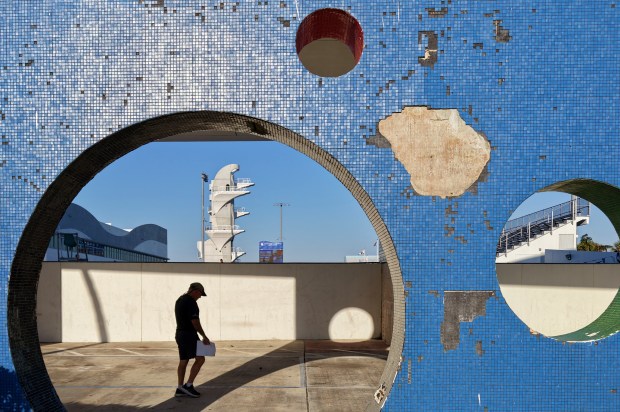 A man walks past the International Swimming Hall of Fame and Fort Lauderdale Aquatic Center on March 14, 2025. (Amy Beth Bennett/South Florida Sun Sentinel)
Vice Mayor John Herbst echoed that concern.
“I’ve had a number of calls about the parking as well,” he said. “I will just say I think this is probably a mistake. My personal preference would be to restore the height and put the parking back. I think cutting the height of the building and losing all that parking space is a mistake. Every time we’ve done a parking reduction in the city, we’ve always come back to regret it.”
Glassman defended the decision to lower the height of the building.
“People complained that we were dwarfing our beautiful high-diving tower,” Glassman said. “We made it very clear we were eliminating two floors of parking. It’s so hard to please everybody. But that’s why we did it. We didn’t just take two floors off for the heck of it or the fun of it. We took them off because that’s what everyone was clamoring for.”
Herbst said he was worried the lack of parking might hurt the bottom line for the new aquarium and museum — and the city.
Fort Lauderdale is expected to recoup money on the public-private project through revenue-sharing from tenants.
Fort Lauderdale is not borrowing the money, but is guaranteeing the debt.
If the project is a success, the city would see a gain of $1.1 million a year.
Under the deal, Fort Lauderdale will be required to contribute up to $13.6 million a year in lease payments over 30 years, bringing the city’s overall payment to $408 million. Under the original comprehensive agreement, Fort Lauderdale would have contributed up to $11 million a year toward the project, for a total of $330 million.
To help offset the increase in the master lease payment, the developer has agreed to increase other revenue that would be paid to the city from $2 million to $4.75 million.
The changes were approved by the commission in January.
“Anything that takes away from the customer experience is going to cut the number of patrons they have,” Herbst said on Tuesday. “And the reason I’m concerned about that is because we are guaranteeing the debt on that entire project. So if it doesn’t hit its revenue targets, we are the payer of last resort.”
Herbst told the commission he is less concerned with whether the swimmers are happy with the height of the building and more focused on whether the project is a financial success.
“I think this (lack of parking) has an impact on the business model,” Herbst said. “I hope I’m wrong.”
Susannah Bryan can be reached at sbryan@sunsentinel.com. Follow me on X @Susannah_Bryan