
As fishermen returned to the Lake Yale boat ramp to offload their catch for the day on Wednesday, many were curious about the barge hauling large blue tanks around and around on the water.Ray Powers made some small talk about their hauls as he looked down the canal onto the water he’s spent his whole life fishing on.”How many did you get?” Powers asked other fishermen before the conversation steered to the treatment that’s happening on the lake that the county describes as “monumental.”Powers, a fifth-generation Lake County native, owns property along Lake Yale and fishes here regularly.”I’m an endangered species, I’m a native of Lake County by that many generations,” Powers told WESH 2. “The lake means a lot to us because I grew up fishing on it. It’s had its troubles.”Like other anglers on Lake Yale, Powers has had to contend with unfortunate realities like algal blooms more and more frequently.Brewing under the surface, increased phosphorus levels have reduced water quality and led to habitat decline, leading to the state naming Lake Yale as the most impaired body of water in Lake County.”This is almost an emergency deal,” Powers said. “People don’t realize how critical it is.”Without action, county officials said, Lake Yale would be effectively a dead lake within just a few years time.”Lake Yale has had several algal blooms, they’re happening more frequently, for a longer period of time,” said Lake County Commission Chair Leslie Campione.“We’re just trying to find that right level that naturally would be occurring if we didn’t have the different things that naturally cause phosphorus levels to go up.”Lake County has begun a course of alum (or aluminum sulfate) treatment on Lake Yale, and WESH 2 got an inside look on the first day of the application.The treatment involves a barge moving around the lake on a daily basis and injecting alum into the lake bed.“Eighty percent of the nutrient that’s driving the poor water quality here is coming from the bottom of the lake,” said Dr. John Holz, a senior limnologist (or lake expert) with Solitude Lake Management.”We need to find a way to deal with the phosphorus that’s already in the lake, and that’s when the alum technology made sense for this lake.”Alum is used in the Apopka Beauclair Canal which feeds from Lake Apopka into the Harris Chain of Lakes. Holz and Campione said it is used in a multitude of bodies of water, both across the state and nationally, and has been for more than a century.But this is the first time it’s being applied in a public lake in Lake County.The hope, Campione said, is that the treatment will be successful and can be replicated to restore other impacted lakes in the county.“The hope is with this project we’re able to actually watch the results, we believe it’s going to be successful. It’s worked in other places in the country, it’s worked in other places in Florida,” she said.The treatment will be applied daily for a month and the cycle will repeat next year.“The fisheries will improve, over time the oxygen levels will improve,” Holz said. “We know a lot about it, we know that it’s safe, we know how to do the dose, we know how to apply it.” While Solitude is handling the application of the product, the treatment has been birthed from more than a decade of work by the Lake County Water Authority (or LCWA).“It’s a perfect fit for the issues we have at this lake,” said Robert Hendrick, Chairman of LCWA. “This should prove concept and we’ll be able to apply it in other lakes that have similar issues.” Hendrick said LCWA has worked alongside partners like the Florida Fish and Wildlife Commission (FWC), the St. Johns River Water Management District and the Florida Department of Environmental Protection.“I want to bring this lake back to the quality it was when I was younger and was able to water ski and swim and fish,” he said. Monitoring of the effects of the alum will be stringent, with tests being taken before, during and after the completion.“What we’re doing is one step in restoration in an effort to sort of bind those nutrients and not make them available for algal blooms or excessive impairments to water quality,” said Justin Elkins, Director of Water Resources for the County Commission and LCWA.“We don’t just get here to applying chemical. It takes a lot of sound science to get to this point.” In the meantime, all the parties affirm it is safe to eat any fish caught in Lake Yale.For longtime residents and fishermen like Powers, the prospect of restoring the lake back to the quality that existed when he was growing up is exciting.”We want it to be healthy,” he said. “It’s happening. And it’s important.”
EUSTIS, Fla. —
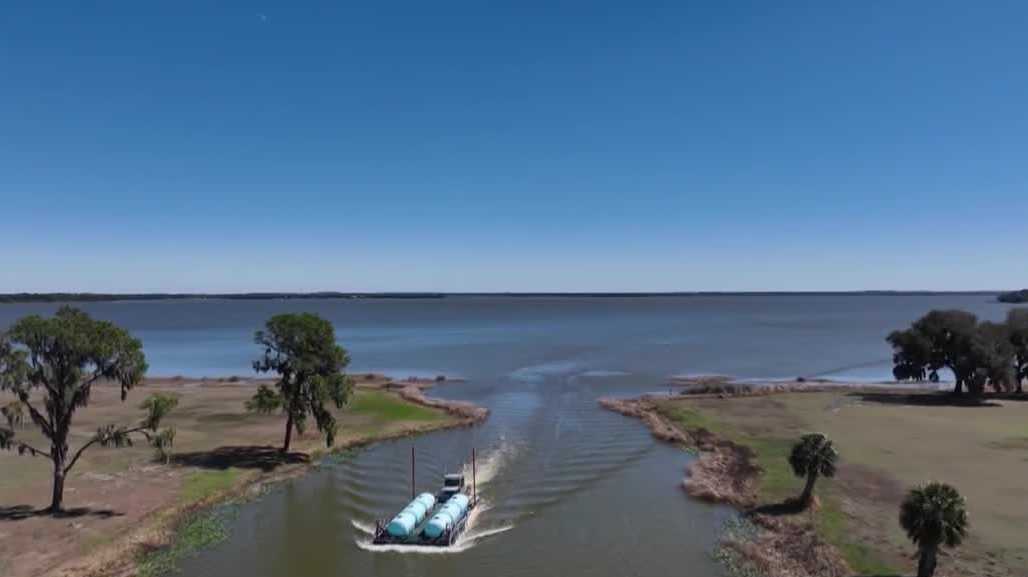
As fishermen returned to the Lake Yale boat ramp to offload their catch for the day on Wednesday, many were curious about the barge hauling large blue tanks around and around on the water.
Ray Powers made some small talk about their hauls as he looked down the canal onto the water he’s spent his whole life fishing on.
“How many did you get?” Powers asked other fishermen before the conversation steered to the treatment that’s happening on the lake that the county describes as “monumental.”
Powers, a fifth-generation Lake County native, owns property along Lake Yale and fishes here regularly.
“I’m an endangered species, I’m a native of Lake County by that many generations,” Powers told WESH 2. “The lake means a lot to us because I grew up fishing on it. It’s had its troubles.”
WESH 2 News
The race to save a dying lake in Central Florida
Like other anglers on Lake Yale, Powers has had to contend with unfortunate realities like algal blooms more and more frequently.
Brewing under the surface, increased phosphorus levels have reduced water quality and led to habitat decline, leading to the state naming Lake Yale as the most impaired body of water in Lake County.
“This is almost an emergency deal,” Powers said. “People don’t realize how critical it is.”
Without action, county officials said, Lake Yale would be effectively a dead lake within just a few years time.
“Lake Yale has had several algal blooms, they’re happening more frequently, for a longer period of time,” said Lake County Commission Chair Leslie Campione.
“We’re just trying to find that right level that naturally would be occurring if we didn’t have the different things that naturally cause phosphorus levels to go up.”
Lake County has begun a course of alum (or aluminum sulfate) treatment on Lake Yale, and WESH 2 got an inside look on the first day of the application.
The treatment involves a barge moving around the lake on a daily basis and injecting alum into the lake bed.
“Eighty percent of the nutrient that’s driving the poor water quality here is coming from the bottom of the lake,” said Dr. John Holz, a senior limnologist (or lake expert) with Solitude Lake Management.
“We need to find a way to deal with the phosphorus that’s already in the lake, and that’s when the alum technology made sense for this lake.”
Alum is used in the Apopka Beauclair Canal which feeds from Lake Apopka into the Harris Chain of Lakes. Holz and Campione said it is used in a multitude of bodies of water, both across the state and nationally, and has been for more than a century.
But this is the first time it’s being applied in a public lake in Lake County.
The hope, Campione said, is that the treatment will be successful and can be replicated to restore other impacted lakes in the county.
“The hope is with this project we’re able to actually watch the results, we believe it’s going to be successful. It’s worked in other places in the country, it’s worked in other places in Florida,” she said.
The treatment will be applied daily for a month and the cycle will repeat next year.
“The fisheries will improve, over time the oxygen levels will improve,” Holz said. “We know a lot about it, we know that it’s safe, we know how to do the dose, we know how to apply it.”
While Solitude is handling the application of the product, the treatment has been birthed from more than a decade of work by the Lake County Water Authority (or LCWA).
“It’s a perfect fit for the issues we have at this lake,” said Robert Hendrick, Chairman of LCWA.
“This should prove concept and we’ll be able to apply it in other lakes that have similar issues.”
Hendrick said LCWA has worked alongside partners like the Florida Fish and Wildlife Commission (FWC), the St. Johns River Water Management District and the Florida Department of Environmental Protection.
“I want to bring this lake back to the quality it was when I was younger and was able to water ski and swim and fish,” he said.
Monitoring of the effects of the alum will be stringent, with tests being taken before, during and after the completion.
“What we’re doing is one step in restoration in an effort to sort of bind those nutrients and not make them available for algal blooms or excessive impairments to water quality,” said Justin Elkins, Director of Water Resources for the County Commission and LCWA.
“We don’t just get here to applying chemical. It takes a lot of sound science to get to this point.”
In the meantime, all the parties affirm it is safe to eat any fish caught in Lake Yale.
For longtime residents and fishermen like Powers, the prospect of restoring the lake back to the quality that existed when he was growing up is exciting.
“We want it to be healthy,” he said. “It’s happening. And it’s important.”