
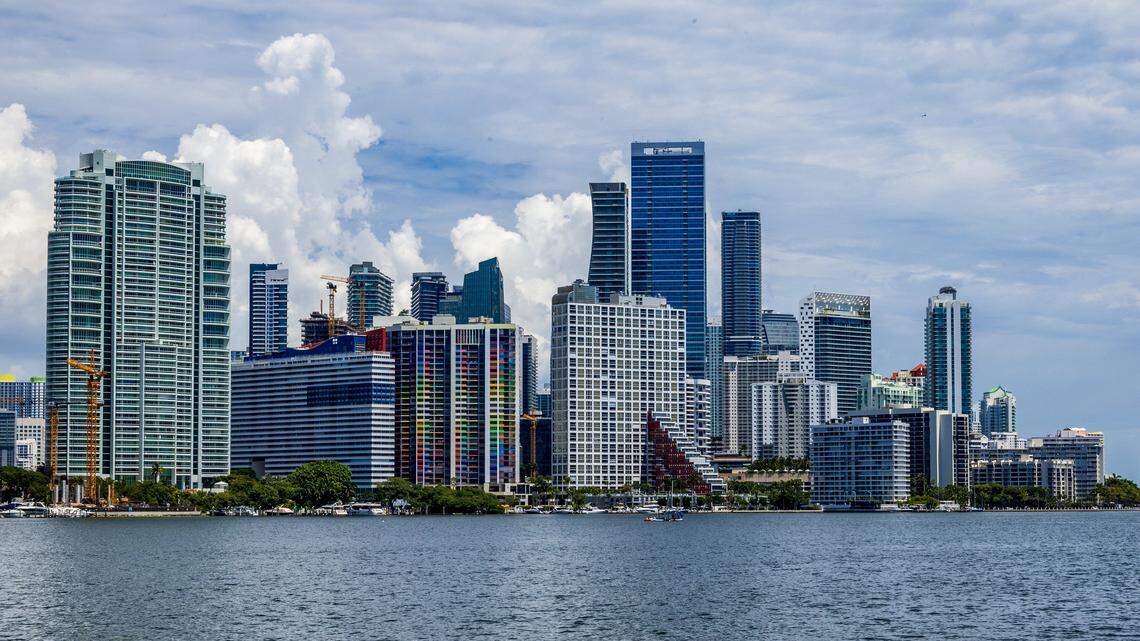
View of the Miami skyline from the Rickenbacker Causeway on Aug. 27, 2025.
Pedro Portal
pportal@miamiherald.com
The Stronger Miami coalition recently collected over 20,500 signatures to place a charter amendment on the 2026 ballot expanding the Miami City Commission from five seats to nine. Supporters argue this means better representation and an end to political dynasties. It is a well-intentioned idea. It is also completely unnecessary, and voters just proved it.
The argument behind this proposal has always been rooted in frustration. For years, residents felt that Miami’s entrenched political families (we all know who they are) were impossible to dislodge. Reformers concluded that more seats and more districts were the only path forward. If you cannot beat the dynasties, change the system.
I understood that frustration. I shared it. But the November 2025 election rendered this argument moot.
In a field of 13 mayoral candidates, voters chose two reform-minded outsiders for the runoff: me and Eileen Higgins. We hold opposing views on how to lead this city, but neither of us is a product of a local political dynasty. Voters chose us decisively over every other familiar name on the ballot. As the Miami Herald’s Editorial Board put it, voters “rejected some of the city’s longtime political players.”
The commission races told the same story. In Districts 3 and 4, newcomers Rolando Escalona and Ralph Rosado won their elections handily. Both won under the current five-district system. Neither is from a political dynasty.
So, I ask: If the justification for expanding the commission was that voters could not break the old power structures, and voters just broke through those power structures, why are we still talking about this?
Increasing the commission from five to nine members means additional district offices, staffs, budgets and commissioners with access to the discretionary spending that has fueled the very corruption reformers claim to oppose.
We have seen sitting commissioners use their positions and budgets for political patronage, self-promotion, no-bid contracts, no-work arrangements and weaponization of government. Are we prepared to increase those opportunities at a time when residents are demanding fiscal restraint and a minimum of ethical standards?
There is an even more dangerous risk. When a charter is fundamentally restructured with new districts and new seats, it creates a legitimate legal argument for termed-out politicians to claim they should be allowed to run again. If the office has been fundamentally altered, the old term limits arguably could no longer apply.
We saw a preview when Frank Carollo, a former Miami commissioner, argued his way onto the 2025 runoff ballot despite voters having just approved lifetime term limits. Imagine that multiplied across nine newly created districts. This charter overhaul could become a Trojan horse, reopening the door for the very dynasties that voters did not merely reject but voted overwhelmingly to ban for life.
A second component of this initiative also deserves scrutiny: moving city elections from odd years to even years. Supporters claim this would boost turnout and save money. The savings are real but modest.
The turnout argument, however, does not hold up under its own logic. If maximizing participation is the goal, why not hold the first round during the August primary and the runoff during the November general election? Nearly every Miami city race goes to a runoff. This would save even more money, eliminate runoff costs entirely, and guarantee the highest turnout for the decisive vote. The fact that proponents are not proposing this tells you their turnout argument is more political than principled.
Regardless, I would not move city elections to even years. Partisan statewide and national races will overwhelm the airwaves, dilute fundraising for local races and dominate coverage. Recycled politicians with leftover PAC funds would become immediate front-runners.
City voters evaluating local candidates will find it nearly impossible to cut through the noise of gubernatorial, senatorial, congressional and presidential campaigns. Odd-year elections may draw fewer voters, but those who show up are focused on their city.
The dynasties are finished, not because we added more seats, but because the people said “enough.” Miami does not need more commissioners. It needs better commissioners and engaged voters. And for the first time in a long time, that is exactly what it got.
Emilio T. González was a 2025 candidate for Miami mayor. Previously, he was a Miami city manager and director of U.S. Citizenship and Immigration Services under President George W. Bush. He is a partner/advisor for a financial services and investment firm.