
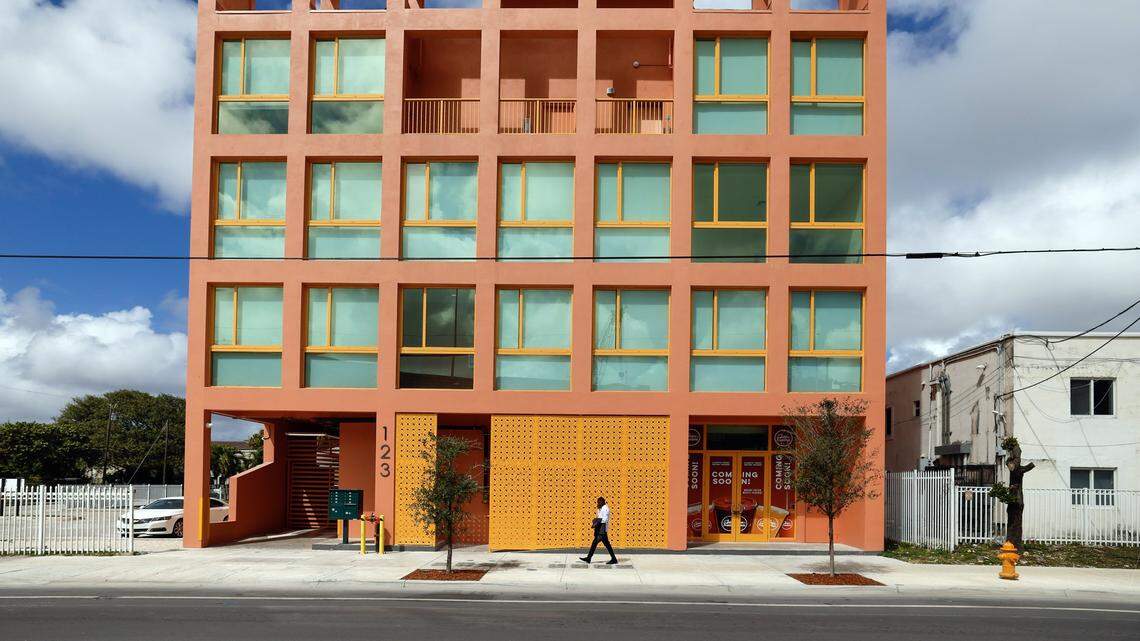
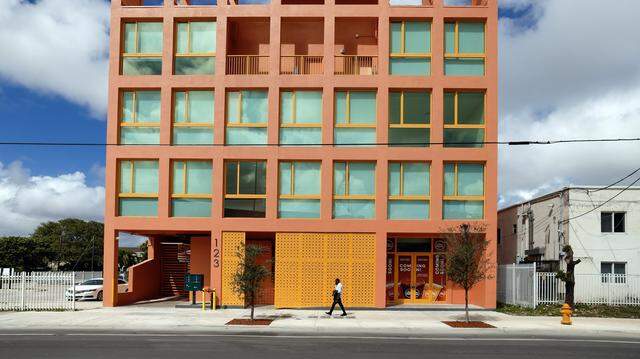
The new Project Peach building in Miami’s Overtown neighborhood takes its name and color from a one-time local staple, peach-flavored Cola-Nip soda. The compact building includes a forthcoming juice bar, office and community event spaces, and three affordable live-work apartments.
PHOTO BY AL DIAZ
adiaz@miamiherald.com
The first sign that there’s something unusual about the newly opened building in the heart of Miami’s Overtown is its color — a deep shade of peach, inspired by a bit of neighborhood soda-pop history.
The second is its simple yet sophisticated modern design, a street-front grid of floor-to-ceiling windows framed in yellow to pop out of the peach-colored structure.
And the third is its compact scale. At a time when extensive redevelopment in the core of Miami’s foundational Black neighborhood fills entire blocks with high-rise towers, Project Peach is wedged into a narrow, substandard lot and rises all of four stories.
But that’s precisely the point.
That modest but appealing envelope contains a multitude of uses, including a ground-floor shop that’s set to become a juice bar, a floor of offices for a community services group, three truly affordable apartments designed as both working and living spaces, an interior courtyard with private balconies for all, and a rooftop terrace for community events.
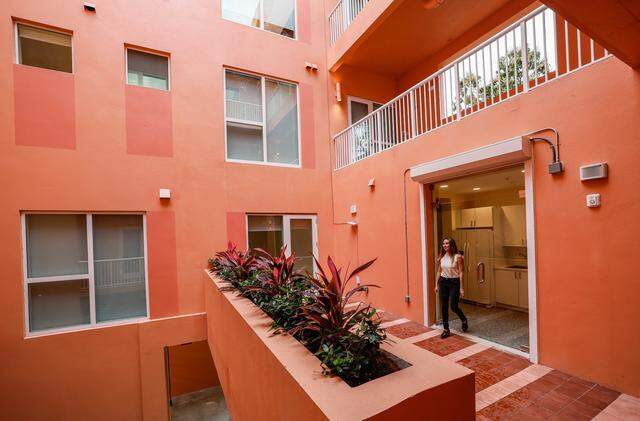 Developer Laura Weinstein-Berman shows off the office floor of her new Project Peach building in Overtown. Though built on a tiny lot, the building incorporates an open atrium and private terraces for its office and residential tenants to demonstrate the feasibility of compact redevelopment in historic Miami neighborhoods. PHOTO BY AL DIAZ adiaz@miamiherald.com
It’s meant to be an attention-grabbing example of what its sponsors believe a radically changing Miami badly needs but sorely lacks: low-cost yet well-designed housing and commercial space that could, in theory at least, be easily replicated to replenish historically walkable urban neighborhoods like Overtown by rebuilding on hard-to-redevelop lots at a human scale.
“Even though it’s a small project, it provides a model that is almost nonexistent in the city,” said Carie Penabad, who designed Project Peach with her husband and architectural partner, Adib Cure. “If you were able to do this kind of development on many lots, you can densify the city without losing the human scale that people love.”
Penabad and like-minded experts say the shortage of that intermediate, moderately priced scale in Miami and other U.S. cities, dubbed “the missing middle,” is a product of longstanding zoning restrictions and typical real-estate and development practices that favor two polar-opposite types of costly construction — detached single-family homes at one end and high-rises at the other, with little in between.
The national housing-affordability crisis has now spawned a movement to restore that middle scale of development, which once made up much of the fabric of U.S. cities, as an approach that could go a long way to easing the problem.
Right now, Penabad and Project Peach developer Laura Weinstein-Berman say, it takes dedication and creativity, as well as low-cost financing from private and public sources to secure affordable rents. But what their collaboration shows, they say, is that it’s eminently doable.
“We did it because there aren’t many precedents. We believed it was important to do. We need more people to see this is possible,” Penabad said.
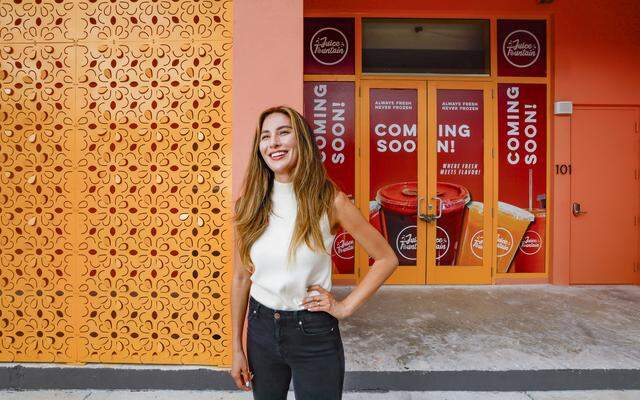 Laura Weinstein-Berman, owner and developer of Project Peach, an innovative but compact new building in Overtown that combines design flair with three affordable apartments, offices and a retail space on a small substandard lot. It’s an intense peach/salmon color that recalls a popular peach soda once produced in Overtown by a Black-owned company. PHOTO BY AL DIAZ adiaz@miamiherald.com The parking predicament
While the $2.6 million project, at 123 NW 14th St., serves as a demonstration, it’s also a revenue-generating business endeavor that must cover its costs, noted Weinstein-Berman, who is a for-profit developer.
“It’s nice to have a vision, but the numbers also have to work,” Weinstein-Berman said.
There’s one major impediment to building more of the “missing middle” that Project Peach only partially solved. Miami’s minimum parking standards that require most new buildings to accommodate cars, critics say, add substantial costs to housing development.
They can also make redevelopment unfeasible in the case of small lots in historic city neighborhoods like Little Havana or Overtown, where fitting in required parking and enough housing, rentable or sellable space to make a project work within the established middle-scale zoning limits is often impossible. Because those 1920s neighborhoods were built primarily with on-street parking only, their apartment buildings typically did not provide space for cars.
Zoning rules were changed in 1936 to accommodate increasing dependency on cars. One eventual consequence was that historic buildings and neighborhoods no longer conformed to the new rules and often had to make way for new development at a larger scale to accommodate parking on site.
“There was a moment when the city was given over to the car, and we forgot about the human experience,” Penabad said.
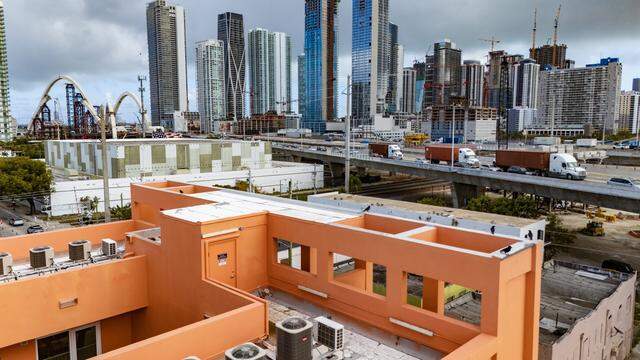 A terrace atop Overtown’s new Project Peach building, designed to demonstrate the feasibility of compact redevelopment on small lots in Miami’s historic neighborhoods, looks south to the downtown skyline. The terrace will host public events and exhibitions. PHOTO BY AL DIAZ adiaz@miamiherald.com
Weinstein-Berman was able to negotiate with a neighboring institution, the church-linked St. John Community Development Corporation, to use its parking lot for Project Peach’s office and retail tenants and visitors. But the city zoning officer insisted she provide three parking spaces for residential tenants on her property, which has a bus stop directly in front.
Those parking spots took the place of what could have been another retail space on the ground floor, she said.
Numerous cities across the country have eliminated or scaled back parking requirements, particularly in dense districts served by public transit. Those range from San Francisco, San Diego and Portland, Oregon, to car-focused Sun Belt towns like Austin, Texas.
Miami has lagged behind, however.
The city years ago did lift parking minimums for certain transit-heavy areas, like downtown, where some developers have built residential towers with no on-site parking, using shared parking in city or private garages nearby.
A 2015 measure that lifted minimum parking requirements for low-scale housing development along certain transit-heavy corridors led to construction of dozens of new buildings in Little Havana and other neighborhoods. But it was significantly curtailed by the City Commission seven years later after then-Commissioners Manolo Reyes and Joe Carollo complained it was making street parking hard to find in their districts, which included Little Havana.
While the more-liberal rule was still in place, Weinstein-Berman managed to build an 18-unit workforce apartment building in the city’s Health District with no on-site parking. Working again with Cure and Penabad, she also converted a set of three one-story 1940s Art Deco apartment buildings in East Little Havana into the El Jardin Inn. Because they were originally built with no on-site parking, she could do the renovation without adding any on the property.
Penabad said that kind of thinking — that on-site parking is essential — is outdated and counterproductive. Many Miamians will now gladly trade some convenience for affordable rents, she said. Some in dense urban neighborhoods don’t have cars or don’t need one on a daily basis. The first tenant to move into Project Peach, for instance, works nearby and uses a golf cart to get around.
“Why can’t you walk a block to park if your rent is $1,000 less?” she asked.
Across Biscayne Bay, the city of Miami Beach is now considering a proposal by Commissioner David Suarez that incorporates “missing middle” concepts to reverse the years-long decline of Washington Avenue. Suarez’ plan would rezone a full mile of the commercial corridor, from Fifth to Seventeenth streets, to encourage development of residential buildings of up to 75 feet in height, in part by lifting parking requirements.
The idea, he said, is to provide attainable housing for people who work and live in Miami Beach and walk or use transit to get around town, while providing a stable base for improved neighborhood retail.
Miami Beach, which has lost population in recent years, “has not kept up when it comes to housing,” Suarez said during a commission hearing on his plan earlier this year. “This is an opportunity to reimagine Washington Avenue as one of greatest places in Miami Beach for residents, not just visitors.”
A return to walkability 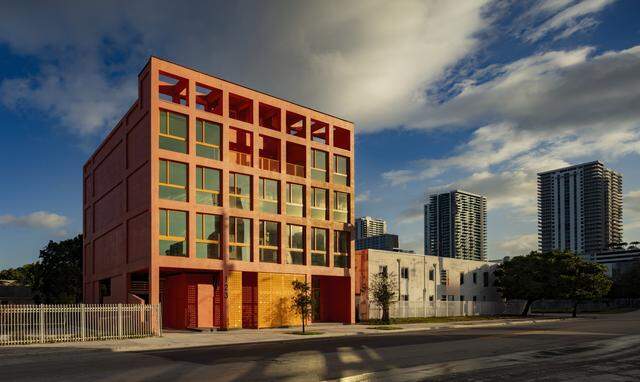 The new Project Peach building in Miami’s Overtown neighborhood takes its name and color from a one-time neighborhood staple, peach-flavored Cola-Nip soda. The compact building includes a forthcoming juice bar, office and community event spaces, and three affordable live-work apartments. Steven Brooke Steven Brooke
Penabad said Project Peach showed there’s a lot the city of Miami could do to encourage more projects like it. The project took nearly five years, in part because of the COVID-19 pandemic but also because of bureaucratic hurdles and complicated zoning and fire-safety rules that often don’t easily accommodate low-scale projects and sometimes make little sense, she said.
“The city just has to make it easier,” Penabad said. “The whole process has to be more streamlined.”
Project Peach got its start after Weinstein-Berman, a small developer focused on historic preservation and neighborhood projects, learned the Miami-based Knight Foundation had made flexible funding available to help launch local affordable housing initiatives. Though it’s one of Miami’s poorest neighborhoods, Overtown is also one of the city’s richest in historical terms, she said.
Before Overtown was decimated by highway construction and the end of legal segregation in the 1960s, its population was a mix of working-class people and an elite of lawyers, doctors and other professionals who often lived with their families above their offices in small buildings that made up a walkable, cohesive neighborhood, Weinstein-Berman noted.
That’s the model — mixed-use, in modern planning terminology — that Project Peach sought to emulate, she said.
“I’ve always been fascinated with the urban history of Overtown, and there was funding available for doing an interesting project, to make it feasible,” Weinstein-Berman said. “Fourteenth Street was a mixed-use thoroughfare with professional offices below and family above.”
Financing the project
To finance the project, the Florida Community Loan Fund, a nonprofit lender that supports community development projects in low-income areas, provided a low-cost $1.26 million loan. A portion of that funding, $500,000, came from a $1 million Knight Foundation grant to the fund to support affordable-housing development in Miami-Dade County.
The city of Miami’s Omni Community Redevelopment Agency (CRA), which helps finance projects in a portion of Overtown, then kicked in $1.3 million in the form of a forgivable loan.
The CRA money made it possible for Weinstein-Berman to keep rents for Project Peach’s three one-bedroom apartments affordable to people making just 50% of the city of Miami’s area median income of around $62,000, for a minimum of 30 years.
To design the project, Weinstein-Berman turned to Cure and Penabad, longtime faculty members at the University of Miami’s architecture school, where she studied. Penabad, whose private practice with Cure fuses historic architectural styles and modern design, was her favorite teacher at the school, Weinstein-Berman said.
“We always kept in touch, and they loved the challenge” of Project Peach, Weinstein-Berman said.
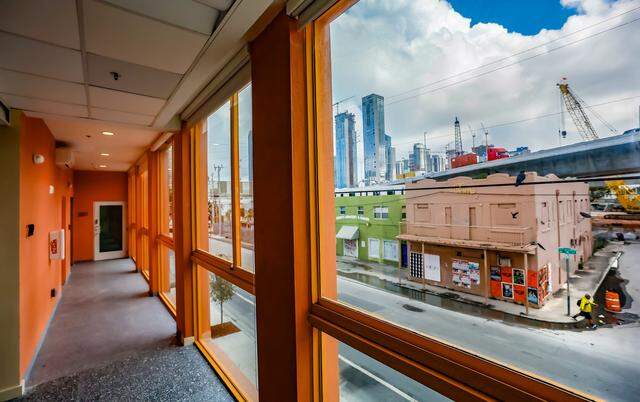 An office hallway with floor-to-ceiling windows in Overtown’s new Project Peach building overlooks a pair of 1920s buildings and the downtown Miami skyline. Built on a tiny lot, the building combines affordable apartments and commercial space to demonstrate the feasibility of small-scale redevelopment that fits into the city’s historic neighborhoods. PHOTO BY AL DIAZ adiaz@miamiherald.com
That challenge was significant. The lot Weinstein-Berman acquired for the project in 2021, for $500,000, is, at barely 3,000 square feet, only half the size of a typical Miami residential lot, Penabad said. Developers consider those “throwaway lots” because they are hard or impossible to build on, she said.
That’s not only because of parking minimums, but other building safety regulations that require two means of egress and two stairways. Those are requirements that Penabad, Weinstein-Berman and “missing middle” advocates argue are inefficient and unnecessary in a small building like Peach Project, eating up space that could be used in other ways.
City fire-safety officials, however, would not budge.
“No project is ever easy, but the city of Miami is just very difficult,” Weinstein-Berman said.
For inspiration, Penabad and Cure turned to their experience working in and traveling to dense Japanese cities, where it’s common to find buildings on compact lots that encompass a multiplicity of uses in creative ways. Another template, Weinstein Berman notes, sits across 14th Street: a pair of century-old two-story buildings, one the longtime home of neighborhood fixture Moore’s Grocery and Bakery, which has closed, with apartments over storefronts.
Cure and Penabad’s design solution to maximize the available footprint was to build to the lot lines but provide an interior courtyard lined with balconies that the offices and apartments all open out to. That means the offices and apartments have lots of natural light, plus the advantage of natural cross-ventilation, so that residents can turn off the AC and open the expansive windows to save money and enjoy fresh air.
The front portion of the apartments, facing south and providing panoramic views of Overtown, the downtown Miami skyline, and the new beveled and elevated Interstate 395 overpass through the floor-to-ceiling windows, is roomy enough for residents to work in or run businesses from home. All three apartments are leased.
The second floor is an office suite. Weinstein-Berman is negotiating a lease with a medical group that provides free community services.
On the fourth floor, there’s an open terrace and an enclosed space for community events. First up is a planned exhibit by Overtown photographer Zykeria Rolle.
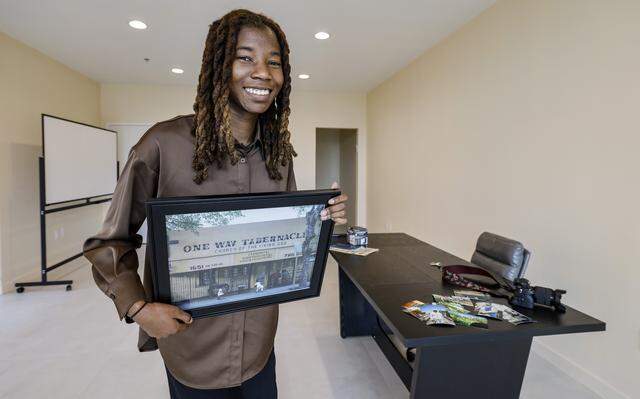 Photographer Zykeria Rolle holds one of her images of Overtown that will be shown as part of the inaugural exhibition at the rooftop gallery in the neighborhood’s new Project Peach building. The project combines affordable apartments, offices, and community and retail space on a tiny lot to demonstrate the feasibility of compact redevelopment in Miami’s historic neighborhoods. PHOTO BY AL DIAZ adiaz@miamiherald.com
Penabad said the building’s south-facing facade is a perfect square, and the interiors are designed according to “golden ratios,” classic mathematical proportions derived from nature and the human body that produce pleasing spaces for people.
And what about that color? Cure and Penabad turned to a long-vanished neighborhood hallmark, the Black-owned Cola-Nip Bottling Company, which produced a popular Peach Whip soda-pop drink. They blended peach and salmon Benjamin Moore colors to replicate the drink’s trademark hue.
The company’s 1925 building, a designated historic landmark a half-dozen blocks from their project, was razed in 2002 after it partially collapsed because of longtime neglect.
But its memory lives on in Project Peach.
“It attests to design, that we don’t have to lose our design sensibilities in that market,” Penabad said. “We can still provide something that people can care about.”

Miami Herald
Andres Viglucci covers urban affairs for the Miami Herald. He joined the Herald in 1983.