
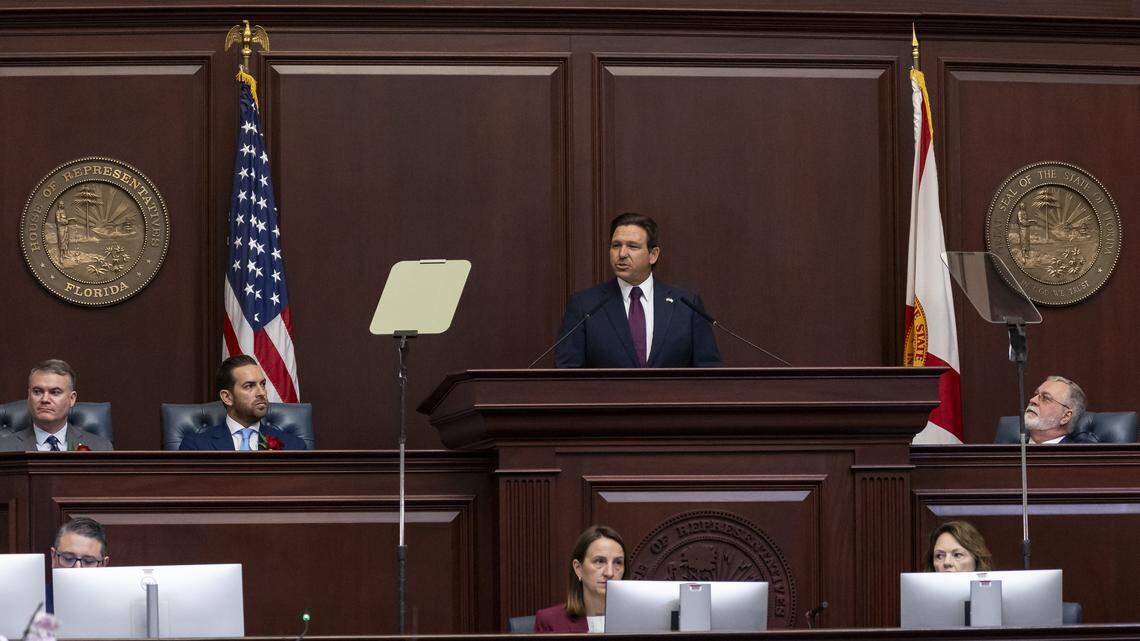
Gov. Ron DeSantis delivers his State of the State address as Florida House Speaker Daniel Perez, R-Miami, and Florida Senate President Ben Albritton, R-Wauchula, listen on Jan. 13, 2026, in Tallahassee.
Photo by Matias J. Ocner
mocner@miamiherald.com
A new poll confirms something we have been saying for more than a year about the priorities of Floridians: Affordability is the top concern — more than political polarization or immigration.
And that holds true across party lines and demographics, according to the recent poll conducted by the Public Opinion Research Lab (PORL) at the University of North Florida.
Other worries aren’t even close. Asked what they think is the most important problem facing Florida, a full 50% of respondents said affordability and cost of living are No. 1. Political division and polarization came next, at 12%, while immigration — something the state is spending hundreds of millions of dollars on at the behest of Gov. Ron DeSantis — was the top concern of only 8% of those polled.
When are state lawmakers going to act like they understand that very basic fact? There are less than two weeks left in the annual session in Tallahassee, and we are still waiting. Lawmakers seem to only see one way to attack the affordability problem — rolling back property taxes — by pushing a bill that probably isn’t going anywhere and definitely shouldn’t.
The proposal — HJR203 — is far too extreme, eliminating all non-school property taxes for homesteaded properties, with the likely result that it will hollow out local governments and harm other organizations such as Miami-Dade County’s public hospital system. Miami-Dade County could lose as much as $2.3 billion a year. Smaller cities and towns could face financial devastation.
Tackling the critical issue of affordability requires more than property tax relief alone. There’s been no action this year on property insurance, a major pain point for Floridians, but what about creating more affordable housing? That’s supposed to be the goal of the controversial Live Local Act Law: creating more affordable housing by overriding local regulations that can get in the way. This session, Tallahassee lawmakers are trying to tweak it to allow housing to be built on land owned by schools and governments and to build more duplexes and other multifamily dwellings in single-family neighborhoods.
We’re glad they’re trying to make the law work better, but the real trick is making that new construction truly affordable. Live Local may spur construction of more “workforce housing” — defined as rentals for residents earning up to $148,680 per year for a household of four in Miami-Dade — but that doesn’t do much for those making less, say under $100,000 for the same family size.
We understand these laws may take a while to work, but affordability should be foremost on lawmakers’ minds. Even if they aren’t very interested in doing something real to help Floridians struggling to afford living here, they’re usually pretty good at remembering their own self-interest: Mid-term elections are in November. President Trump’s approval ratings don’t look good. (And he tried to dismiss the problem of affordability as a “hoax” perpetuated by Democrats.) Republicans are in charge of the House, Senate and the governor’s office in Florida.
The University of North Florida poll, by the way, found the property tax issue had less support than might be needed to pass it. About 56% supported the idea of a constitutional amendment that would phase out taxes on homesteaded property — but any property tax measure that makes it onto the November ballot would require 60% of voters approve it. This is far from a new idea. DeSantis has been talking about cutting property taxes for at least a year.
The poll is just a snapshot, conducted between Feb. 21 and March 2, with a margin of error of four percentage points. But it highlights something lawmakers must focus on: Affordability is becoming such a big issue, it’s blotting out everything else.
The tax rollback idea is probably headed to a special session. There’s already one scheduled in April for DeSantis’ congressional redistricting efforts. November is barely half a year away. If Floridians aren’t being heard by lawmakers now, they may be ready to speak up, loud and clear, at the ballot box.
BEHIND THE STORY MORE What’s an editorial?
Editorials are opinion pieces that reflect the views of the Miami Herald Editorial Board, a group of opinion journalists that operates separately from the Miami Herald newsroom. Miami Herald Editorial Board members are: opinion editor Amy Driscoll and editorial writers Isadora Rangel and Mary Anna Mancuso. Read more by clicking the arrow in the upper right.
What’s the difference between an op-ed and a column?
Op-Eds, short for “opposite the editorial page,” are opinion pieces written by contributors who are not affiliated with our Editorial Board.
Columns are recurring opinion pieces that represent the views of staff columnists that regularly appear on the op-ed page.
How does the Miami Herald Editorial Board decide what to write about?
The Editorial Board, made up of experienced opinion journalists, primarily addresses local and state issues that affect South Florida residents. Each board member has an area of focus, such as education, COVID or local government policy. Board members meet daily and bring up an array of topics for discussion. Once a topic is fully discussed, board members will further report the issue, interviewing stakeholders and others involved and affected, so that the board can present the most informed opinion possible. We strive to provide our community with thought leadership that advocates for policies and priorities that strengthen our communities. Our editorials promote social justice, fairness in economic, educational and social opportunities and an end to systemic racism and inequality. The Editorial Board is separate from the reporters and editors of the Miami Herald newsroom.
How can I contribute to the Miami Herald Opinion section?
The Editorial Board accepts op-ed submissions of 650-700 words from community members who want to argue a specific viewpoint or idea that is relevant to our area. You can email an op-ed submission to oped@miamiherald.com. We also accept 150-word letters to the editor from readers who want to offer their points of view on current issues. For more information on how to submit a letter, go here.