
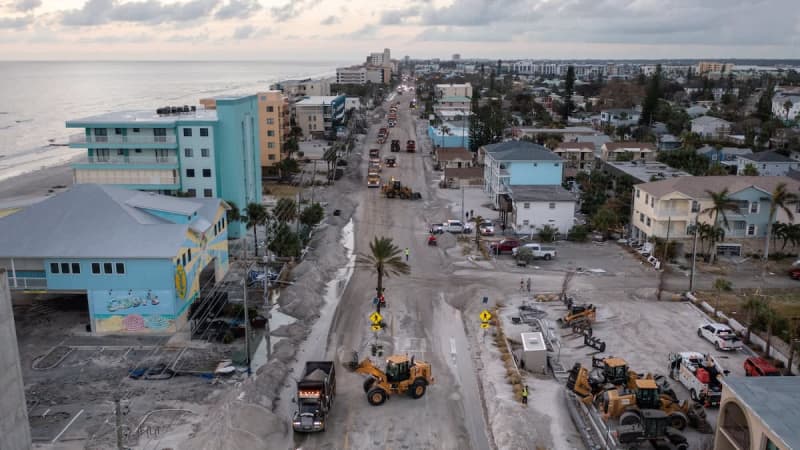
Florida homeowners now pay an average of $5,838 a year to insure their homes, the third highest in the nation. In parts of the Keys, premiums top $18,000. In Miami, $10,000. In Clearwater and St. Petersburg, the low $5,000s. And more than 1.2 million owner-occupied homes have no insurance at all.
What’s the state Legislature doing about it? Not much. And, like it or not, the inaction is largely by design.
During the current session, lawmakers filed a few property insurance bills, but most appear unlikely to survive the legislative gauntlet. Don’t expect another sweeping round of reforms like the ones a few years ago.
Back then, homeowners were struggling with average annual premiums of about $3,000. They were painful enough to require three separate special sessions of the Legislature.
Those previous reforms — limiting litigation, curbing contractor schemes, pushing customers off the state-owned insurer — are working and need more time to help the market “continue to organically recover, without fear of any major legislative or regulatory disruptions,” the state office that regulates insurance said before the start of this year’s legislative session. Translation: Lawmakers stay out of the way.
For anyone who just opened another five-figure renewal notice, the hands-off strategy could be infuriating. But they may have to accept it. Some of the state’s most powerful officials are on board.
The $5,838 average premium comes from a recent Bankrate report, which examined the cost to insure a $300,000 dwelling across the country. Florida’s cost is behind only tornado-prone Nebraska and everything-prone Louisiana.
The average price is a bit misleading. Most cities fall below it: $2,199 in Tallahassee. Under $3,800 in Tampa.
But the high end is really high, which pushes the average up. In Key West, the average is $18,545, according to Bankrate.
The real measure of the crisis might not be what Floridians are paying, but how many stopped paying altogether. The 1.2 million owner-occupied homes — out of 6.2 million — without insurance place Florida sixth-highest in the nation. These aren’t vacant properties or vacation homes. They’re where people live, with no insurance buffer the next time a hurricane strikes.
Last year, the state released data showing that most policyholders saw costs rise for covering their single-family homes in the first part of 2025. Companies that raised their average premiums insured two-thirds of the customers, the South Florida Sun Sentinel reported in August. Only one-third were with companies that posted decreases.
That may be changing. The same state office reported in January that more companies are now lowering rates or keeping them flat. The state insurance office, the Florida Chamber of Commerce and industry trade groups all say the market is “stabilizing.” Of course, “stable” doesn’t mean cheaper. It can mean the bills stay high — or climb more slowly. That’s the math of averages.
As for more potential relief, the state House overwhelmingly passed a bill that would pull back the curtain on how insurance companies use affiliates to shift profits, a practice a powerful Times story helped spotlight. The insurance industry in Florida isn’t known for its transparency. It often invokes “trade secrets,” though that excuse is stretched spiderweb-thin. Companies have even shielded their policy manuals from outside scrutiny, despite mailing those same manuals to new customers. The opacity breeds mistrust, especially when another eye-popping insurance bill lands in the mailbox.
But that House bill faces long odds in the Senate.
Ben Albritton, the Senate president, warned last month not to expect any major changes to property insurance this year. He told reporters that the previous reforms, combined with the lack of storms last year, should ensure some rate relief. He emphasized that Florida has a cap on insurance company profits, and more companies are seeking rate reductions.
“Why would I mess around with that when we’re moving in a great direction?” he said.
For years, our leaders kept saying rates would drop or at least stabilize. They counseled patience. But overall, the costs remained frustratingly high.
Now, the message is familiar — relief is here for some and coming for others; hang on a little longer. And pray the hurricanes stay away.
Floridians have heard that before.