
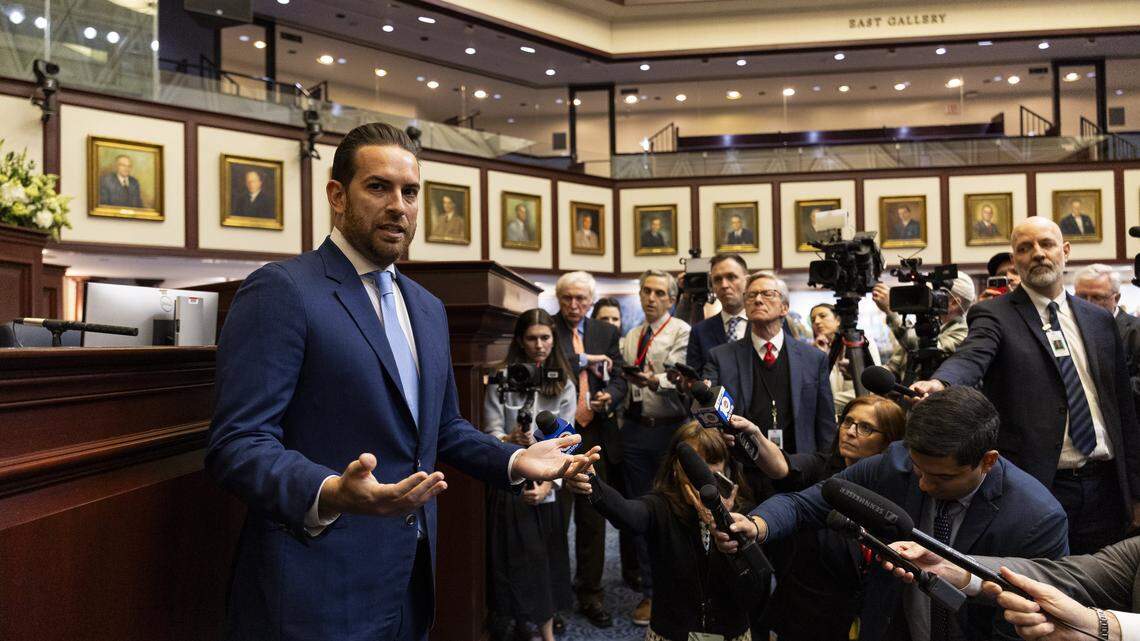
Florida House Speaker Daniel Pérez, R-Miami, voted for a bill that would change how Miami-Dade County deals with its Urban Development Boundary.
Matias J. Ocner
mocner@miamiherald.com
Unfortunately, we cannot count on the Miami-raised Florida House speaker — and most of our Republican legislative delegation — to stop bad legislation that attacks Miami-Dade’s autonomy to prevent urban sprawl from reaching into the Everglades.
How disappointing.
On Wednesday, the Florida House voted 71-38 to pass House Bill 399. The proposal, filed by Doral Republican Rep. David Borrero, would make it easier to approve development beyond Miami-Dade’s Urban Development Boundary. The UDB protects rural and environmental lands by limiting construction outside the 78-mile-long legal line.
Currently, a super majority of the 13-member Miami-Dade County Commission is required to approve changes to land use outside the UDB. The bill would reduce that to a simple majority of commissioners present at a hearing, as few as four votes.
The bill also requires the state to “conduct a study to identify the effect of removing” the UDB or similar boundaries in other counties. That looks like a precursor to the Legislature eventually eliminating the line.
It’s troubling that lawmakers who live hundreds of miles away from South Florida would threaten this important boundary line and infringe on Florida’s tradition of local home rule. Sadly, they got plenty of help from Miami-Dade’s own delegation. These lawmakers represent people who will be directly affected if the county is forced to allow construction too far outside the existing urban core.
If more homes are allowed west of West Kendall, for example, where will those extra cars go? Florida’s Turnpike, the Dolphin Expressway and other congested roadways.
Voting in favor of HB 399 was House Speaker Daniel Perez, according to House records. He represents District 116, stretching from the Dolphin Expressway, along the Turnpike, south to Southwest 88th Street and the Don Shula Expressway — areas notorious for downtown-bound traffic.
Other Miami-Dade House members also voted for the bill: Republicans Tom Fabricio; Alex Rizo; Demi Busatta; Omar Blanco; Mike Redondo and Juan Carlos Porras.
Voting against HB 399 in the local delegation were Democratic Reps. Felicia Robinson, Wallace Aristide, Ashley Gantt and Kevin Chambliss, and Republicans Fabian Basabe and Jim Mooney. Basabe represents Miami Beach, the apparent target of another provision in the bill that would likely allow the Fontainebleau hotel to build a controversial water park that residents oppose.
The Senate has yet to approve the legislation and, luckily, influential Miami Republicans there are speaking up against this ill-conceived idea.
Sen. Alexis Calatayud co-authored an opinion article in the Miami Herald on Tuesday opposing the legislation. She called the UDB a tool to protect South Florida’s supply of “drinking water, reduce flooding risk, preserve farmland and safeguard the Everglades.”
Local Republican Sens. Ana Maria Rodriguez and Ileana Garcia also oppose HB 399. Garcia told the Herald: “How can we pursue federal funding for the protection and restoration of the Everglades while we pass state legislation to decimate it?“
Meanwhile, Borrero is pushing his bill as a solution to South Florida’s housing shortage, a misguided idea at best.
“… You have local government regulations that are preventing people from supplying inventory to a much-needed market,” he said on the House floor Tuesday. “You don’t have enough land, and you don’t have enough housing to meet the demand, and that is why the cost of housing has skyrocketed.”
Expanding the size of the county’s urban areas into the Everglades may seem like a way to increase supply and affordability. But that ignores that the county has policies to incentivize new construction along transit corridors and close to existing infrastructure.
Miami-Dade is indeed running out of land for single-family homes within the UDB. But the county has designated areas where the line could be expanded with permission from commissioners. The problem starts when developers who cannot win enough commission votes — or cannot overcome a mayoral veto — use state law to preempt local authority.
As the Herald Editorial Board recently wrote, there are instances when a state preemption might be warranted to facilitate the construction of housing, but only when it leads to true affordability. That is not the case with HB 399.
As Robinson, one of the lawmakers who voted against the legislation, told the House on Tuesday, “this bill seems to be addressing developers” instead.
BEHIND THE STORY MORE What’s an editorial?
Editorials are opinion pieces that reflect the views of the Miami Herald Editorial Board, a group of opinion journalists that operates separately from the Miami Herald newsroom. Miami Herald Editorial Board members are: opinion editor Amy Driscoll and editorial writers Isadora Rangel and Mary Anna Mancuso. Read more by clicking the arrow in the upper right.
What’s the difference between an op-ed and a column?
Op-Eds, short for “opposite the editorial page,” are opinion pieces written by contributors who are not affiliated with our Editorial Board.
Columns are recurring opinion pieces that represent the views of staff columnists that regularly appear on the op-ed page.
How does the Miami Herald Editorial Board decide what to write about?
The Editorial Board, made up of experienced opinion journalists, primarily addresses local and state issues that affect South Florida residents. Each board member has an area of focus, such as education, COVID or local government policy. Board members meet daily and bring up an array of topics for discussion. Once a topic is fully discussed, board members will further report the issue, interviewing stakeholders and others involved and affected, so that the board can present the most informed opinion possible. We strive to provide our community with thought leadership that advocates for policies and priorities that strengthen our communities. Our editorials promote social justice, fairness in economic, educational and social opportunities and an end to systemic racism and inequality. The Editorial Board is separate from the reporters and editors of the Miami Herald newsroom.
How can I contribute to the Miami Herald Opinion section?
The Editorial Board accepts op-ed submissions of 650-700 words from community members who want to argue a specific viewpoint or idea that is relevant to our area. You can email an op-ed submission to oped@miamiherald.com. We also accept 150-word letters to the editor from readers who want to offer their points of view on current issues. For more information on how to submit a letter, go here.