
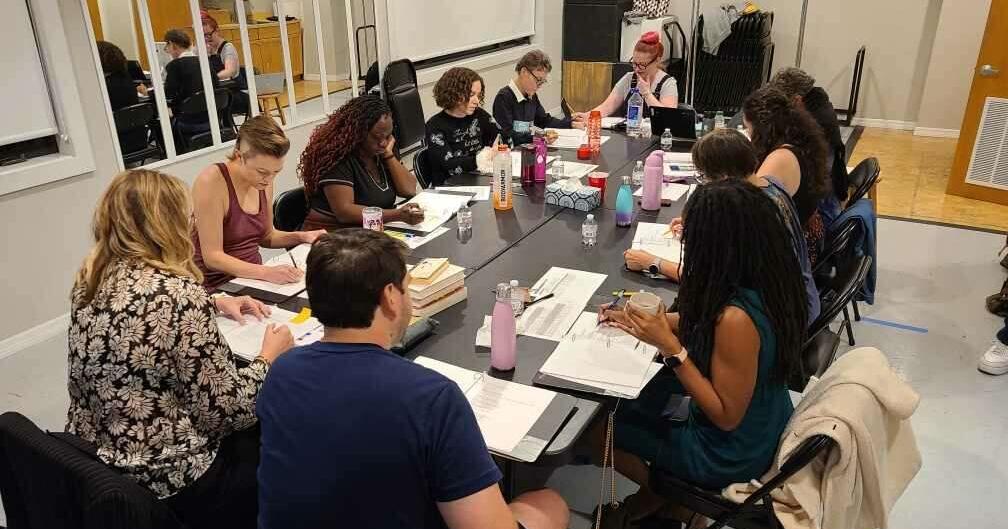
ST. PETERSBURG — An all-women adaptation of “Julius Caesar” will arrive in time for the Ides of March, running March 12-22 at The Studio@620, 620 First Ave. S., St. Petersburg.
General admission tickets are $40 a person, discounts available for studio members, seniors and students. Visit thestudioat620.org/events/julius-caesar/.
This production will offer a raw, intimate examination of power, loyalty, and civic responsibility at a moment when those questions feel urgently unresolved. Directed by Kristin Clippard and adapted by local award-winning artist Roxanne Fay, the production reframes Shakespeare’s political tragedy through an all-women ensemble, stripping the story of inherited assumptions and exposing the human cost beneath political violence.
At its core, “Julius Caesar” follows a tight-knit group of senators who fear Caesar’s growing power and decide to act. As their conspiracy unfolds, the play becomes a study of ambition, betrayal, persuasion, and fear — not as abstract ideas, but as deeply personal choices with irreversible consequences. In this adaptation, conspirators, orators, and citizens alike are portrayed by women, allowing familiar roles to be seen with renewed clarity and urgency.
The all-women casting is not a novelty, but an intentional artistic intervention. By placing women in roles historically written for men, the production reframes how authority is performed and perceived onstage — who is trusted, who is believed, and who bears responsibility when institutions fracture. Power is revealed not as gendered, but as systemic and human, shaped by fear, ego, loyalty, and the desire to do what feels necessary in the moment.
The ensemble brings together some of the sharpest women working across Tampa Bay’s stages today. The cast features Roxanne Fay, Robin Gordon, Sara Nower, Jenna Jane, Alexa Perez, Jada Griffin, Jemier Jenkins, and Jennifer Casler — artists known for their range, rigor, and commitment to emotionally grounded storytelling. Together, they form a company capable of holding Shakespeare’s language while interrogating its relevance with precision and urgency.
“‘Julius Caesar is often called timeless — and that’s a sobering reality,” said Fay. “Written in the sixteenth century, the play remains painfully relevant as a cautionary tale about the corruption of power, unchecked ambition, and the manipulation of public opinion. What feels most urgent today is the reminder that these struggles are not confined to men or to any single group. As women increasingly hold positions of leadership and influence, this story no longer belongs to a male-centric world alone. By reimagining ‘Julius Caesar’ with an all-women cast, I hope to reveal that the seeds of destruction — and the potential for repair — exist within all of us. We all bear witness. We all share responsibility.”
Director Kristin Clippard emphasized the immediacy of the play’s themes.
“The questions at the heart of Julius Caesar — loyalty versus betrayal, liberty versus tyranny, duty versus ambition — feel impossible to ignore right now,” she said. “Was this play written in 1599, or just last week? Seeing women step into these roles invites audiences to reconsider how power operates and how leadership decisions are shaped by fear, honor, and the human impulse to choose what feels like the least harmful path.”
Rather than presenting Shakespeare as distant history, the production treats Julius Caesar as a living inquiry into democracy under strain. Themes of polarization, misinformation, civic fear, and eroding public trust resonate sharply with contemporary audiences. The play offers no easy answers; instead, it invites reflection, conversation, and reckoning.
“Theatre functions as social infrastructure,” said Erica Sutherlin, artistic executive director of The Studio@620. “Live performance brings people into a shared, embodied space at a time when disconnection is the norm. Through storytelling, theatre builds empathy, emotional literacy, and civic imagination — all essential to a healthy community.”
Audiences may not leave debating whether they “liked” the play. They leave considering power, responsibility, and their own role within the systems that shape collective life. This all-women Julius Caesar uses a classic text to interrogate modern leadership and reminds us that democracy is not inherited — it is practiced, questioned, and rebuilt by the people within it.
This production turns Shakespeare’s story of conspiracy and betrayal into a modern warning about how power corrupts and public trust collapses. In an era of polarized politics and viral misinformation, the play reminds us how quickly societies can fracture when fear replaces truth.
Beyond the stage
To extend the conversation beyond the stage, The Studio@620 will host Arts Passport Book Club — The Silence of the Girls, set for Sunday, March 15, with a 2 p.m. book discussion, followed by a 3 p.m. performance of “Julius Caesar.”
This community-centered event invites audiences to engage with the themes of “Julius Caesar” through discussion, reflection, and shared space.
In partnership with The Tampa Bay Arts Passport, March’s book club centers women’s voices in stories of power and war. Participants will read “The Silence of the Girls” by Pat Barker, a searing retelling of “The Iliad” told from the perspective of the women enslaved by its heroes. The novel’s examination of violence, agency, and historical silence creates a resonant companion to the exploration of leadership, loyalty, and moral consequence in “Julius Caesar.”
To sign up for the Arts Passport Book Club event, visit www.tbartspassport.com/arts-passport-book-club/.
About The Studio@620
For more than 20 years, The Studio@620 has been a cultural cornerstone in St. Petersburg, a place where creativity, conversation, and community converge. Under the leadership of Artistic Executive Director Erica Sutherlin, the studio is entering a new era with a renewed mission: to ignite cultural vibrancy and propel creative careers by connecting artists, audiences, and collaborators across disciplines. With a commitment to equity, access, and radical imagination, The Studio@620 provides space for exhibitions, performances, residencies, and community partnerships that reflect and shape the stories of our time.
Learn more at thestudioat620.org.