
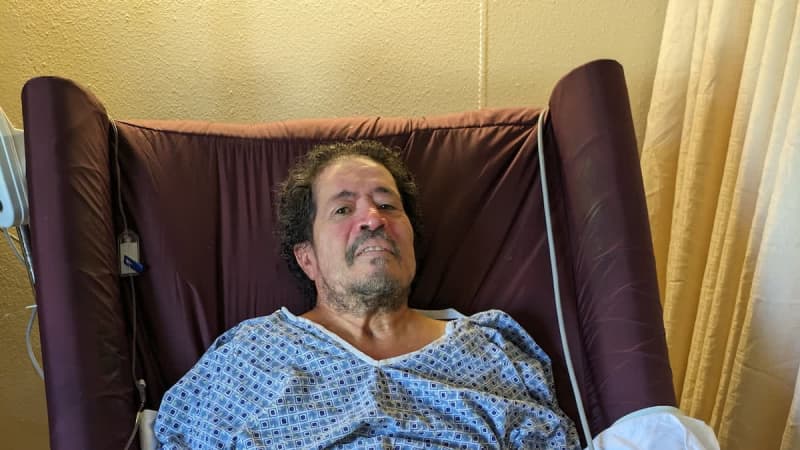
In 2021, Jose Correa was in a crosswalk at the intersection of Le Jeune and Bird roads when a Miami-Dade County bus making a left-hand turn slammed into him. After a lawsuit, the county settled for $4.3 million for Correa’s injuries.
Two years later, Heriberto A. Sanchez-Mayen, arrested for sleeping in a St. Petersburg Park during the day,was so abused by police en route to the Pinellas County Jail that he had to have both legs amputated above the knees. The city settled for $2.5 million.
In practicality, those settlements were only a ticket to a new fight for compensation, this time with the Florida Legislature.
Under state law, no one can get more than $200,000 from a judgment or settlement against the government in cases of negligence without the Legislature passing a bill to pay out the rest. State agencies, cities, counties, sheriffs’ offices, state universities, public hospitals and schools are immune from payment in negligence lawsuits above that amount without legislative intervention.
Lawmakers have taken up the call eight times this legislative session to pay out injured Floridians and tourists — who together are owed a collective $47.2 million — for injuries caused by local governments, distinct from other claim bills moving this session for injuries caused by state agencies. With session scheduled to wrap on March 13, the Legislature has passed just two of those bills, including one that would pay Sanchez-Mayen his remaining $2.3 million.
But some lawmakers think it should be easier for injured Floridians and tourists to get a bigger slice of the money they are owed from settlements and judgments against state and local governments. A bill in the Senate, SB 1366, would increase the payment cap per injured person to $350,000. A bill in the House, HB 145, would go further and increase the payment cap per person to $500,000.
The Senate bill would also increase the payment cap per incident when more than one person is owed damages, from $300,000 to $500,000. The House bill would increase it to $1 million.
State representatives passed the House bill in January 104-7. A third committee passed the Senate version 21-1 on Tuesday. It is ready for a full vote by the chamber.
Florida’s payment caps haven’t increased since 2011. But lawmakers have been trying to raise them for years. The negotiations fall apart amid pushback from representatives of local governments who say they can’t afford the increases. The Senate sponsor, Jason Brodeur, a Sanford Republican, pushed back on those arguments this year, saying the proposed increases are essentially the same as they were when first set, after being adjusted for inflation.
“This money is going into places to compensate people who have been avoidably harmed by municipalities who admit they already did it,” Brodeur said while debating the bill in committee. “And so, at some point, this is going up. Maybe it’s this year, maybe it’s next year.”
Brodeur added: “We are trying very hard to have a reasonable place to land, so that all counties equitably feel exactly what they felt in 2011.”
Before voting for the bill on Tuesday, incoming Senate President Jim Boyd, a Bradenton Republican, urged Brodeur to “stick tight” to his proposal in negotiating with the House.
“I think it’s a good level to be at after years of a lower limit,” Boyd said. “But a little bit higher … causes taxpayers potentially more money.”
The payment process for damages owed to a person injured by their local government is rooted in an arcane legal theory called “sovereign immunity,” derived from British common law, meaning state entities cannot be sued without consent, including local governments and the state itself.
The Florida law that allows an individual to be paid up to $200,000 is a waiver to that law. Lawmakers are contemplating making that waiver more robust.
Rep. Fiona McFarland made a case for why reform is needed on the House floor in January before the chamber passed her version of the bill seeking to increase the financial limit to $500,000 per person and $1 million per incident. Simply put: Finding financial relief is too hard.
When a legislator files a claim bill on behalf of the injured person, staff attorneys for the House and Senate act as a magistrate and hold a hearing based on evidence from the trial or settlement and beyond. At the end, they recommend a payout, which is often similar to the settlement or judgment figure. Lawmakers use it as a starting point.
“We know this process well,” McFarland, a Sarasota Republican, said in her closing argument on HB 145. “You have to find a bill sponsor. You have to keep your attorney with you. You have to hope that a lobbyist will represent you, and then you also have to hope that both chambers of government will be inclined to hear a claims bill.”
McFarland, who has run some form of her bill since 2024, added: “It’s an incredibly arduous and difficult process.”
Not only is McFarland seeking to more than double the amount a person can get without having to find a lobbyist to take up their claim and a lawmaker to sponsor the necessary legislation, she is looking to circumvent that process entirely.
Under current law, the only way a city, for instance, can settle above the $200,000 threshold is if it has purchased insurance coverage. McFarland’s bill would do away with that requirement, allowing the city to settle the claim above the limit without intervention by the Legislature.
That’s not the case with the Senate bill; Brodeur would face significant pushback from counties, cities, school districts, hospitals and sheriffs if he considered adding it to the provision.
State entities covered by sovereign immunity are frequently self-insured. Removing the insurance provision would, in effect, remove the leverage those governments have in negotiating with an injured victim. Currently, the injured party has no recourse but to settle for the $200,000 limit or go to the Legislature for a higher payment, which usually takes years.
The oldest incident among the claims bills this year is from 2001. The most recent is from 2023.
Even when the governmental entity has insurance, that doesn’t mean the victim will be guaranteed a payment above the cap. In 2011, Kansas native Erin Joynt was sunbathing in Daytona Beach when a lifeguard ran over her head with his truck, Fox 35 Orlando reported.
Joynt sued Volusia County and was awarded $2 million. Because of the sovereign immunity cap, Joynt went after the county’s insurer, Star Insurance Co., for most of the money. But Star Insurance included a clause in the county’s policy stating the coverage was only triggered when the county was “legally obligated” to pay damages, according to a case summary.
In 2018, a federal court in Florida interpreted the clause to mean that the insurer only had to pay up to the sovereign immunity cap, ruling in Star’s favor, setting a legal precedent. So, if an insurance policy is tailored like Star’s, it won’t have to pay above the cap without a claim bill.
During the Senate debate on Tuesday, Bob Harris, a lobbyist and general counsel for the Panhandle Area Educational Consortium, said that most of the time, the school districts he represents do not pay the insurance limit on their policies.
“We settle, fortunately, fortunately, most of the cases for less than policy limits,” Harris said.
Harris told the Times/Herald he wasn’t sure how the consortium’s insurance policy was written. He said that his main concern is that if sovereign immunity limits go up, so will the amount school districts have to pay for each claim before insurance kicks in.
Currently, that amount is $150,000 — with insurance covering the other $50,000 to get to the cap. If the cap increases, Harris believes the amount the schools pay up front will also increase.
“You will see more and more pressure because there will be more cases,” Harris said. “That’s generally what happens when you have increases.”
Senate Budget Chairman Ed Hooper, a Palm Harbor Republican who serves on the Rules Committee where the Senate bill was heard Tuesday, said he had “sympathy” for local governments in fiscally constrained counties where the school districts Harris represents are located, and the “predicament they’re in” regarding potentially higher payouts for injuries.
But Hooper still voted for the bill, he said, because the current payout cap is too low for people who are “severely hurt or killed because of an accident.” And the claims process can take “five or six years” while “an attorney, a magistrate and a lobbyist extract tens and tens of thousands of dollars out of that settlement for their rightful earned fees.”
“So, I think this bill, in a way, might encourage more people to avoid that claims process and maybe attempt to settle at this upper limit, which I believe is fair,” Hooper said.