
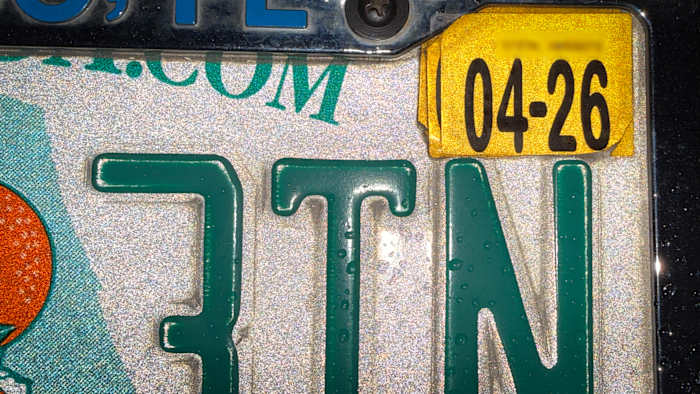
TALLAHASSEE, Fla. – After Florida’s latest license plate law sparked confusion last year, a new proposal just passed the state House that aims to fix it, according to a report from our sister station WKMG in Orlando.
That bill — HB 543 — makes a variety of different traffic-related changes to state law, though the license plate rule in particular may stand out to some.
Last year’s law mandated that alterations to license plates are now treated as a crime, though it sparked some confusion over whether license plate frames would be allowed.
State officials later clarified that frames are allowed, just so long as they don’t obscure the important parts of a license plate.
This includes the alphanumeric sequence in the middle and the registration decal in the upper-right corner.
However, HB 543 clarifies this in state law to avoid further confusion, specifically providing that license plate frames are legal when they don’t cover up these parts of the plate.
Meanwhile, HB 543 also makes several other changes, including the following:
Speed Limits: Provides more flexibility for local governments to set lower speed limits at any level below the legal maximum speed limit in a residential district
Disabled Parking: Lets vehicles with a disabled parking permit and permanently installed mobility access equipment to occupy more than one parking space when necessary to use such equipment safely, so long as no designated spaces are available to otherwise accommodate
Golf Carts: Allows a golf cart that’s been converted to a low-speed vehicle to be titled and registered for operation on roads with up to 35 mph speed limits without inspection by the DHSMV if the owner submits a written affidavit that the vehicle complies with state requirements
Exhaust Noise: Prohibits drivers from intentionally revving their engines in a way that produces “excessive or unusual noise”
License Plate Readers: Private entities may install automated license plate recognition systems solely for use on their property, so long as it’s for a public safety-related purpose.
The bill passed the House on Wednesday with only one lawmaker voting against it. As such, it’s now on track to go before the Senate and — if it survives there — Gov. Ron DeSantis.
If passed into law, though, HB 543 is set to take effect in full on July 1.
Copyright 2026 by WJXT News4JAX – All rights reserved.