
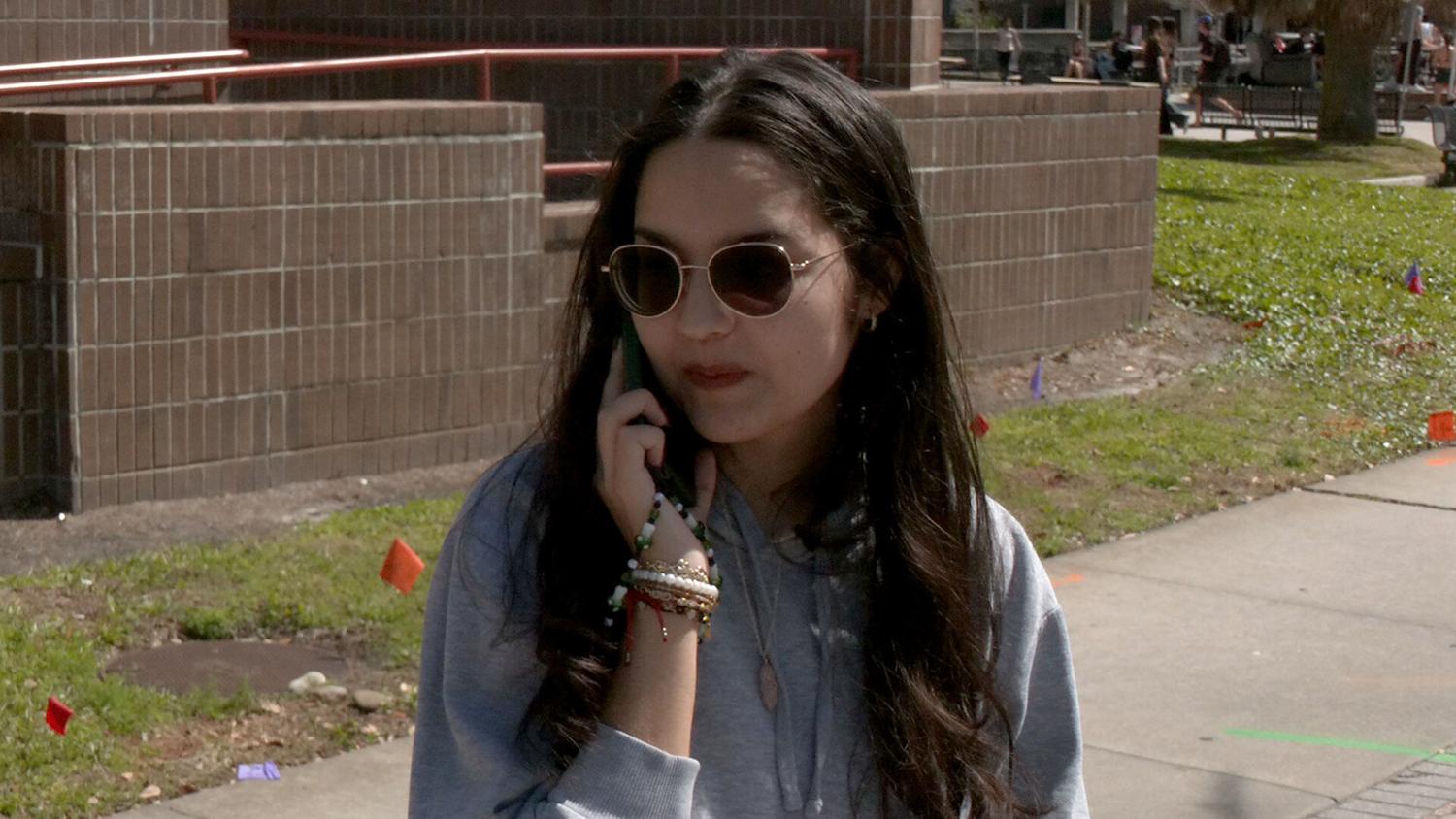

Gabriella Rodriguez, senior writing and rhetoric major, talks to her family in Cuba on the phone. Rodriguez said her dad is struggling to find food and faces blackouts every single day.
John Warner
Amid Cuba’s ongoing fuel and economic crisis, Cuban students at UCF said they are worried about their families in Cuba, who are struggling to find food and keep the lights on.
Living conditions in Cuba have deteriorated over the last month due to tight restrictions imposed by the United States, which recently took control of Venezuelan oil supplies and threatened other nations that tried to supply oil to Cuba, according to the United Nations.
Restricting Cuba from Venezuelan oil is intended to protect the United States against Cuba’s “malign actions and policies,” according to a Jan. 29 executive order signed by President Donald Trump.
Celine Matos, senior computer science major, is the former president of the Cuban American Student Association. She said she is worried about her family, who lives in Cuba.
Matos said that Cubans have been dealing with shortages of many things for quite a while, but in recent years, the situation has become much more difficult.
“This situation brings a lot of mixed emotions,” Matos said. “There is worry for loved ones, frustration at the living conditions, and sometimes a feeling of helplessness because we are so far away.”
Gabriella Rodriguez, senior writing and rhetoric major, lived in Cuba for the first nine years of her life. She said the situation in her home country is just getting worse.
Rodriguez said her father still lives in Cuba and is struggling to get basic necessities.
“It’s more worrying about the fact that there’s no food there,” Rodriguez said. “He goes out every single day, and it’s just difficult to get food and money.”
“People in Cuba have been dealing with basic shortages for quite a while, but in recent years the situation has become more difficult,” Matos said.
The living conditions in Cuba have worsened to the point of “humanitarian risk,” according to the U.N. This comes after the United States removed former Venezuelan President Nicholás Maduro from power and cut off Cuba from the Venezuelan oil supply. Venezuela alone was responsible for providing over half of Cuba’s oil supply.
“If Trump is really serious about regime change there, maybe it is now going to the next level, like kidnapping the leader of Venezuela or dropping bombs like we’re doing in Iran,” said Dr. Aubrey Jewett, associate director of the School of Politics, Security and International Affairs at UCF.
The Trump administration has pursued direct involvement in Iran, where nearly 800 people have been killed as a result of the bombings, according to The New York Times.
Jewett said the context of the United States and Cuba relations is important to consider, as well as President Trump’s recent history with foreign policy and intervention.
“U.S. foreign policy towards Cuba has always been directed at hoping that the Cuban people themselves would rise up and force change,” Jewett said. “Now, with the U.S. restriction on oil going to Cuba, the thought is to make it so miserable that the government fails, that the people riot and protest and demand change.”
Cuban UCF students said they are hopeful that all of this means change is coming to the regime of Cuba.
Rodriguez said part of her wants the United States to get involved because she feels like the country could not do more harm than what Cuba’s government has done. She said she understands that everyone may not be excited about the United States getting involved in yet another foreign country.
“It’s not exciting to get someone to intervene, but it’s also the only kind of hope that they have because it’s getting worse and worse every single year,” Rodriguez said.
Rodriguez said she is optimistic about the situation, even if things do not look good right now.
“Seeing that things could potentially get better does give hope to all of us here and the people there,” Rodriguez said. “I would love to go back there one day because I miss my country so bad.”