
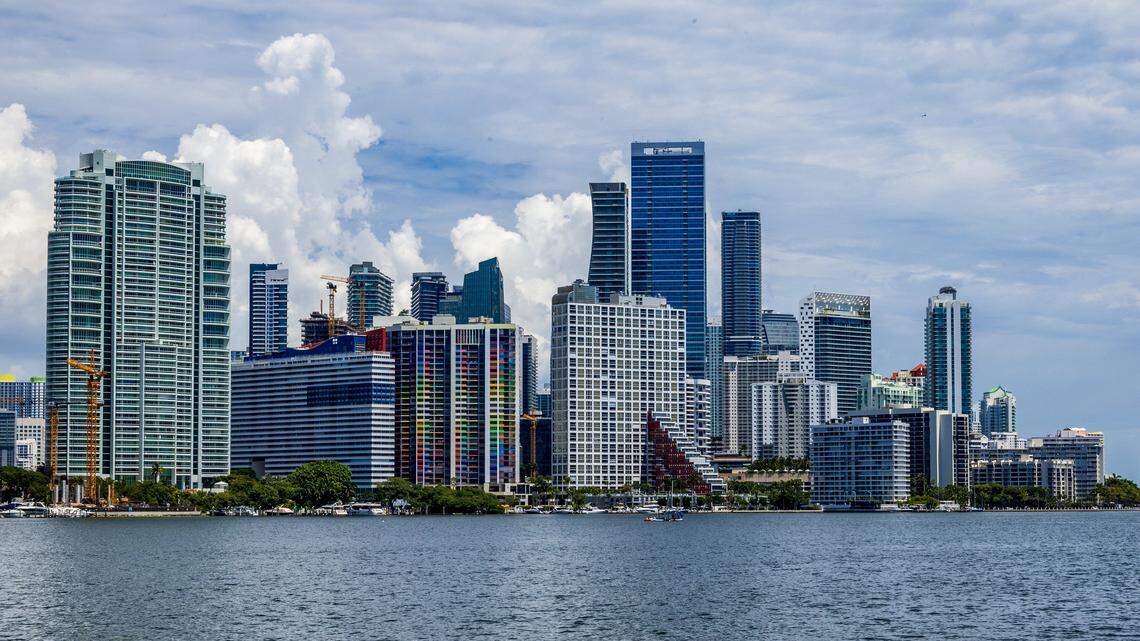
View of the Miami skyline from the Rickenbacker Causeway in Miami on Aug. 27, 2025.
Pedro Portal
pportal@miamiherald.com
The 21st century demands a sophisticated new strategy for the Western Hemisphere, one that replaces the 1823 Monroe Doctrine.
Today’s challenges are complex, involving economic subversion, technological competition and global resource security. We need an updated agenda to secure the next century of American leadership.
We call this strategy the Manaroe Doctrine. It’s a vision for a unified economic, military and human resources alliance between the United States, Latin America and the Caribbean. By blending proactive policy, massive infrastructure investment and integrated military strength, we can create a fortress of stability.
The Mana organization believes that Miami is the city of the future, destined to become the Western Hemisphere’s global hub. Recent political shifts in Venezuela represent a wake-up call. The steps we take now are critical; this moment will either lead to a renaissance of hemispheric cooperation or another exhausting cycle of conflict and foreign occupation.
In 2019, I met with Panama’s President Nito Cortizo regarding a major infrastructure agreement with China. This project would have effectively created a Chinese economic enclave at the Panama Canal — the gateway that shapes the future of the hemisphere.
I warned that such a move would inevitably awaken a “sleeping tiger.” The U.S. can never allow control of the canal to shift into the hands of a rival power. The canal is not merely Panamanian infrastructure; it is a strategic asset for all the Americas. Ultimately, that agreement was canceled, but the episode highlighted a broader trend: China now controls a significant share of the world’s processed critical minerals. This is an existential security risk.
Latin America is America. The hemisphere must act as one unified region. Allowing foreign powers to control our oil, copper and lithium undermines our collective sovereignty. Since 2014, the Mana organization has championed a “One America” vision. Dependency on extractive agreements or alternative reserve currencies only fuels instability. Dollarization, when paired with institutional rebuilding, opens the door for Western banks to invest and lowers borrowing costs.
The main points of the doctrine:
Hemisphere first and industrial resilience. Energy independence, food security and supply chain resilience are non-negotiable. We must prioritize industrial and trade coordination to strengthen sovereignty. Reshoring critical production to Latin America reduces our vulnerability to global shocks and distant nations that do not share our democratic values.Capital markets as infrastructure. U.S. Treasuries must anchor regional stability. We propose Hemisphere Infrastructure Bonds to finance ports, energy corridors, and logistics hubs. By establishing Miami as the financial gateway for Latin America, we ensure that capital flows bind our nations more effectively than any political treaty could.Dollar system and Federal Reserve coordination. Adopting the U.S. dollar as the shared currency would stabilize volatile markets and eliminate friction in trade. We must encourage dollar trade settlement and commodity pricing while utilizing Federal Reserve coordination. This includes permanent swap lines and repo facilities to prevent bond crises and ensure regional stabilization during times of global volatility.Addressing the global balance. North America’s declining population is unsustainable. While the U.S. has 350 million people, China and India have 1.4 billion each. By integrating with Latin America, we create a bloc of over 1.1 billion people. This integration increases demand for U.S. Treasuries, helping to stabilize the $36 trillion U.S. debt burden over time.
The Manaroe Doctrine offers a roadmap: One economy. One strategy. One hemisphere. By treating ports, rail, and energy corridors as sovereignty assets rather than short-term political chips, we build an economic architecture that transcends centralization.
The strategic outcome is clear: internal trade settled in dollars, growth financed by integrated capital markets and a hemisphere that finally controls its own supply chains. Latin America is not a battleground — it is the solution to securing American leadership. Now is the time to act before rivals fill the void.
Moishe Mana is an entrepreneur, the CEO of Mana Common, a conglomerate consisting of art, fashion, entertainment, technology and agriculture, and one of the largest landowners in Miami.