
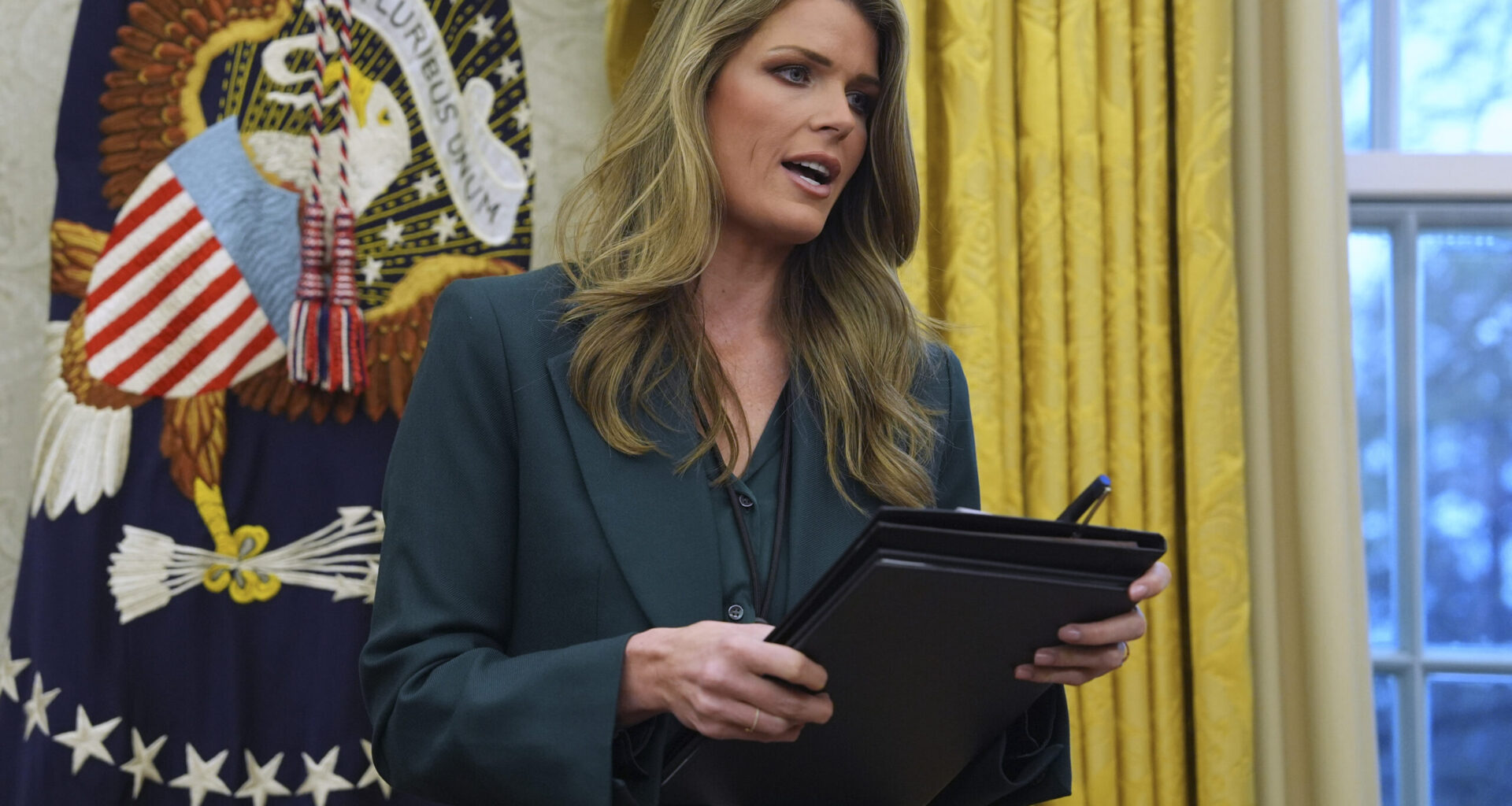
Florida’s bar said Friday it is not currently investigating Lindsey Halligan, a loyalist President Donald Trump selected to bring criminal charges against his political opponents, reversing a claim it made in a recent letter.
One of Trump’s former personal attorneys, Halligan unsuccessfully brought criminal charges against former FBI Director James Comey and New York Attorney General Letitia James after Trump nominated her to a temporary U.S. attorney post last year.
The Florida Bar told the Campaign for Accountability (CfA), a nonpartisan, nonprofit watchdog organization, in a letter last month that it had opened an ethics probe into Halligan. The bar was responding to CfA’s renewed ethics complaint against the Trump appointee, in which the watchdog accused her of violating several rules of conduct during her failed prosecutions of Comey and James.
“We are aware of these developments and have been monitoring them closely,” the bar said in the letter. “We already have an investigation pending.”
In a statement to Democracy Docket Friday, however, the Florida Bar claimed that the letter “erroneously” stated Halligan was under investigation and that it was only monitoring legal proceedings related to her.
“In response to an inquiry from a complainant, The Florida Bar wrote a letter to the complainant erroneously stating that there is a pending Bar investigation of member Lindsey Halligan,” a spokesperson said.
“There is no such pending Bar investigation of [Lindsey] Halligan. In this case, The Florida Bar received a complaint against Lindsey Halligan and, consistent with standard practice, the Bar is monitoring the ongoing legal proceedings underlying the complaint.”
In a statement to Democracy Docket, CfA expressed confusion about the Florida Bar’s reversal.
“CfA has not heard directly from the Florida Bar, but it’s hard to reconcile this latest statement with the bar counsel’s previous letter saying there is an investigation pending,” Michelle Kuppersmith, CfA’s executive director, said.
“If there is no longer an investigation into Halligan, the question is why not, given that three judges indicated she engaged in conduct that appears to violate ethics rules,” Kuppersmith added.
The bar did not say whether it planned to open an investigation into Halligan in the future. It also did not clarify how it was monitoring legal proceedings involving her in light of her departure from the Department of Justice (DOJ) in January.
In September, Trump tapped Halligan for a 120-day term as the interim U.S. attorney for the Eastern District of Virginia. At the time, she had no prosecutorial experience.
Halligan’s nomination came shortly after Trump publicly ordered Attorney General Pam Bondi to target his political enemies more aggressively. Days after being sworn in, Halligan personally brought criminal charges against Comey and James, two of Trump’s long-time foes.
The prosecutions were legally dubious and clearly stemmed from Trump’s wider effort to wield the DOJ against his enemies. Both cases eventually failed after Comey and James successfully challenged the charges by arguing Halligan’s appointment was illegal.
In its original complaint, CfA accused Halligan of making misrepresentations before the grand juries that approved the criminal indictments against Comey and James. In addition to the Florida Bar, CfA also sent its complaint to the Virginia State Bar.
Should the Florida Bar open an ethics probe into Halligan in the future, she could eventually face severe sanctions depending on the results of the investigation.
If the bar determines it has probable cause to believe Halligan committed wrongdoing, it could recommend a range of disciplinary actions against her, including disbarment, though state courts have the final say on disciplining lawyers in Florida.
Recently, the DOJ has sought to derail state bar associations’ disciplinary proceedings against its lawyers.
On March 4, the DOJ proposed a new rule in the Federal Register that, if finalized, would attempt to allow it to suspend any state ethics proceedings against current or former DOJ attorneys if the department decides to conduct its own review first.
Legal experts said the proposed rule was the DOJ’s latest attempt to limit ethical oversight. They also noted that it would likely be unenforceable, as the department has no formal authority over state bar disciplinary organizations.
While the proposed rule would apply to former DOJ attorneys, it’s unclear whether it would shield Halligan from a potential Florida Bar probe.
In November, a federal judge determined that Trump and Bondi violated federal law in appointing Halligan as interim U.S. attorney and formally disqualified her from exercising that role’s authority. However, weeks after the ruling, the DOJ and Halligan continued to refer to her as a U.S. attorney, at times even dropping “interim” or “acting” from her title.
Halligan only resigned in January after the chief judge of the Eastern District of Virginia declared the district’s U.S. attorney title vacant and began accepting applications for her replacement.
Judges in the district have yet to appoint a new U.S. attorney. If they do, the official will likely be immediately fired by Trump.
In the wake of Halligan’s resignation, Deputy Attorney General Todd Blanche promised as much in a social media post, saying that “it’s guaranteed that the President gets to pick his U.S. attorneys.”