
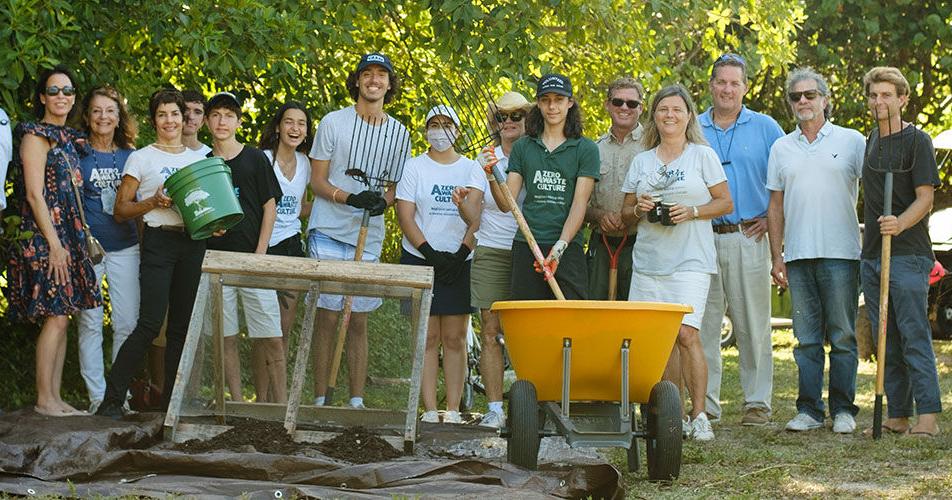
Students at three Key Biscayne schools are helping reduce landfill waste in a hands-on way; by composting their food scraps.
Key Biscayne Presbyterian School, St. Agnes Academy and St. Christopher’s Montessori School have collectively diverted more than 17,000 pounds of food waste from landfills through their composting programs, according to the local nonprofit organization A Zero Waste Culture (AZWC), co-founded by Helena Iturralde to support local sustainability efforts.
Instead of sending banana peels, orange skins and leftover lunch scraps to the trash, students separate organic waste that is then composted and transformed into nutrient-rich soil.
At several schools, the compost created from those scraps is returned to campus gardens and vegetable beds, allowing students to see the full environmental cycle firsthand — from discarded food to healthy soil that helps grow new plants.
Iturralde says the initiative not only reduces waste but also provides a tangible learning experience about sustainability, climate impact and responsible consumption.
“By diverting food waste from landfills, the schools also help reduce methane emissions, a potent greenhouse gas generated when organic material decomposes in traditional waste streams,” Iturralde said.
The composting efforts are supported by A Zero Waste Culture, which works with local institutions to promote waste reduction and environmental education across the Island.
School leaders say the programs give students practical tools to understand how everyday actions, even something as small as separating food scraps, can contribute to a healthier community.
Visit azerowasteculture.org for more information.
Why composting matters
• Reduces landfill waste: Food scraps make up a significant portion of household trash. Composting keeps organic material out of landfills.
• Cuts greenhouse gases: When food waste decomposes in landfills, it produces methane, a potent greenhouse gas. Composting reduces those emissions.
• Creates healthy soil: Finished compost enriches soil, improves water retention and supports plant growth without harmful fertilizers.
• Closes the loop: School compost programs allow students to see the full cycle, from food scraps to nutrient-rich soil used in campus gardens.
• Builds lifelong habits: Teaching students to separate organic waste encourages environmental responsibility beyond the classroom.