
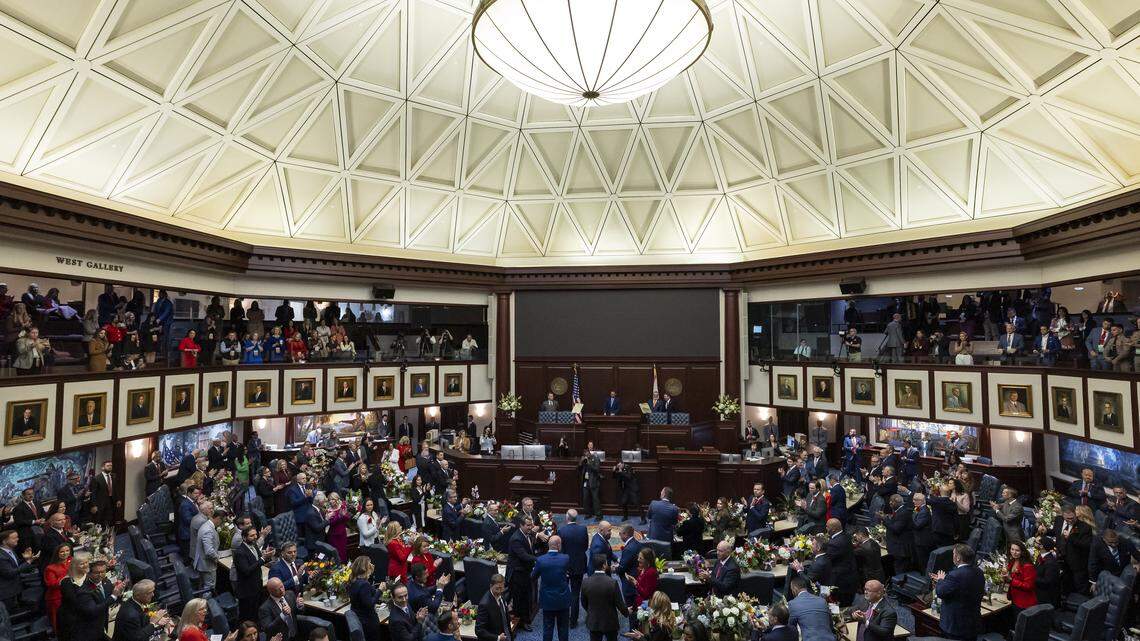
Elected officials prepare for Florida Governor Ron DeSantis’ State of the State address during the first day of the legislative session at the Florida State Capitol on Tuesday, Jan. 13, 2026, in Tallahassee, Fla.
Photo by Matias J. Ocner
mocner@miamiherald.com
TALLAHASSEE
The high cost of living is the top constituent issue in Florida, but you wouldn’t necessarily know it if you were in the state’s Capitol.
With the legislative session winding down, lawmakers have done little to make the state more affordable. Efforts to drive down insurance and utility rates failed. They haven’t agreed on a way to lower property taxes.
And for thousands of Floridians, lawmakers could make things more expensive.
They’re prepared to impose Medicaid work requirements on nearly 112,000 of the poorest Floridians. Another bill could force thousands of condo owners onto pricier insurance.
The trend flies in the face of what Americans, and Floridians, have been saying for months: Life is too expensive.
This week, a University of North Florida poll showed that half of respondents identified affordability and the cost of living as the most important problem facing them. Political division was a distant second at 12%.
Top Florida GOP pollster Ryan Tyson agreed — and said the issue wasn’t going away any time soon. One of his recent Florida GOP primary polls showed that 44% of voters said lowering property taxes or homeowners insurance was their top priority.
That was higher than the percentage of people who said the top priority was supporting President Donald Trump’s agenda (21%) and fighting illegal immigration (14%).
“It’s the same in the primary as well as the general,” Tyson said. “Affordability is it. That is what the issue is.”
At the start of the legislative session, Republican Senate President Ben Albritton cautioned senators that their ability to lower the cost of goods and services was “pretty limited.”
“We have to be honest with constituents,” he said.
But lawmakers in both parties had ideas this session.
House lawmakers passed a bill to place limits on homeowners insurance companies using affiliates to shift profits. It hasn’t received a hearing in the Senate.
Powerful Pensacola Republican Sen. Don Gaetz had a bill that would have required state utility regulators to consider affordability when taking up rate hike proposals.
But he told the Tampa Bay Times this week that Florida Power & Light, owned by the world’s largest electric utility, lobbied hard against it. His bill only passed one of its committees.
“The bill was smothered in its legislative cradle,” Gaetz said.
Gov. Ron DeSantis has pushed for legislators to place a constitutional amendment to reduce property taxes on this year’s ballot. The House passed a proposal that would phase out all non-school property taxes on primary homes, but DeSantis said he doesn’t want lawmakers to approve something until later this year.
Even if lawmakers do put a property tax reduction on the ballot, and 60% of voters approve it, changes wouldn’t take effect until next year. And cities and counties have warned that such reductions could lead them to increase other taxes and fees, including charging to use public parks.
Meanwhile, lawmakers are poised to pass a bill that could force cash-strapped condo owners into riskier and more expensive policies.
The bill, pushed by a billionaire GOP megadonor, would force condo owners with Citizens policies into private policies if they get offers within 15% of what the state-run insurer is charging them.
House and Senate bill sponsors said the legislation could drive down costs by spurring more competition in the private market.
Gaetz is also sponsoring SB 1758, which could pass the Senate next week. It would require the state to create a plan to impose additional work requirements on Medicaid recipients, following language in the federal One Big Beautiful Bill Act.
The act required states that have expanded Medicaid, the health insurance program for the nation’s poorest and neediest, to adopt work requirements.
Florida hasn’t expanded Medicaid but is pushing ahead anyway. Most Floridians, such as parents of young children and caretakers, wouldn’t have to comply. But an estimated 112,000 people deemed able-bodied would.
Opponents have said the change could cause those people to lose their health insurance by forcing them into low-paying jobs, earning too much to qualify for Medicaid, but too little to qualify for Affordable Care Act coverage.
“There’s a reason the federal government did not require states that have not expanded Medicaid to have work requirements,” Susan Harbin, a senior director for the patient advocacy group American Cancer Society Cancer Action Network, testified Monday.
The bill would also raise the age limit of people who have to comply with work requirements for the Supplemental Nutrition Assistance Program, previously known as food stamps, from 59 to 64.
Gaetz said the change was needed to address a $1 billion hole the state faces because the One Big Beautiful Bill Act is penalizing states like Florida that have high error rates in their food assistance programs.
Democratic lawmakers, who introduced a slate of affordability ideas at the beginning of session, have said that Republicans instead have spent time on lesser issues.
On Wednesday, Senate Minority Leader Lori Berman noted the chamber spent five hours debating a bill cracking down on local governments’ diversity initiatives instead of the costs of health care, insurance and other pressing issues.
“I think we need to refocus a little bit here in this chamber,” the Boca Raton Democrat said.
House Minority Leader Fentrice Driskell, a Tampa Democrat, said the cost of living was the top affordability issue in the 2024 election, and Republicans entered the 2025 session wanting to do something about it.
“Instead of doing what our communities have asked us to do, Republicans in fact have done the opposite,” she said.
Herald/Times staff writer Romy Ellenbogen contributed to this report.